


If your child's brokerage or savings account threw off enough dividends or capital gains, their tax return can suddenly ask for your marginal tax rate, and that surprise has a name. It is the kiddie tax, and Form 8615 is where it gets calculated. This guide explains what Form 8615 is, who must file it in 2025, what counts as unearned income, and how the tax is figured, in plain language.
Form 8615 is one of the IRS forms for the Tax for Certain Children Who Have Unearned Income. Most people know it by its nickname, the kiddie tax. The rule exists to stop families from shifting investment income to a child to take advantage of a lower rate. Form 8615 is used to calculate the tax when a child's unearned income climbs past a set threshold, and the 8615 is used to calculate that tax at the parent's rate rather than the child's.
Here is the core idea. Normally a child pays tax at their own low rate. Under the kiddie tax rules, once a child's unearned income crosses the line, the excess gets taxed at the parent's marginal tax rate, which is usually higher. The Internal Revenue Code built this in on purpose, so income parked in a child's name does not escape the family's real tax rate. Children with unearned income who are subject to these rules still file their own return using IRS Form 8615, and children who are subject to kiddie tax report it there, but the IRS wants part of that income taxed as if it were the parent's.
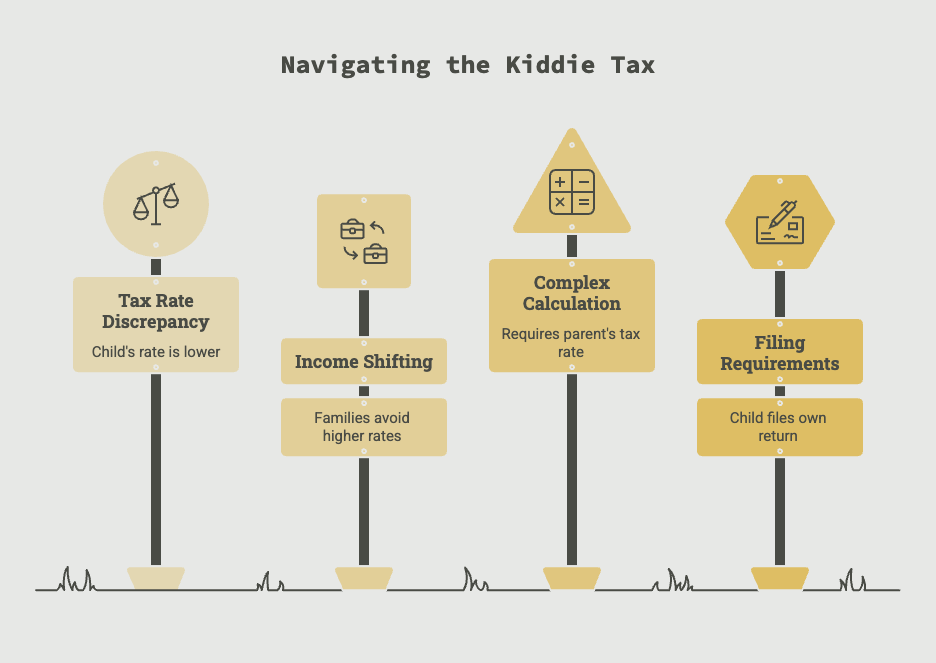
A child files Form 8615 when several conditions apply together. The child had more than 2,700 dollars of unearned income for 2025, the child is required to file an individual income tax return, the child is not filing a joint return, and at least one parent was alive at the end of the tax year. On top of that, the child has to fall within the age limits below.
If all of those conditions apply, you file the form and attach it to the child's return. Miss any one of them and you do not need to file it, so check each before you file a return. Get the required information from both the parent and child up front. The 2,700 dollar figure is the trigger, so a child with a modest savings account usually stays clear, while a child with a funded brokerage account or an inherited account can cross it fast.
Age is measured on December 31, and this is where a lot of parents get tripped up. The child is subject to the rules if any one of these fits. The child was under 18 at the end of the year. The child was age 18 at the end of 2025 and didn't have earned income that was more than half of their support. Or the child is a full-time student at least age 19 and under age 24 at the end of the year, again with wages that were not more than half of their support.
That last group surprises people, because a full-time student can be caught well into college. The support test matters here, and it turns on half of the child's support: if a 20-year-old student covers more than half of their own support from a real job, they fall out of the rules. Notice the pivot in each test is the child's earned income against the child's support, so a student who mostly lives on wages is treated differently from one living on family money and investment returns.
The whole thing turns on the split between earned and unearned income. Earned income means money from work, meaning wages, salary, and self-employment pay, and even foreign earned income is treated as earned income for the purposes of this test. Unearned income is everything else, and unearned income includes interest, ordinary and qualified dividends, capital gains and distributions, rents, royalties, and taxable scholarships.
This distinction drives the whole form. For tax purposes, children's unearned income is what the rule targets. A child's wages from a summer job are taxed at the child's tax rate no matter how large the amount gets. Only the child's unearned income can be pulled up to the parent's rate. So a teenager earning wages at a cafe is fine, while the same teenager holding a brokerage account that spins off investment gains is exactly who the tax was written for. Scholarships that are taxable count as unearned here, and are never considered earned income, which catches some students off guard.
The math runs in tiers, and once you see it, the form makes sense. For the 2025 tax year, the first 1,350 dollars of a child's unearned income is sheltered by the dependent standard deduction, so it is tax-free. The next 1,350 dollars is taxed at the child's own rate. Everything above 2,700 dollars, the child's net unearned income, is taxed at the parent's marginal tax rate if that rate is higher than the child's.
A quick example makes this click. Say a child has 5,000 dollars of unearned income in calendar year 2025. The first 1,350 dollars is tax-free, the next 1,350 dollars is taxed at the child's low rate, and the remaining 2,300 dollars is taxed at the parent's rate. If the parents sit in the 22 percent bracket, that slice draws 22 percent instead of the child's 10 percent, so the child's taxable income carries a bigger tax liability under this tax law, which is why the it can mean higher taxes than families expect. One relief valve stays in place: long-term gains and qualified dividends keep their own preferential tax rate inside the calculation, so they are not suddenly taxed as ordinary income.
There is a shortcut for simple situations. Form 8814 lets parents report a child's income on the parent's return instead of filing a separate return for the child. You can only use it when the child's income is only interest and payouts, including capital gain distributions, and the child's gross income was less than 13,500 dollars for 2025, among a few other conditions.
The trade-off is real. the election saves you from preparing a second return, but folding the child's gross income into the parent's return can raise the parent's own numbers and sometimes the family's total tax. It can also nudge the parents' adjusted gross income up enough to affect other tax benefits that phase out. When the child has investment gains, wages, or anything beyond interest and dividends, it is off the table and Form 8615 is the path.
Form 8615 attaches to the child's Form 1040, and the catch is that you cannot finish it with the child's numbers alone. You need the parent's taxable income and filing status to pull the parent's marginal rate, plus the child's adjusted gross income and unearned income figures. Gathering the parent's tax information before you start this tax form saves a lot of back and forth and time to file, since part of the tax filing depends on the parent's numbers.
Most tax software walks through the form once you enter both sets of numbers, and a tax professional handles it routinely. If the child's investment income is large, it is also worth checking whether the 3.8 percent net investment income tax touches the return, since that is a separate calculation from the tax on Form 8615, much as the earned income tax credit is its own item. When the numbers get messy across a parent and one or more children, a tax pro earns their fee quickly.
The the rules is easy to trigger by accident and easy to miscalculate, especially around the age and support tests and the parent-rate math. Whether a given child is subject, and how the tiers land, depends on the specific income, ages, and the parent's rate in that tax year. Madras Accountancy supports US CPA firms and their clients on exactly this, from confirming who must file to running the Form 8615 computation and the parent election comparison side by side.
If a child's return has you reaching for the parents' tax rate, you can reach out here. This is general information, not tax advice, so confirm the treatment for any specific family with its preparer, and you can review the official Form 8615 instructions for the current rules.
1. What is Form 8615? Form 8615 is the IRS form used to figure the Tax for Certain Children Who Have Unearned Income, known as the tax. It taxes a child's unearned income above a threshold at the parent's marginal tax rate.
2. Who must file Form 8615? A child files Form 8615 for 2025 if they had more than 2,700 dollars of unearned income, are required to file a tax return, are not filing jointly, have at least one living parent, and meet the age tests.
3. What is the it threshold for 2025? For 2025, the rule applies to a child's unearned income above 2,700 dollars. The first 1,350 dollars is tax-free, the next 1,350 dollars is taxed at the child's rate, and the excess is taxed at the parent's rate.
4. What counts as unearned income? Unearned income includes interest, ordinary and qualified dividends, capital gains, rents, royalties, and taxable scholarships. Money from work, meaning wages and pay, is not unearned income and is taxed at the child's own rate.
5. At what rate is a child's unearned income taxed? The child's net unearned income above 2,700 dollars is taxed at the parent's marginal tax rate when that rate is higher than the child's. Long-term gains and qualified dividends keep their own preferential rate.
6. What is the election? this option lets parents report a child's interest and payouts on the parent's return instead of filing a separate one, if the child's gross income was under 13,500 dollars for 2025 and other conditions apply.
7. Does the rules apply to earned income? No. A child's wages from work are always taxed at the child's own rate. Only unearned income, such as investment income, can be taxed at the parent's marginal rate under Form 8615.
8. What ages does the this tax cover? It covers a child under 18, a child age 18 whose earned income was not more than half of their support, and a full-time student age 19 to under 24 who meets that same support test.

The 2026 1099 reporting threshold changed: 1099-NEC and 1099-MISC now start at $2,000, and 1099-K is back to $20,000. Here is what you must file.
A plain guide to how a 2026 sales tax holiday works, which items are exempt, and the rules on price caps, refunds, and rain checks.

Form 7004 buys a 6-month extension of time to file business returns like 1065, 1120-S and 1120. Deadlines, e-file steps and the payment trap.



