


If you have bought, sold, or created NFTs, the tax side probably feels like an afterthought until it is not. The truth is that the IRS treats NFTs as digital assets, which means the same tax rules that apply to property and crypto apply to your non-fungible tokens too. There is no separate, gentler NFT tax. It is regular capital gains and income tax, applied to a new kind of asset.
That has some surprising consequences. Buying an NFT with cryptocurrency can trigger tax before you have sold anything. Selling an NFT for a profit is a taxable event. And if you create and sell NFTs, you may owe a very different kind of tax than an investor does. There is even a twist where some NFTs get taxed at a higher rate than ordinary investments, which catches a lot of people off guard.
This guide walks through how NFTs are taxed from start to finish: what counts as a taxable event, how capital gains work when you sell, the collectibles rule that can push your rate up, how creators are taxed differently, and how to report it all. The goal is to make the rules clear so you are not surprised at tax time. This is general information rather than tax advice, so check your own situation with a tax professional.
An NFT, or non-fungible token, is a unique digital asset recorded on a blockchain, often tied to digital art, a collectible, or some other item. Because each one is unique, it is not interchangeable the way a cryptocurrency is, which is where the "non-fungible" part comes from. For tax purposes, though, that uniqueness does not earn NFTs any special tax treatment.
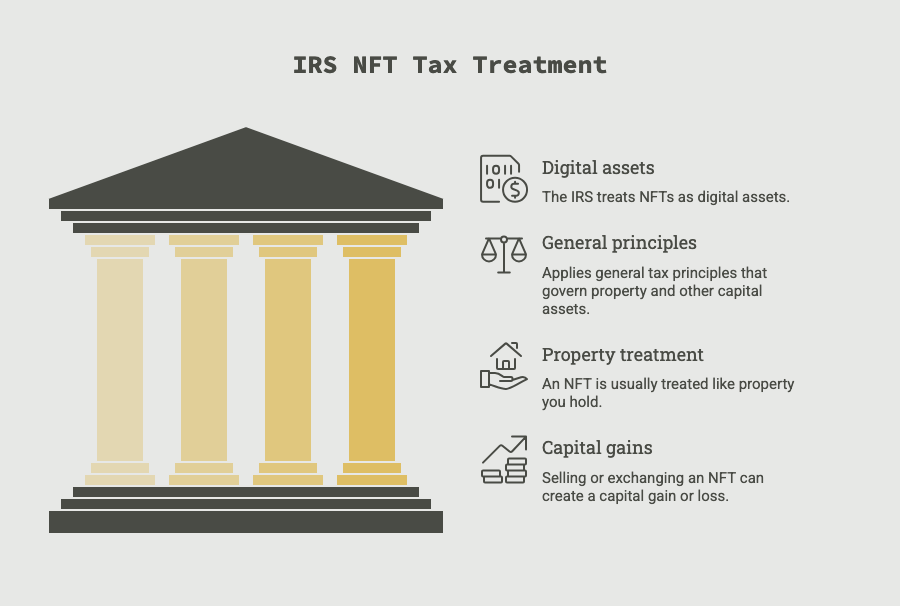
The IRS treats NFTs as digital assets and applies general tax principles to them, the same principles that govern property and other capital assets. In plain terms, an NFT is usually treated like property you hold, so selling or exchanging it can create a capital gain or loss. The mechanics are close to how cryptocurrency is taxed, so if you have dealt with crypto before, a lot of this will feel familiar. If you want a refresher on those broader crypto tax rules, our guide to cryptocurrency tax implications covers the foundation that NFT taxes build on.
The key to NFT taxes is knowing which moments count as a taxable event, because not every action triggers a tax. When you purchase an NFT with regular US dollars, for instance, that is not a taxable event on its own. You are just spending cash, and there is nothing to report yet.
Here is the part that trips people up. If you buy an NFT using cryptocurrency, which is how most people buy NFTs, you have technically disposed of that crypto, and that disposal is taxable. You owe capital gains tax on the difference between what the crypto was worth when you bought the NFT and what you originally paid for the crypto. So a purchase can create a tax bill even though it feels like buying, not selling. Selling an NFT is the more obvious taxable event: you report a capital gain or loss based on the sale. And trading one NFT for another, or swapping an NFT back into crypto, counts as a disposal too. Each of these NFT transactions needs to be tracked, because each one can move the needle on what you owe.
When you sell an NFT that you held as an investment, you calculate a capital gain or loss the same way you would for stock. You take the proceeds, usually the fair market value you received, and subtract your basis, which is what you paid for the NFT plus any related costs. If you paid with crypto, your basis is the value of that crypto at the time you bought the NFT.
How that gain is taxed depends on how long you held the NFT. If you sell it a year or less after buying, any profit is a short-term capital gain, taxed at your ordinary income tax rate, which can be steep depending on your tax bracket. If you held the NFT for more than a year before selling, it is a long-term capital gain, generally taxed at the friendlier long-term capital gains rate of 0, 15, or 20 percent for most assets. That holding period is why timing a sale matters so much, and it is the first lever most NFT investors reach for when they want to pay less.
Here is the wrinkle that surprises even experienced crypto investors. Not every NFT gets the standard long-term capital gains rate. In Notice 2023-27, the IRS said it will treat certain NFTs as collectibles, using what it calls a look-through analysis. The idea is to look at what the NFT actually represents. If the NFT's associated right or asset is itself a collectible, such as a piece of art, a gem, or an antique, then the NFT is treated as a collectible too.
Why does that matter? Because long-term gains on collectibles are taxed at a maximum rate of 28 percent, which is higher than the 20 percent top rate that applies to most other long-term capital gains. So an NFT you held for years and expected to be taxed gently could land in the collectibles bucket and cost you more. Not every NFT is a collectible under this analysis, and the guidance is still developing, but it is exactly the kind of detail that can change your tax bill, so it is worth flagging before you sell.
Everything so far assumes you are an investor. Creators are a completely different story. If you create and sell NFTs as a business or trade, minting an NFT and selling it is not a capital gain at all. That income is ordinary income, reported like any other business revenue, and it is subject to both income tax and self-employment tax.
That self-employment piece is the big surprise for artists moving into NFTs. On top of regular income tax, you generally owe self-employment tax to cover Social Security and Medicare, which an investor selling the same NFT would not pay. Royalties are treated the same way: if you earn ongoing royalties when your NFTs resell on the secondary market, that stream is ordinary income too. The line between investor and creator really matters here, because it changes not just the rate but the entire category of tax you owe, so it is worth being honest with yourself about which one you are.
Reporting pulls all of this onto your tax return. For NFTs you sold as investments, you report each sale on Form 8949 and carry the totals to Schedule D, the same forms used for stocks and crypto. For creator income, you report it on Schedule C as business income and calculate self-employment tax from there. And near the top of Form 1040, there is a digital asset question asking whether you received, sold, exchanged, or disposed of one during the year. If you had NFT activity, the honest answer is yes.
One newer development is worth knowing. Starting with 2025 transactions, digital asset brokers began issuing Form 1099-DA to report gross proceeds from crypto and NFT sales. NFTs have some special and still-evolving treatment under these rules, including a de minimis exception, so you may not receive a 1099-DA for every NFT sale. That does not let you off the hook. The IRS is clear that you must report your income, gains, and losses whether or not a form shows up. Because basis is often not included on these early forms, tracking your own numbers matters, and many people lean on crypto tax software or a preparer to reconcile it all. Getting the reporting right is part of a careful tax preparation process.
You have more control than you might think. The most straightforward move is holding an NFT for more than a year before selling, so your gain qualifies for the lower long-term capital gains rate instead of ordinary rates, keeping the collectibles rule in mind for pieces that qualify as collectibles. Timing is a legitimate lever.
Another is tax-loss harvesting. The NFT market is volatile, and if some of your holdings have dropped below what you paid, selling them at a loss can offset gains from your winners and shrink your overall tax bill. Careful basis tracking is what makes both of these work, since you cannot prove a gain or loss without knowing your true cost. And if you are thinking about giving an NFT away, be aware that gifting can carry gift tax consequences for the giver if the value is high enough. A tax professional can help you weigh these moves against your actual situation rather than guessing.
Worth saying plainly. NFT and crypto taxes are less about knowing the rules and more about the recordkeeping: tracking basis across wallets and marketplaces, catching the crypto disposal buried inside an NFT purchase, separating investor gains from creator income, and reconciling it against a 1099-DA that may not tell the whole story. It is detailed work, and it is easy to get wrong.
That is the kind of work we take on at Madras Accountancy. As an offshore tax preparation and accounting partner to U.S. CPA firms, we help reconcile digital asset transactions, calculate basis and gains on NFT sales, separate creator income for self-employment tax, and prepare the Form 8949 and Schedule D detail that stands up on a return. Since 2015 we have handled detailed tax work like this, including complex digital asset accounting. If your firm has clients active in NFTs or crypto, talk to our team and we will take it from there.
How are NFTs taxed? The IRS treats NFTs as digital assets and applies general tax principles, so they are taxed much like property or cryptocurrency. When you sell an NFT held as an investment, you report a capital gain or loss based on the difference between the sale price and your basis. If you hold it a year or less, the gain is short-term and taxed at ordinary rates; longer than a year, it is long-term. Creators who mint and sell NFTs as a business are taxed differently, on ordinary income subject to self-employment tax rather than capital gains.
Do I owe tax when I buy an NFT? It depends on how you pay. Buying an NFT with US dollars is not a taxable event by itself. But most NFTs are bought with cryptocurrency, and paying with crypto counts as disposing of that crypto. That disposal is taxable, so you owe capital gains tax on the difference between the crypto's value when you spend it and what you originally paid for it. In other words, an NFT purchase made with crypto can create a tax bill even though it feels like buying rather than selling.
What tax rate applies to selling an NFT? If you held the NFT for a year or less, your gain is a short-term capital gain taxed at your ordinary income tax rate. If you held it for more than a year, it is a long-term capital gain, generally taxed at 0, 15, or 20 percent depending on your income. There is an important exception: NFTs the IRS treats as collectibles can be taxed at a maximum long-term rate of 28 percent. So the rate depends on both your holding period and whether the NFT qualifies as a collectible.
Are NFTs taxed as collectibles? Some are. In Notice 2023-27, the IRS said it will treat certain NFTs as collectibles using a look-through analysis, meaning it looks at what the NFT represents. If the NFT's associated asset is itself a collectible, like art, a gem, or an antique, the NFT is treated as a collectible for tax purposes. Long-term gains on collectibles are taxed at a top rate of 28 percent, higher than the usual long-term capital gains rate. Not every NFT falls into this category, and the guidance is still developing, so this is a good area to review before selling.
How are NFT creators taxed? Creators are taxed very differently from investors. If you mint and sell NFTs as a business or trade, the money you make is ordinary income, not a capital gain. It is subject to regular income tax and also to self-employment tax, which covers Social Security and Medicare. Royalties you earn when your NFTs resell on the secondary market are treated as ordinary income too. This is why the distinction between creating and investing matters so much: it changes the type of tax you owe, not just the rate.
How do I report NFT taxes? You report NFT sales you made as an investment on Form 8949 and carry the totals to Schedule D, just like stocks or crypto. Creator income goes on Schedule C, where you also calculate self-employment tax. Form 1040 includes a digital asset question you must answer if you had NFT activity. Starting with 2025 transactions, you may also receive a Form 1099-DA from brokers reporting gross proceeds, though NFTs have special treatment and you might not get one. Either way, you must report your gains, losses, and income whether or not a form arrives.
How can I reduce my NFT taxes? A few strategies can help. Holding an NFT for more than a year before selling qualifies your gain for the lower long-term capital gains rate, though the collectibles rule can limit that benefit for qualifying NFTs. Tax-loss harvesting, selling NFTs that have lost value to offset gains on your winners, can lower your overall tax bill in a volatile market. Careful basis tracking underpins both moves. If you plan to gift an NFT, keep gift tax rules in mind. A tax professional can help you apply these to your specific situation.
How does Madras Accountancy help with NFT and crypto taxes? Madras Accountancy supports CPA firms with the detailed recordkeeping behind NFT and crypto taxes. As an offshore tax preparation partner, we reconcile digital asset transactions across wallets and marketplaces, calculate basis and capital gains on NFT sales, separate creator income that is subject to self-employment tax, and prepare the Form 8949 and Schedule D detail for the return. Because NFT taxes live or die on accurate basis tracking, and 1099-DA forms often do not tell the full story, firms rely on us to reconcile it correctly. You can reach our team through the contact link above.

The 2026 1099 reporting threshold changed: 1099-NEC and 1099-MISC now start at $2,000, and 1099-K is back to $20,000. Here is what you must file.
A plain guide to how a 2026 sales tax holiday works, which items are exempt, and the rules on price caps, refunds, and rain checks.

Form 7004 buys a 6-month extension of time to file business returns like 1065, 1120-S and 1120. Deadlines, e-file steps and the payment trap.