

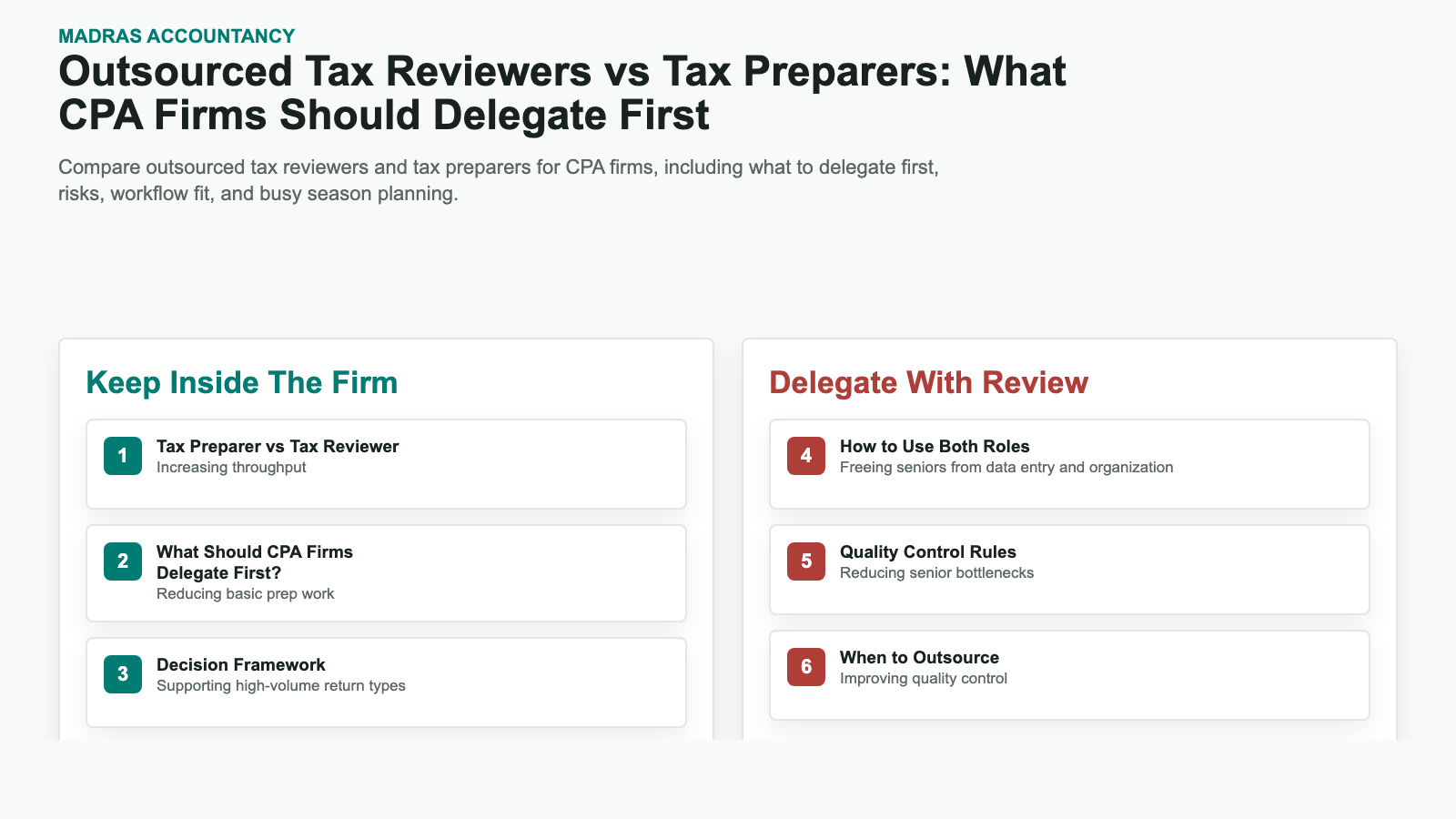

When CPA firms say they need tax help, they often mean two different things.
Sometimes they need preparers to get returns moving. Other times they need experienced reviewers because seniors and managers are buried. Those are not the same problem, and they should not be solved the same way.
Before outsourcing, decide whether your bottleneck is preparation or review.
CTA: Madras Accountancy can help your firm decide which tax roles to offshore first based on workload, return mix, and review pressure.
A tax preparer handles first-pass return preparation. They enter data, organize workpapers, roll forward prior-year details, prepare schedules, and flag open items.
Best for:
A tax reviewer checks prepared returns for accuracy, consistency, missing items, diagnostics, and firm standards. Review work needs more experience and judgment.
Best for:
Most firms should delegate preparation first. It is easier to define, easier to train, and easier to review.
Reviewer outsourcing can work, but it requires stronger alignment with your firm's standards. The reviewer needs to understand your risk tolerance, documentation style, return complexity, and expectations.
Some firms eventually use a layered model:
1. Offshore preparer completes first-pass work. 2. Offshore senior checks basic quality. 3. Internal reviewer handles firm-level review. 4. Partner reviews final issues and client-facing points.
This model can reduce pressure, but only if each role is clearly defined.
Before outsourcing either role:
If you do not track quality, you will only have opinions.
Outsource preparers when you have too much production work.
Outsource reviewers when prepared returns are waiting too long or internal seniors are overloaded.
Do not outsource reviewer-level work until you have a clear review standard. A reviewer cannot read your firm's mind.
Madras supports CPA firms with offshore tax preparation, senior-level support, workpaper organization, open-item tracking, and workflow alignment. The right role mix depends on your firm's bottleneck.
Madras can help scope whether preparer support, reviewer support, or a hybrid team is the better fit.
They can, but review support needs clear standards, experienced staff, and internal oversight.
Usually, yes. Preparation tasks are easier to define and train.
For quality control, firms should separate preparation and review where possible.
Outsourcing may help by improving prep quality and reducing lower-level review work, but partners should still handle final judgment.
Preparation and review are different bottlenecks. Delegate the work that is actually slowing your firm down, define the role clearly, and keep final responsibility inside the CPA firm.
CTA: Madras can help your firm decide whether offshore preparers, reviewers, or a hybrid tax team makes the most sense.
Section 4960's 21% excise tax now reaches far more nonprofit employees. See who is a covered employee in 2026 and what changed.

The Section 45S paid family leave credit is permanent for 2026 with new options. See who qualifies, the amounts, and how to claim it.
Opportunity zones become permanent in 2027 under the One Big Beautiful Bill. See the new deferral, rural bonus, and the 2026 handoff.



