

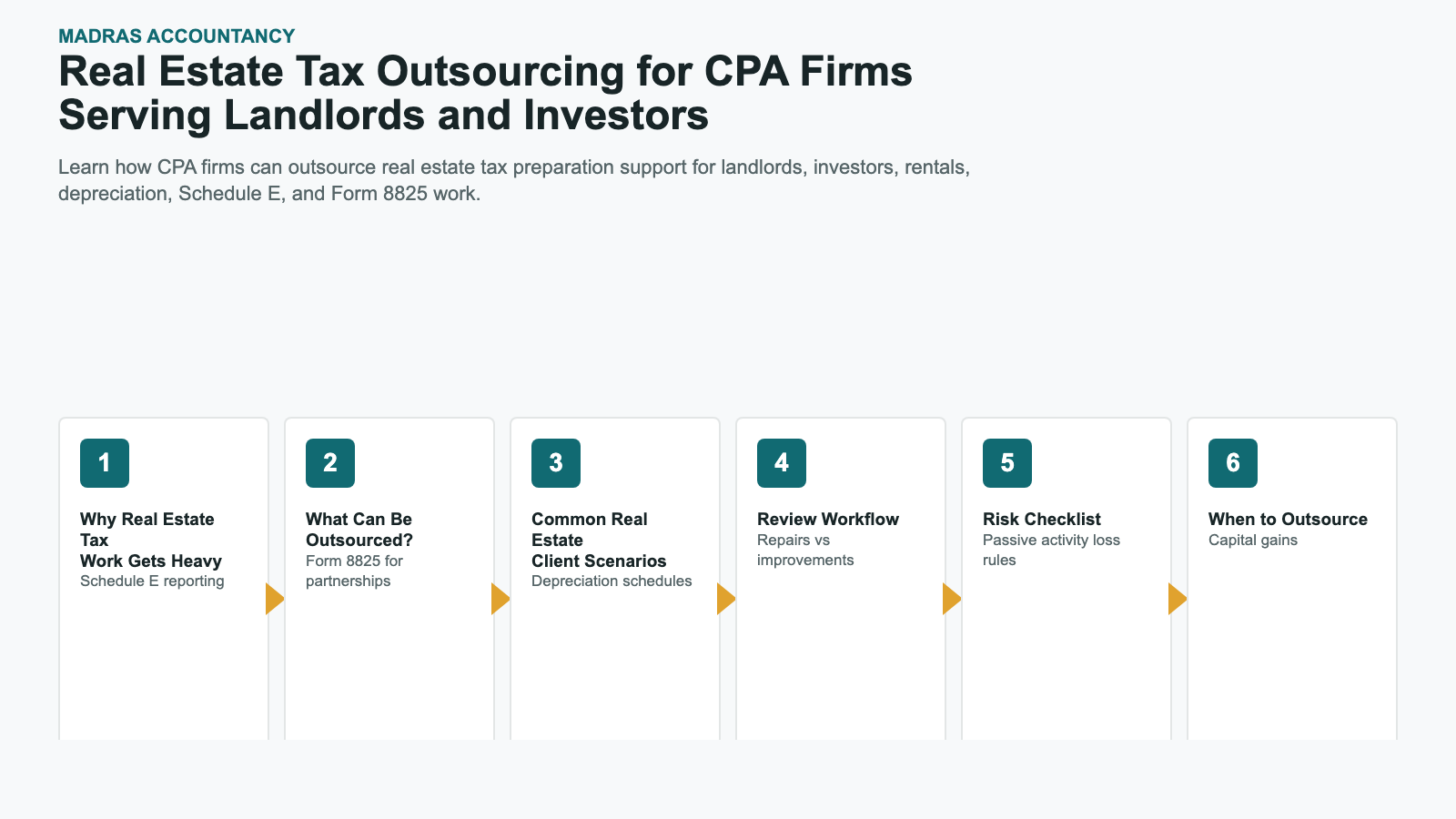

Real estate clients can be profitable for CPA firms, but the work is rarely simple. One landlord becomes five rentals. One rental becomes a partnership. Then come depreciation schedules, passive loss limits, repairs vs improvements, refinancing, cost segregation, and sale reporting.
Real estate tax outsourcing can help CPA firms support these clients without burying internal staff in prep work.
CTA: Madras Accountancy helps CPA firms build offshore support for real estate tax, rental property accounting, and investor-focused workflows.
Real estate tax work often involves many moving pieces:
The work is detailed, repeatable, and easy to delay if documents are missing.
CPA firms may delegate support tasks such as:
Your firm should keep tax positions, final review, client advice, and judgment-heavy decisions.
This client has one to three rentals, mixed personal and business expenses, and incomplete records. Outsourcing can help organize the file and prepare first-pass workpapers.
This client has multiple properties, refinances, repairs, and entity structures. Support work may include property-level schedules and depreciation updates.
Partnership real estate work often needs Form 8825, K-1 support, capital accounts, and partner questions. This requires stronger review but still has delegable preparation work.
Sale years need extra care. Closing statements, depreciation recapture, and Form 4797 support should be organized early.
A clean workflow might look like this:
1. Client documents are collected by property. 2. Offshore team organizes income, expenses, loans, and fixed assets. 3. Depreciation and prior-year details are rolled forward. 4. Open items are listed clearly. 5. Internal reviewer checks classification, tax positions, and final reporting. 6. Client questions stay with the CPA firm.
Watch these areas closely:
These are not areas to handle casually. They need review.
Real estate tax outsourcing makes sense when:
It may not work well if every client file is disorganized and no one inside the firm owns the review process.
Madras supports CPA firms with real estate and property management accounting, tax prep support, bookkeeping, depreciation schedule support, workpaper organization, and related offshore capacity.
The goal is to make real estate client work easier to prepare and review.
Preparation support can be outsourced, but the CPA firm should keep final review and tax judgment.
No. Smaller firms with a real estate niche can benefit if the workflow is clear.
Rental income reports, expense records, loan statements, closing statements, depreciation schedules, prior-year returns, and entity records are common starting points.
Misclassification. Repairs, improvements, personal use, and sale details need careful review.
Real estate tax outsourcing works when it turns messy property-level detail into clean workpapers for review. Keep judgment inside your firm, but delegate the preparation layer.
CTA: Madras can help your CPA firm build real estate tax support for landlords, investors, and property-focused clients.
Section 4960's 21% excise tax now reaches far more nonprofit employees. See who is a covered employee in 2026 and what changed.

The Section 45S paid family leave credit is permanent for 2026 with new options. See who qualifies, the amounts, and how to claim it.
Opportunity zones become permanent in 2027 under the One Big Beautiful Bill. See the new deferral, rural bonus, and the 2026 handoff.