

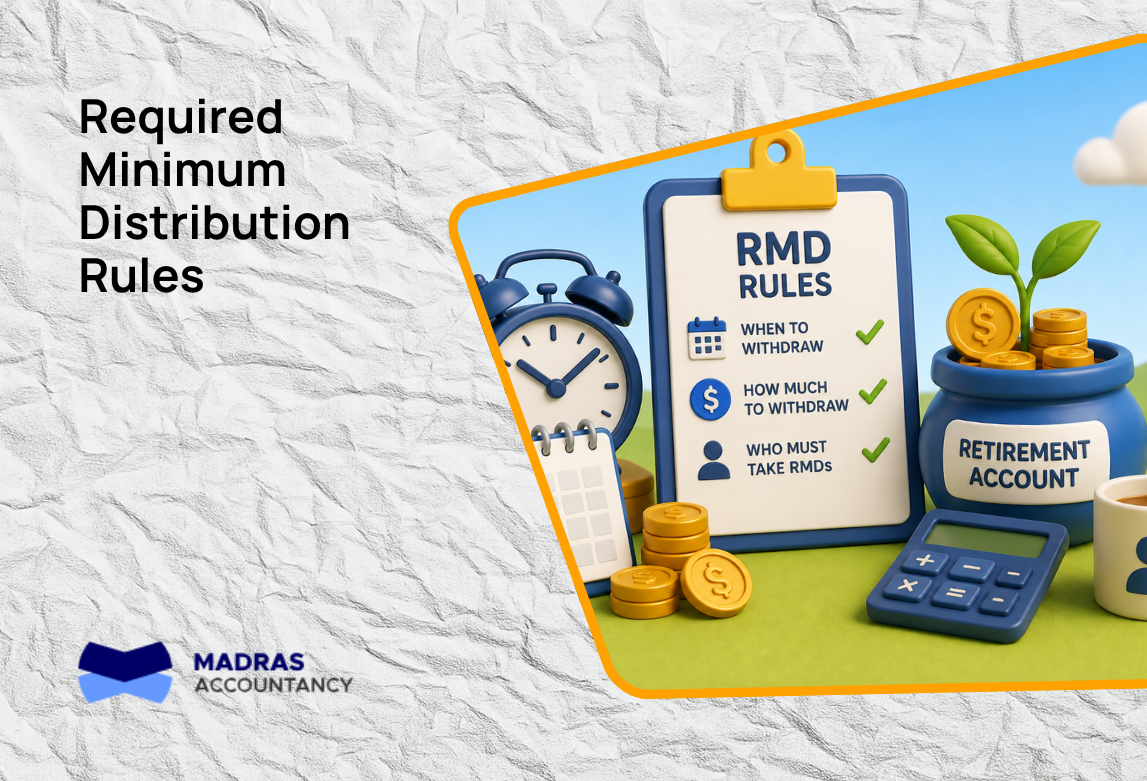

For years the government let your retirement account grow without touching it for tax. At some point it wants its share, and the way it collects is the required minimum distribution. Once you hit a certain age, the rules say you must withdraw a set amount each year, and missing it used to cost half the shortfall.
This guide walks through when RMDs start, which accounts they hit, how the amount is figured, and how to avoid the penalty, in plain language you can act on.
A required minimum distribution, or RMD, is the smallest amount you have to take from a tax-deferred retirement account each year once you reach that age. The money went in without tax, grew without tax, and now the government wants that deferral to end. Each RMD counts as ordinary income in the year you take it.
The key word is minimum. You can always withdraw more than the RMD, but you cannot go lower. Think of it as a floor, not a ceiling. And because the amount you must withdraw lands on your tax return as income, an RMD can nudge you into a higher bracket, so it pays to see it coming rather than react in December.
Under current rules, the starting age is 73. The year you turn 73, you are required to take your first RMD, though the timing has a wrinkle that trips people up. That first withdrawal is not due until April 1 of the year after you turn 73, a date the rules call your required beginning date.
That delay sounds generous, but it hides a trap. If you wait until April 1 of the year after your 73rd birthday to take that first distribution, you still owe a second RMD by December 31 of that same year, so two withdrawals land in one tax year and can spike your income. Every RMD after the first is simply due by December 31. Many people take that first withdrawal in the year they turn 73 instead of waiting, precisely to avoid doubling up. For anyone born in 1960 or later, the starting age is 75 rather than 73.
Most tax-deferred accounts are in scope. RMDs apply to a traditional IRA, a SEP IRA, a SIMPLE IRA, and workplace plans like a 401(k), 403(b), and 457(b). If you deferred tax going in, the government expects RMDs coming out.
Roth accounts are the big exception. A Roth IRA has no RMDs during the original owner's lifetime, which is one of its biggest advantages, and since 2024 a designated Roth 401(k) no longer requires them either. That said, a beneficiary who inherits one still faces withdrawal rules, usually the 10-year rule. If you are still working past 73 and own less than 5 percent of the company, you can often delay RMDs from that employer's 401(k) until you actually retire, though your IRAs still follow the normal schedule.
The math is simpler than it looks. To calculate your RMD, you take your account balance as of December 31 of the prior year and divide it by an age-based factor assigned by the IRS. That is the whole formula: prior year-end balance divided by a number.
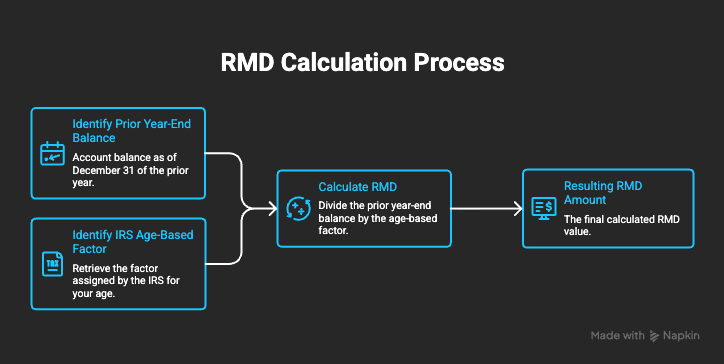
Here is how the RMD is calculated in practice. Say your IRA held 200,000 dollars at the end of last year and that factor is 25.5. Divide 200,000 by 25.5 and your RMD is about 7,843 dollars. Each year the factor shrinks a little, so the RMD amount rises as you age. Any decent RMD calculator will run this for you, but knowing the formula means you can sanity-check the number rather than trust it blindly.
That divisor comes from an IRS life expectancy table, and which table you use depends on your situation. Most people use the Uniform Lifetime Table, which covers account owners whose spouse is either not the sole beneficiary or is less than 10 years younger.
There are two other tables worth knowing. If your sole beneficiary is a spouse more than 10 years younger than you, you use the Joint Life and Last Survivor Table, which produces a smaller RMD because the money is expected to stretch across two longer lives. If you inherited an account, you use the Single Life Table instead. Picking the wrong table quietly throws off every calculation, so it is worth confirming which one fits before you divide.
Where the money comes from matters, and the rules split by account type. If you hold several IRAs, you add up the RMD for each, then you can take the total from any one IRA you choose. The rules only care that the full amount leaves your IRAs, not which one.
Workplace plans work differently. Each 401(k) calculates its own RMD, and you must take that amount from that specific plan, with no combining across plans. So someone with two old 401(k)s and three IRAs aggregates the IRA side but has to pull separately from each 401(k). Consolidating old workplace accounts before RMD age is one way to make this less of a headache later.
Skipping an RMD is expensive. The penalty is an excise tax of 25 percent of the amount you failed to withdraw, which is steep, though far better than the 50 percent it was before 2023. If you catch the mistake and fix it within two years by taking the missed amount and filing IRS Form 5329, the penalty drops to 10 percent.
The good news is that this penalty is almost entirely avoidable. A calendar reminder, an automatic distribution set up with your custodian, or a quick year-end check with your advisor keeps you clear of it. Very few retirees should ever pay it, yet people still do, usually in the year they turn 73 when the rules are new to them and the first deadline feels far away.
Because every RMD is taxable, the real game is managing the tax hit, not only meeting the deadline. If you are charitably inclined, a qualified charitable distribution lets you send up to 111,000 dollars in 2026 straight from your IRA to a charity, and it counts toward your RMD without adding to your taxable income. Converting some traditional IRA money to Roth in your sixties, before withdrawals begin, is another way to shrink the balance that future distributions are based on.
This is the kind of multi-year planning that rewards looking ahead, and it is exactly what Madras Accountancy handles for US CPA firms, modeling RMDs against a client's wider retirement plan so nothing surprises them at 73. For clients with larger estates, the interplay with other income shows up in high net worth planning too. If you want to talk through your firm's workload, you can reach out here. This is general information, not tax advice, so confirm the specifics for any client with their preparer, and you can check the official IRS RMD FAQs for the current rules.
1. What is a required minimum distribution? It is the minimum amount you must withdraw each year from a tax-deferred retirement account once you reach the trigger age. The withdrawal is taxed as ordinary income, and you can always take more than the minimum but never less.
2. At what age do RMDs start? The trigger age is currently 73 for most people. If you were born in 1960 or later, it rises to 75. You become required to take RMDs in the year you reach age 73.
3. When is my first RMD due? That first payout is due by April 1 of the year after you turn 73. Every RMD after that is due by December 31. Waiting that long forces two withdrawals into one tax year, so many people take the first one early instead.
4. How do I calculate my RMD? Take your account balance as of December 31 of the prior year and divide it by your life expectancy factor from the IRS Uniform Lifetime Table. An RMD calculator does the same math, but the formula is just balance divided by factor.
5. Do Roth IRAs have RMDs? No. Roth IRAs have no RMDs during the original owner's lifetime, and since 2024 neither do Roth 401(k) accounts. Beneficiaries who inherit one, however, still have to follow withdrawal rules, usually the 10-year rule.
6. What is the penalty for missing an RMD? The penalty is 25 percent of the amount you failed to withdraw, reduced to 10 percent if you correct it within two years by taking the distribution and filing Form 5329. It is easily avoided with a reminder or automatic withdrawal.
7. Can I take my RMD from just one account? For IRAs, yes. You total the RMD across your IRAs and can withdraw it from any one of them. For 401(k) plans, no, you must take each plan's RMD from that specific plan, with no aggregating across workplace accounts.
8. Are RMDs taxed? Yes. Each RMD from a pre-tax account is taxed as ordinary income in the year you take it. Because it adds to your income, an RMD can raise your bracket, increase the tax on Social Security, and affect Medicare premiums.
The 2026 1099 reporting threshold changed: 1099-NEC and 1099-MISC now start at $2,000, and 1099-K is back to $20,000. Here is what you must file.

A plain guide to how a 2026 sales tax holiday works, which items are exempt, and the rules on price caps, refunds, and rain checks.
Form 7004 buys a 6-month extension of time to file business returns like 1065, 1120-S and 1120. Deadlines, e-file steps and the payment trap.



