


When someone buys into a partnership or inherits a partner's interest, they usually pay for it based on what the partnership's assets are really worth. The problem is that the partnership's own basis in those assets does not automatically move to match that price. Left alone, that gap can tax the new partner on gain they already paid for. The Section 743(b) basis adjustment is the fix.
In plain terms, a 743(b) adjustment gives the incoming partner a special, personal adjustment to their share of the partnership's basis in its property, so it lines up with what they actually paid for the interest. It only kicks in when there is a transfer of a partnership interest and the partnership has a Section 754 election in place, or when the rules make the adjustment mandatory. Get it right and the new partner gets the depreciation and gain treatment they are entitled to. Miss it and they quietly overpay tax for years.
This guide is built for tax preparers and CPA firms who run into partnership transfers and need the mechanics straight. It walks through the inside and outside basis problem, when a 743(b) adjustment applies, how to compute it, how Section 755 spreads it across the partnership assets, and the filing steps that make it stick. The rules are dense, so the aim is to keep the logic clear.
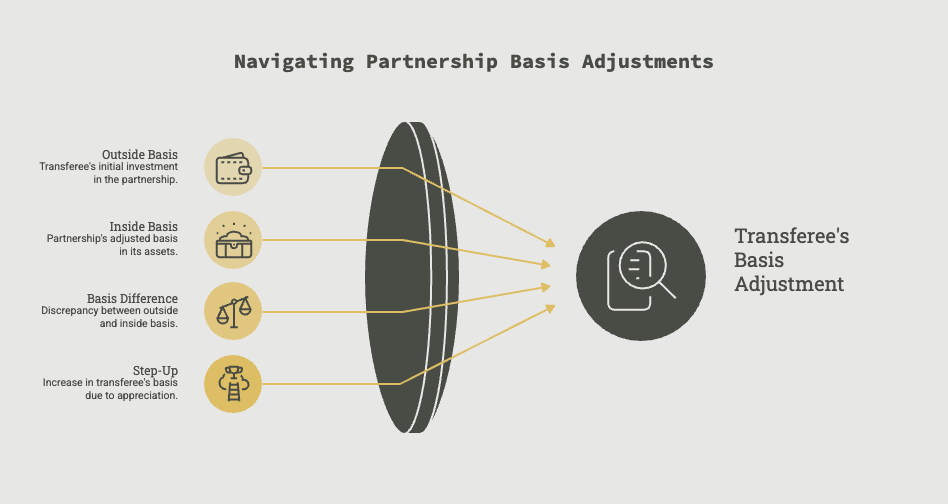
To see why the adjustment exists, you need two ideas. A partnership has inside basis, which is the partnership's own adjusted tax basis in its assets. Each partner separately has outside basis, which is that partner's basis in their partnership interest. When a partnership is running normally, a partner's outside basis and their share of the partnership's inside basis stay roughly in sync.
A transfer breaks that alignment. Say a partner sells their interest for its market value, or passes away and an heir takes the interest at a stepped-up value. The buyer or heir, the transferee, now has an outside basis equal to the purchase price or the date-of-death value. But the partnership's inside basis in its assets has not changed at all. So the transferee is stuck with a share of inside basis that reflects the old, lower figure, even though they paid the higher price.
That mismatch has real consequences. Without a fix, when the partnership later sells an appreciated asset or claims depreciation, the transferee is taxed on their share as if their basis were still the old amount, effectively paying tax again on value they already bought. If you want a refresher on how partnerships are taxed as pass-through entities in the first place, our business entity selection guide sets the stage.
This is where 743(b) steps in. It gives the buyer a basis adjustment equal to the difference between their outside basis and their share of the partnership's inside basis. The adjustment brings the transferee's share of inside basis up, or in some cases down, to match what they paid. When the outside basis is higher, which is the common case with appreciated property, the result is a step-up.
The most important feature is that this adjustment is personal to the transferee. It does not touch the other partners' shares of inside basis, and it does not change the partnership's common basis in its assets for anyone else. Only the transferee sees the effect, on their own distributive share of depreciation, gain, and loss. That is why a 743(b) adjustment is sometimes described as a special basis adjustment: it sits on top of the normal rules just for the partner who bought in.
A 743(b) adjustment is not automatic on every transfer. Normally, it applies only if the partnership has made a Section 754 election. That election is the partnership's decision to adjust the basis of partnership property on transfers and certain distributions, and once made, it stays in effect for all future years until it is revoked with the agency's consent. A partnership may make the election by attaching a statement to a timely filed Form 1065 for the year of the transfer.
It triggers on a sale or exchange of a partnership interest, or on the death of a partner, since both are transfers that give the transferee a new outside basis. Worth knowing: the same 754 election that turns on 743(b) for transfers also turns on the parallel Section 734(b) adjustment for certain partnership distributions, so electing affects both.
There is also a case where the adjustment is not optional. Even without a 754 election, a 743(b) adjustment is mandatory when the partnership has a substantial built-in loss immediately after the transfer. That generally means the partnership's adjusted basis in its property exceeds the property's fair market value by more than $250,000, or the transferee partner would be allocated a loss of more than $250,000 if the partnership sold all its assets at market value right then. Congress added this mandatory rule to stop transferees from duplicating built-in losses.
The computation is a subtraction, though gathering the inputs takes care. The Section 743(b) adjustment equals the transferee's outside basis in the partnership interest minus the transferee's share of the partnership's inside basis, often described as their share of the partnership's previously taxed capital plus their share of partnership liabilities.
In practice, the buyer's outside basis usually starts from the purchase price they paid, or the fair market value at a partner's death. Their share of inside basis comes from the partnership's books. If the outside basis exceeds the share of inside basis, the adjustment is a positive step-up. If the share of inside basis is higher, the adjustment is negative, a step-down, which reduces the transferee's basis. Because partnership liabilities feed into both outside basis and the inside basis share, they have to be tracked carefully so the two sides are measured consistently.
Computing the total adjustment is only half the job. That single number then has to be spread across the partnership's individual assets, and Section 755 provides the rules for doing it. You cannot just park the whole adjustment on one convenient asset.
Under Section 755, the adjustment is first allocated between two classes of property: capital gain property and ordinary income property. Within each class, it is then allocated among the specific assets based on how much built-in gain or loss each one carries, using their relative values. The goal is to put the adjustment where the economic difference actually sits, so a step-up tied to an appreciated building or other real property lands on that asset. The way the adjustment is spread matters a great deal, because an amount allocated to depreciable or amortizable property produces future deductions, while an amount allocated to land or non-depreciable property just waits until that asset is sold.
Here is why all this work is worth it. Once the 743(b) adjustment is computed and allocated, it directly improves the new partner's tax position. An adjustment allocated to depreciable property gives them additional depreciation deductions over the life of the asset, deductions that are theirs alone and do not affect the other partners.
The adjustment also shows up when the partnership sells an asset. Because the transferee's basis in that asset has been stepped up, their share of the taxable gain is smaller, or their loss is larger, than it would have been without the adjustment. All of this flows to the transferee through their Schedule K-1, separately stated so the effect stays personal to them. Over the years, a properly computed step-up can be worth a substantial amount, which is exactly why it is worth catching at the time of the transfer rather than discovering it was missed later.
The adjustment does not happen by itself, and the paperwork matters. The transferee is generally required to give written notice to the partnership of the transfer, including the details the partnership needs, within a set window after the sale or exchange. That notice is what puts the partnership on the hook to make the adjustment.
From there, the partnership computes the 743(b) adjustment, allocates it under Section 755, and attaches a statement to its Form 1065 for the year of the transfer showing the adjustment and how it was allocated. The transferee's share of the adjustment is then reported on their Schedule K-1 each year it has an effect, such as the extra depreciation. The proposed regulations and final regulations under Sections 743 and 755 set out the detail, and in some cases the transferee may need to amend prior returns to properly reflect an adjustment that should have been in place. Because the mechanics are exacting and easy to miss on a busy return, this is an area where a careful tax preparation process earns its keep. The Form 1065 instructions and the primary rules in Section 743 itself are the source to check against.
Worth saying plainly. A 743(b) adjustment touches the least routine part of a partnership return: tracking each partner's inside and outside basis, computing the adjustment on a transfer, allocating it correctly across assets under Section 755, and carrying it through the Schedule K-1 for years afterward. It is easy to overlook and painful to unwind.
That is the kind of work we take on at Madras Accountancy. As an offshore tax preparation and accounting partner to U.S. CPA firms, we help maintain partner basis schedules, compute and allocate 743(b) adjustments when interests change hands, and report them cleanly on Form 1065 and the affected K-1s, so the value is captured and nothing slips. Since 2015 we have handled detailed partnership tax planning and compliance work like this. If your firm has partnership clients with transfers or 754 elections in play, talk to our team and we will take it from there.
What is a Section 743(b) basis adjustment? A Section 743(b) basis adjustment is a special, partner-specific adjustment to a transferee's share of a partnership's inside basis in its assets. It applies when a partnership interest is transferred and the partnership has a Section 754 election in place, or when the adjustment is mandatory. The purpose is to align the transferee's share of the partnership's inside basis with their outside basis, which is what they paid for the interest, so they are not taxed on gain or denied depreciation they effectively already purchased.
What is the difference between inside basis and outside basis? Inside basis is the partnership's own adjusted tax basis in its assets. Outside basis is a partner's basis in their partnership interest. In a smoothly running partnership, a partner's share of inside basis and their outside basis stay aligned. A transfer of a partnership interest breaks that alignment, because the transferee's outside basis becomes the purchase price or the fair market value at death, while the partnership's inside basis stays the same. The Section 743(b) adjustment closes that gap for the transferee.
When does a Section 743(b) adjustment apply? It applies when there is a transfer of a partnership interest, by sale or exchange or on the death of a partner, and the partnership has a Section 754 election in effect. The election, once made, applies to all future transfers and certain distributions until it is revoked. A 743(b) adjustment is also mandatory, even without a 754 election, when the partnership has a substantial built-in loss immediately after the transfer, which prevents a transferee from duplicating built-in losses.
What is a Section 754 election? A Section 754 election is a choice a partnership makes to adjust the basis of partnership property on transfers of interests and on certain distributions. When in place, it turns on the Section 743(b) adjustment for transfers and the parallel Section 734(b) adjustment for distributions. The partnership makes the election by attaching a statement to a timely filed Form 1065. Once made, it stays in effect for all later years unless the IRS consents to revoke it, so it is a lasting decision rather than a year-by-year one.
How is the Section 743(b) adjustment calculated? The adjustment equals the transferee's outside basis in the partnership interest minus their share of the partnership's inside basis, which is generally their share of previously taxed capital plus their share of partnership liabilities. The outside basis usually starts from the purchase price paid, or fair market value at a partner's death. If outside basis is higher, the adjustment is a positive step-up. If the inside basis share is higher, it is a negative step-down. Liabilities must be tracked carefully because they affect both sides of the calculation.
How is the Section 743(b) adjustment allocated among partnership assets? Section 755 governs the allocation. The total adjustment is first split between two classes of property, capital gain property and ordinary income property, and then allocated among the specific assets in each class based on their built-in gain or loss and fair market values. The point is to place the adjustment where the real economic difference sits. An amount allocated to depreciable property produces future depreciation deductions for the transferee, while an amount on land or similar property is realized only when that asset is sold.
Is the Section 743(b) adjustment mandatory? Usually it depends on a Section 754 election, but it becomes mandatory in one situation: when the partnership has a substantial built-in loss immediately after the transfer. That generally means the partnership's adjusted basis in its property exceeds fair market value by more than $250,000, or the transferee would be allocated a loss greater than $250,000 on a hypothetical sale of all assets at market value. In that case the partnership must make the 743(b) adjustment even without a 754 election in place.
How does Madras Accountancy help with Section 743(b) adjustments? Madras Accountancy supports CPA firms with the detailed partnership work behind 743(b). As an offshore tax preparation partner, we help maintain partner inside and outside basis schedules, compute the 743(b) adjustment when an interest is transferred, allocate it across assets under Section 755, and report it on Form 1065 and the transferee's Schedule K-1, including in later years. Because the adjustment is easy to miss and costly to correct after the fact, firms rely on us to catch and document it. You can reach our team through the contact link above.

The section 4960 excise tax is 21% of nonprofit pay over $1M. From 2026 it covers all employees. See the medical carve-outs, Form 4720 and a worked example.

The paid family and medical leave tax credit is permanent from 2026. See the 12.5% to 25% rates, the premium option, the 6-month rule and how Form 8994 works.

Opportunity zones become permanent in 2027 under the One Big Beautiful Bill. See the new deferral, rural bonus, and the 2026 handoff.