
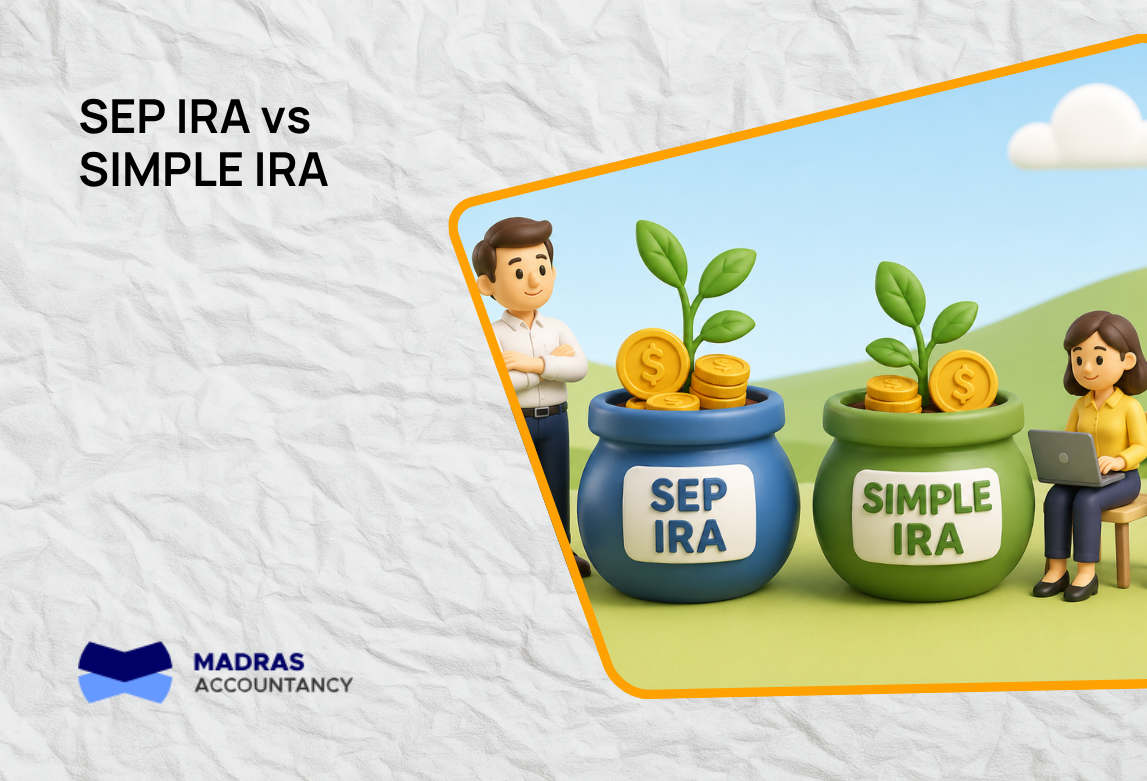

You want to set up a retirement plan for your small business, you start reading, and within five minutes you hit a wall of acronyms. The good news is that for most small businesses the real choice comes down to two IRA plans, and once you see how they differ, picking the right one is not hard.
This guide will compare SEP and SIMPLE IRAs in plain language: who contributes, how much, who qualifies, and which type of retirement plan fits your business.
A SEP, short for Simplified Employee Pension, is a retirement plan that allows an employer to save for retirement on a pre-tax basis. The defining feature is simple: only the employer contributes, so there are no employee contributions to manage.
That design makes the plan popular with self-employed individuals, sole proprietors, and small business owners who want high limits without much paperwork. SEP IRAs work for businesses of any size, the plans are designed to be easy to run, and there is no annual government filing. A business owner or employer can contribute up to 25 percent of each employee's pay each year, and because contributions are discretionary, you can give more in a strong year and less when cash is tight. As a pension plan, this profit sharing style of funding is flexible, with one catch: whatever percent of each employee's pay you choose, you generally apply it to every eligible worker. SEP contributions are made by the company alone.
A SIMPLE IRA, the Savings Incentive Match Plan for Employees, works the other way around. Here both employer and employee put money in, which gives staff a direct stake in their own retirement savings. It is built for smaller companies, specifically businesses with 100 or fewer employees.
The trade for that shared funding is a required contribution from the company. A SIMPLE IRA allows the employee to defer salary, and in return the business must contribute either a dollar-for-dollar match of up to 3 percent of pay, or a flat 2 percent for every eligible worker whether or not they save. This incentive match plan for employees tends to lift employee participation, because people save more when the match is on the table. The plan is easy to set up and cheaper to run than a full 401(k), which is a big reason small employers reach for it.
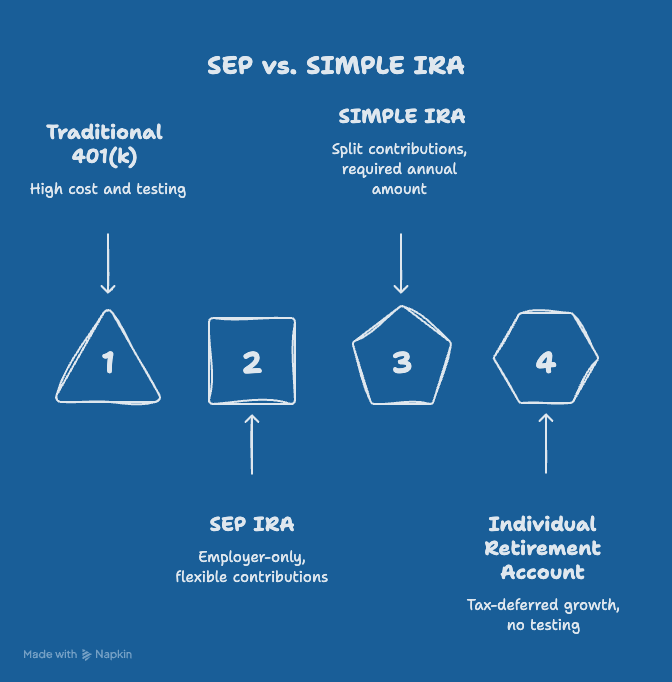
Strip away the jargon and the key differences come down to who funds the account and how much can go in. A SEP is employer-only and flexible. A SIMPLE splits the money between employer and employee and locks the business into a required amount each year.
That single distinction drives almost everything else. Because it relies on the company alone, owners who want to make larger contributions in profitable years lean toward it. Because a SIMPLE lets employees contribute their own money, it spreads the saving load and suits businesses with employees who want to build their own balances. Both are individual retirement accounts under the hood, both grow tax-deferred, and both avoid the cost and testing of a traditional 401(k). They simply hand the wheel to different people.
The numbers are where these plans for small businesses separate most, and they are subject to cost-of-living adjustments each year. For that plan, the company can contribute up to 25 percent of compensation, capped at 70,000 dollars in 2025 and 72,000 dollars the next year. That is the headline reason the plan appeals to high earners: the ceiling is high, well above a traditional IRA.
A SIMPLE runs on a smaller employee deferral. A worker can defer 16,500 dollars, rising to 17,000 dollars next year, plus a catch-up of 4,000 dollars once they reach age 50. There are higher contributions for employees age 60 to 63, who get a 5,250 dollar catch-up, and small firms with 25 or fewer staff get a slightly higher deferral cap. On top of the employee amount sits the match or the 2 percent contribution. So while it offers higher contribution limits at the top end, a SIMPLE can still add up once you stack the deferral and the company piece together. Either contribution limit is far above what a standard IRA allows.
The funding rules are the heart of the comparison. Under this plan, the employer contributes and no one else does, so a year with no profit can mean no contribution at all, which is real flexibility for a shaky year.
A SIMPLE flips that. Employers are required to make a contribution every year, through the match or the 2 percent amount, so the cost is predictable but not optional. Employees can choose how much of their own pay to defer, up to the annual limit, and they can often split it between pre-tax and Roth. Eligible employees must generally have earned a modest amount in prior years to take part, and each eligible employee must receive the company contribution once they are in. The rules that allow employers this structure are meant to protect participants and keep the plan fair. If you value certainty for your team, that guaranteed money is a feature; if you value control over cash, it is a constraint.
Business size and structure usually settle the question. It suits sole proprietors and self-employed people with no staff, or small firms that want a plan with almost no admin and little additional administrative burden. Because it works for businesses of any size and asks little of the company beyond funding, SEPs are often the first plan a solo owner opens.
A SIMPLE is aimed squarely at small businesses with employees, and it is capped at 100 employees. It shines when an owner wants to help employers and staff save together, giving real retirement benefits without the weight of a 401(k) and trading a bit more structure for strong employee engagement. A quick rule of thumb: a one-person shop or an owner who wants big, flexible contributions leans SEP, while a growing team that wants everyone to save leans SIMPLE. For the wider picture, our retirement planning guide puts the choice in context, and self-employed owners have their own wrinkles worth reading.
Both plans changed under the SECURE 2.0 Act, and the headline is Roth. A company can now allow Roth contributions inside either plan, so savers can pay tax now for tax-free growth later, though provider platforms are still catching up on the SIMPLE side. The higher catch-up for people ages 60 to 63 is another recent addition, and it means older workers can make larger contributions in the final stretch before retirement.
These updates matter because they close an old gap: for years, neither plan offered a Roth choice at all. Now employees can choose the tax treatment that fits them, and Roth contributions sit right alongside the pre-tax kind in the same savings accounts, where these IRAs could keep growing tax-free. Keep in mind the figures are subject to change from year to year, so confirm the current numbers before you finalize a plan design rather than assume last year's still hold.
The right retirement plan is the one that matches how you want to fund it. Choose a SEP if you are self-employed or run a lean business, want the highest limits, and value the freedom to skip a weak year. Choose a SIMPLE, which is another type of retirement plan entirely, if you have employees, want them saving alongside you, and can commit to the required contribution each year. As small business retirement plans go, both deliver real tax benefits and steady savings, and both let people build far faster than a plain account. Whichever you pick, the money lands in individual retirement accounts or annuity contracts held for each worker.
Neither plan is complicated once it is running, but the setup, payroll coordination, and yearly contribution math still reward getting it right. That behind-the-scenes work is what Madras Accountancy handles for US CPA firms, keeping contributions accurate through payroll so nothing slips at year end. If you want retirement plan solutions tailored to a client, you can reach out here. This is general information, not legal or tax advice, so confirm the specifics with a qualified advisor. You can also review the IRS pages on the SEP plan and the SIMPLE IRA plan for the official rules.
1. What is the main difference between a SEP IRA and a SIMPLE IRA? This plan is funded only by the employer, while a SIMPLE is funded by both the employer and the employee. That one difference shapes the contribution limits, the yearly cost, and which businesses each plan suits when you compare SEP and SIMPLE options.
2. What are the 2026 contribution limits for SEP and SIMPLE plans? For that year, a SEP allows contributions up to 25 percent of pay, capped at 72,000 dollars. A SIMPLE lets employees defer 17,000 dollars, plus a 4,000 dollar catch-up at age 50 and a 5,250 dollar catch-up at ages 60 to 63, on top of the required employer contribution.
3. Can employees contribute to a SEP IRA? No. A traditional SEP is employer-funded only, so employee contributions are not allowed. If you want your team to contribute their own money, a SIMPLE or a 401(k) is the better fit.
4. SEP IRA vs SIMPLE IRA: which is better for a self-employed person? A SEP is usually the easier choice for self-employed individuals and sole proprietors, since there are no employees to match and the limits are high. Many solo owners open one precisely because it lets them make larger contributions with little paperwork.
5. How many employees can a SIMPLE IRA have? A SIMPLE is limited to employers with 100 or fewer employees. If your business grows past that, you generally move to a 401(k), which has room for more staff and higher contribution limits.
6. Does the employer have to contribute? It depends on the plan. A SEP contribution is discretionary, so the company can skip a year. A SIMPLE requires a yearly contribution: the employer is required to make either a dollar-for-dollar match up to 3 percent or a 2 percent amount for all eligible employees, and it must contribute even in a lean year.
7. Can I make Roth contributions to a SEP or a SIMPLE? Yes, in principle. The SECURE 2.0 Act allows employers to offer Roth contributions in both plans if the provider permits it, though Roth support on the SIMPLE side is still rolling out. Roth contributions are made with after-tax dollars for tax-free growth later.
8. Simple IRA vs SEP: which has higher contribution limits? A SEP generally has higher contribution limits at the top, up to 72,000 dollars for a high earner. A SIMPLE has a lower deferral, but stacking the employee amount with the company match can still produce a meaningful total. Weighing SEP or SIMPLE IRAs this way is the fastest route to the right retirement plan.
The 2026 1099 reporting threshold changed: 1099-NEC and 1099-MISC now start at $2,000, and 1099-K is back to $20,000. Here is what you must file.
A plain guide to how a 2026 sales tax holiday works, which items are exempt, and the rules on price caps, refunds, and rain checks.
Form 7004 buys a 6-month extension of time to file business returns like 1065, 1120-S and 1120. Deadlines, e-file steps and the payment trap.