

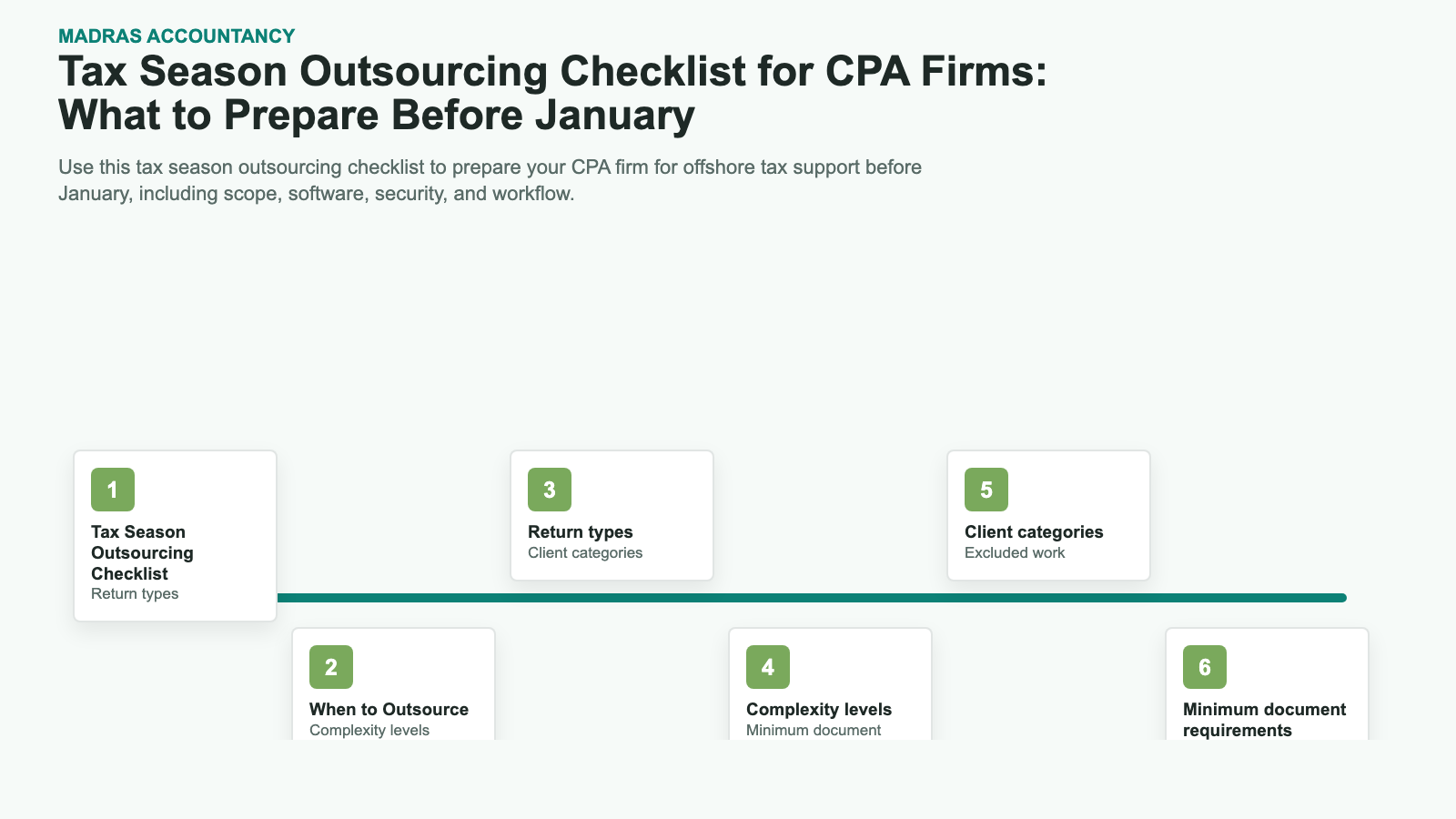

A tax season checklist for CPA firms that outsource preparation has two halves. The first covers compliance items the firm must have in place before any return leaves the office: current PTINs, signed Section 7216 consents for preparers outside the US, and a written security program that meets the FTC Safeguards Rule. The second covers production: which returns go out, how they move through tax software, and who answers questions.
This checklist is built for the 2027 filing season, which covers tax year 2026 returns. Most of the items take weeks to finish, so the practical deadline for this tax season checklist for CPA firms is December, well before client documents start arriving. Each step below lists what to confirm, who usually owns it, and the official rule behind it where one exists.
Once documents arrive, every hour spent on setup comes out of preparation and review time. Access requests, consent forms and routing questions that take ten minutes in November can stall a batch of returns for days in February.
The calendar for tax year 2026 is fixed. Individual returns follow the IRS rule that returns are due April 15, and "if day 15 falls on a Saturday, Sunday or legal holiday, the due date is delayed until the next business day." April 15, 2027 falls on a Thursday. Calendar year partnership and S corporation returns are due March 15, 2027, a Monday. Business returns that need more time go on Form 7004, which our guide to the Form 7004 six-month business extension covers in detail.
If this is the firm's first season working with an outside team, read our walkthrough on preparing your CPA firm for its first outsourced tax season alongside this list. That article covers the change management side. This one is the item-by-item checklist.
The IRS states that "anyone who prepares or assists in preparing federal tax returns for compensation must have a valid 2027 PTIN before preparing returns." The PTIN requirements page confirms that 2027 applications and renewals are being processed now and that the renewal fee is $18.75.
Confirm in writing that every preparer on the outsourced team holds a valid 2027 PTIN, along with your own staff. Keep the list with your engagement file for the provider.
Sending a client's return information to a preparer outside the United States requires the client's written consent first. Treasury Regulation 301.7216-3 states that "a taxpayer must provide written consent before a tax return preparer discloses or uses" the taxpayer's tax return information.
Social Security numbers carry an extra rule. For Form 1040 filers, the regulation says the US preparer generally "may not obtain consent to disclose the taxpayer's social security number (SSN)" to a preparer abroad and "must redact or otherwise mask the taxpayer's SSN" before disclosure. The exception applies only when the firm uses an adequate data protection safeguard as defined in IRS guidance and verifies that safeguard in the consent request.
Checklist items:
Our article on Section 7216 consent for tax return preparers explains the form wording and timing in more depth.
The FTC Safeguards Rule lists "tax preparation firms" among the businesses it covers. The FTC's Safeguards Rule guidance says the security program "must be written and it must be appropriate to the size and complexity of your business." The same guidance requires firms to:
A breach involving "at least 500 consumers' unencrypted information" must be reported to the FTC "no later than 30 days after discovery."
Before the season, add the outsourcing provider to the program by name, record which systems its staff can reach, and set a date to reassess its controls. For a broader control list, see our checklist for protecting client data in offshore accounting partnerships.
Outsourced preparers prepare returns. Your firm, as the electronic return originator, still transmits them. If the firm has a new office, a new principal or a lapsed application, start now. The IRS says on its authorized e-file provider page that "it can take up to 45 days from the date of submission for the IRS to approve your e-file application."
Start with work that is repeatable and easy to review. Define these in one document:
Our breakdown of the 1040, 1065 and 1120 tax prep workflow shows which steps firms commonly delegate for each form.
Every staff member should know which returns go out and which stay in without asking a partner. A simple rule set looks like this:
| Return situation | Routing |
|---|---|
| Individual return, prior-year client, documents complete | Outsourced preparation, internal review |
| Business return with clean books | Outsourced preparation, senior internal review |
| New client or incomplete records | Internal first; outsource after cleanup |
| Return headed for extension | Outsourced extension workpapers, internal sign-off |
| Return without a signed 7216 consent | Internal only |
Clients who send clean books get through this queue faster. Our bookkeeping cleanup before tax season checklist is a useful document to send to business clients in November.
Set up user accounts, permission levels and multi-factor authentication for every outside preparer. Test each login against a sample return before January. Agree on how the team reaches your software, whether through a hosted environment or a virtual desktop, and record that in the security program from step 3. The tax software handoff checklist for offshore tax teams lists the settings to check.
Outside preparers follow your firm's conventions only if they can see them. Send your return prep checklist, workpaper examples, file naming rules, sample review notes and two or three prior-year returns per return type.
Include an update sheet for law changes that affect tax year 2026 intake. The IRS summary of One Big Beautiful Bill Act deductions lists four that are "effective for 2025 through 2028":
| Deduction | Maximum (per IRS) | Intake item for preparers |
|---|---|---|
| Qualified tips | $25,000 per year | Tip amounts and the client's occupation |
| Qualified overtime | $12,500 ($25,000 joint) | Overtime premium from employer reporting |
| Car loan interest | $10,000 per year | Loan statement and vehicle details |
| Senior deduction | $6,000 per eligible individual | Age and income for the phase-out |
Set standard and rush turnaround by return type. State what pauses the clock, such as a missing K-1, and how review comments come back. Then build one open-item tracker with these columns: client, return type, question, owner, date raised, status and deadline impact. Questions that live in email threads get lost by March.
Turnaround and escalation terms belong in the service agreement. Our guide to offshore accounting SLA clauses covers the clauses firms most often add.
One person at the firm should manage the outsourced workflow. That person releases batches, answers or routes questions and watches the tracker. Without an owner, questions scatter across partners, and returns wait in a queue nobody checks.
Send a small batch first and review it closely. Look for repeated review notes and fix the instructions before increasing volume. A structured approach is set out in our article on running a 30-day pilot outsourcing engagement.
Take a firm that plans to send 300 individual returns to an outside team and wants the first live batch released on Monday, February 1, 2027. Working backward with common lead times gives this schedule. The lead times are planning assumptions, apart from the 45-day e-file figure, which comes from the IRS.
| Checklist item | Lead time before go-live | Latest start date |
|---|---|---|
| New or updated e-file application | 45 days | Friday, December 18, 2026 |
| 7216 consents sent with organizers | 6 weeks | Monday, December 21, 2026 |
| Standards, samples and law-change sheet shared | 5 weeks | Monday, December 28, 2026 |
| Pilot batch of 30 returns (10% of 300) | 3 weeks | Monday, January 11, 2027 |
| Software logins and MFA tested | 2 weeks | Monday, January 18, 2027 |
The pilot can use prior-year returns or early-arriving client files. The firm in this example would need to start the e-file and consent items in mid-December at the latest. Starting those items in January instead pushes the first live batch to mid-February or later, when internal staff are already full.
| Area | Item | Done by |
|---|---|---|
| Compliance | 2027 PTINs confirmed for all preparers | December |
| Compliance | Section 7216 consents in engagement packets | December |
| Compliance | Security program names the provider; MFA on | December |
| Compliance | E-file application current | Mid-December |
| Production | Scope and routing rules written | November |
| Production | Standards, samples, law-change sheet shared | December |
| Production | Turnaround terms and open-item tracker live | January |
| Production | Internal owner named | November |
| Production | Pilot batch reviewed | Mid-January |
If the season has already started, keep the scope narrow. Outsource one return type with complete documents and add more after the first batch comes back clean. For firms where workload, rather than setup, is the main concern, our article on reducing busy season burnout in CPA firms covers capacity planning.
When should a CPA firm start its tax season outsourcing checklist? October or November is a practical start. The e-file application can take up to 45 days for IRS approval, and 7216 consents need to go out with organizers, so December is the latest point for the compliance items.
Do outsourced preparers need their own PTINs? Yes. The IRS requires anyone who prepares or assists in preparing federal returns for compensation to hold a valid 2027 PTIN before preparing returns in the 2027 season.
Can a CPA firm send client SSNs to an offshore preparer? Generally the SSN must be masked or redacted for Form 1040 filers. The regulation allows consent to disclose the SSN only when the firm uses an adequate data protection safeguard as defined in IRS guidance and verifies it in the consent request.
Which returns should go to an outside team first? Prior-year individual returns with complete documents are the usual starting point. They are repeatable and quick to review, which makes problems in the instructions easy to spot during the pilot.
Does the Safeguards Rule apply to small tax practices? The FTC lists tax preparation firms among covered businesses and says the written program should fit the size and complexity of the business. Smaller firms still need a written program, a Qualified Individual and MFA.
Madras Accountancy works with US CPA firms on outsourced tax preparation, workpaper organization, open-item tracking and seasonal capacity. If you want help working through this checklist before January, contact our team.
The section 4960 excise tax is 21% of nonprofit pay over $1M. From 2026 it covers all employees. See the medical carve-outs, Form 4720 and a worked example.

The paid family and medical leave tax credit is permanent from 2026. See the 12.5% to 25% rates, the premium option, the 6-month rule and how Form 8994 works.

Opportunity zones become permanent in 2027 under the One Big Beautiful Bill. See the new deferral, rural bonus, and the 2026 handoff.