

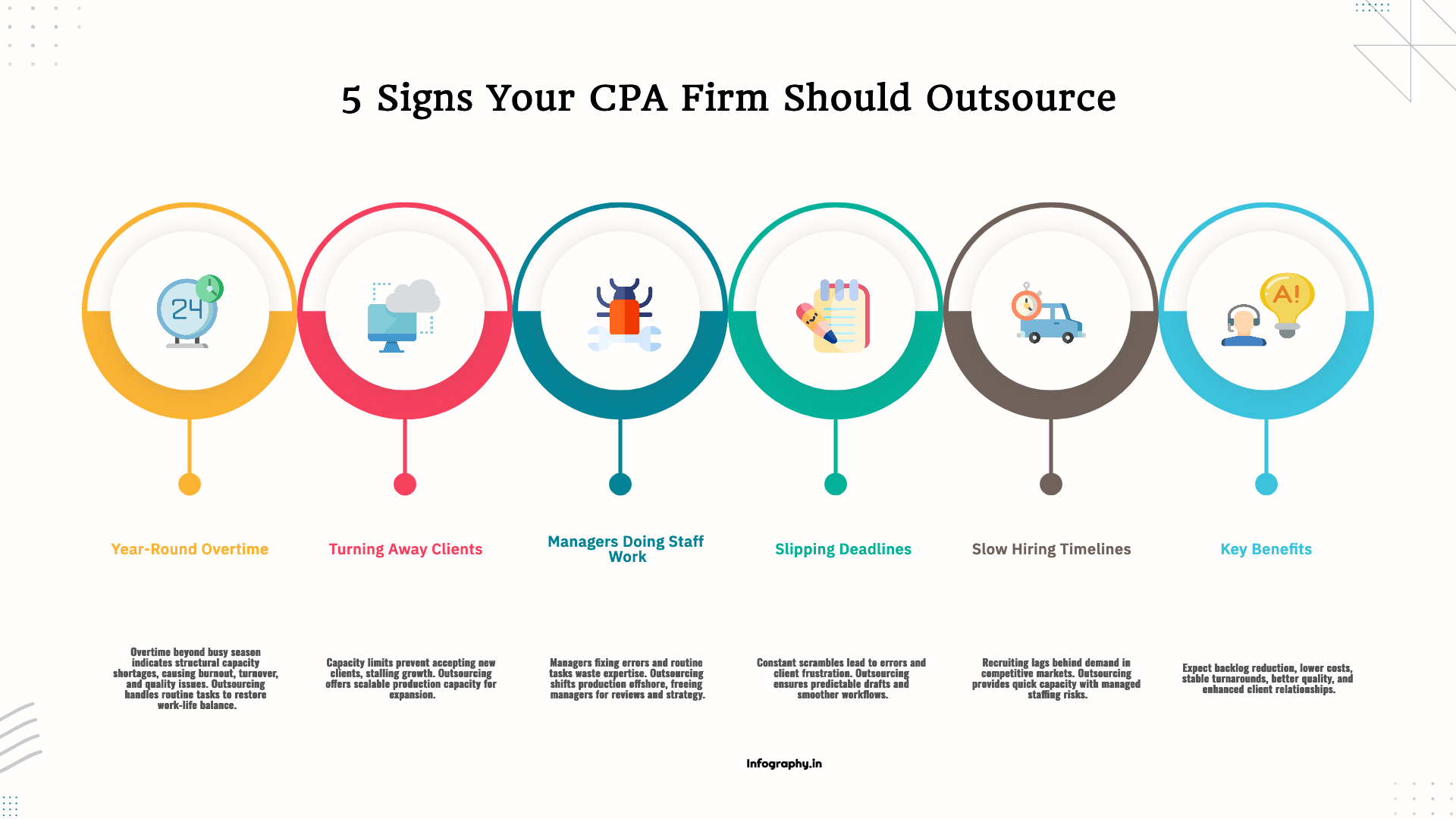

If your firm is growing but your calendar has no room for new work, you already know outsourcing is worth exploring. The decision is not whether you need more capacity. The decision is when to act and how to implement it without disrupting quality or client relationships. Waiting for the perfect moment means continuing to turn away prospects, overwork your team, and compress deadlines in ways that erode quality. The signs that outsourcing should be seriously considered are not subtle. They show up in overtime patterns, client acquisition constraints, work allocation mismatches, deadline pressure, and hiring timelines that cannot keep pace with demand.
Busy season overtime is expected in accounting. Tax season demands surge capacity. Annual audits create concentrated work periods. These seasonal peaks are normal and manageable when they are temporary. What is not normal or sustainable is year-round overtime where staff consistently work nights and weekends regardless of the calendar.
Year-round overtime signals a structural capacity problem, not a temporary crunch. The firm does not have enough production capacity to handle its current workload at a sustainable pace. Staff are burning out. Quality slips because people are tired and rushing. Turnover rises because talented professionals leave for firms where work-life balance is achievable. The firm loses institutional knowledge and spends more time recruiting and training, which further strains capacity.
Outsourcing does not eliminate busy season. It cannot make deadlines disappear or reduce the inherent complexity of accounting work. What it can do is remove the steady backlog that turns every month into a mini busy season. When the offshore team handles routine preparation work, the onshore team has breathing room during non-peak periods. Overtime becomes seasonal again rather than constant, which improves retention and quality.
Turning away prospects is not a deliberate strategy. It is a symptom of capacity constraints. When a CPA firm cannot take on new bookkeeping clients or additional tax preparation work without hiring more staff, growth stalls. The firm maintains revenue but misses opportunities to expand relationships, enter new markets, or increase profitability through better fixed cost absorption.
The constraint is not usually partner time or client-facing capacity. It is production capacity. The firm does not have enough staff to handle the data entry, reconciliations, workpaper preparation, and drafting that must happen before review and finalization. Hiring solves this problem if hiring is fast and retention is predictable. But in competitive markets where recruiting takes months and turnover is high, hiring cannot keep pace with growth opportunities.
Outsourcing converts fixed staffing limits into a more flexible capacity model. The offshore team can scale up when client volume increases and scale back when it decreases. The firm can say yes to prospects knowing that production capacity is available, even if hiring another full-time staff member is not immediately feasible. This flexibility turns capacity from a growth constraint into a managed variable.
This pattern is easy to spot and expensive to ignore. Managers are reconciling bank accounts, fixing transaction coding errors, and chasing clients for missing documentation. These are tasks that should be handled by junior staff or support teams. When managers do staff-level work, two problems emerge.
First, the time is expensive. Managers are paid for their judgment, experience, and ability to handle complex situations. When they spend hours on routine tasks that could be done by someone at half their bill rate, the firm is destroying value. The work gets done, but at a cost that makes the engagement unprofitable or requires the firm to absorb the inefficiency.
Second, managers are not doing manager work. They are not reviewing work thoroughly, coaching junior staff, identifying process improvements, or having strategic conversations with clients. The work that only managers can do gets compressed into shorter windows or deferred entirely. This affects quality, staff development, and client service in ways that compound over time.
Outsourcing shifts routine production work to a team that specializes in execution. Managers return to review, coaching, and client interaction. The per-hour cost of production decreases, and the firm gets full value from its managers' expertise rather than burning it on tasks that do not require their skill level.
When deadlines slip, people rush to catch up. When people rush, errors appear. Errors require rework, which consumes time that was supposed to go toward new work. The cycle repeats and accelerates. Staff become demoralized because they never feel caught up. Clients become frustrated because deliveries are late or require multiple rounds of corrections.
This scramble mode is not caused by incompetence or poor work ethic. It is caused by insufficient production capacity relative to workload. The team is working hard, but there simply are not enough hours in the day to complete the volume of work with acceptable quality.
Outsourcing can stabilize the production layer when implemented with clear processes and review standards. Drafts arrive on a predictable schedule because the offshore team is dedicated to production work without the distractions of meetings, client calls, and administrative tasks that fragment onshore time. Review becomes predictable because reviewers know when work will be ready and can schedule their day accordingly. The constant scramble reduces because work flows more smoothly through the production-review-finalization pipeline.
Recruiting timelines reveal the health of the local talent market. If hiring takes three to six months and the best candidates receive multiple competing offers before accepting, the firm cannot build a growth plan that depends on hiring speed. The market dynamics are working against the firm, and wishing for faster hiring does not change reality.
Outsourcing is not a replacement for building a strong onshore team. It is a way to add capacity when the local hiring market cannot deliver talent fast enough to meet demand. The offshore team provides production capacity that can be added in weeks rather than months. This speed matters when client growth accelerates, when unexpected staff departures create gaps, or when busy season demands surge capacity beyond what the existing team can handle.
The benefit is not just speed. It is also reduced hiring risk. When the firm hires locally, it invests months in recruiting, training, and onboarding. If the hire does not work out, the investment is lost and the process starts over. When the firm works with an offshore provider, the provider manages staffing, backup, and replacement. If one team member is not performing, the provider swaps them out. The firm's operational risk decreases because capacity is not concentrated in one or two critical hires.
Outcomes vary based on implementation quality, but firms that implement outsourcing with clear workflows and strong review processes commonly experience several benefits.
Backlog reduction is often the most visible immediate gain. Work that has been piling up for months starts to clear. Close timelines improve because production work happens faster. Staff stop spending weekends catching up. The firm moves from reactive crisis mode to proactive workflow management.
Lower manager cleanup time frees capacity for higher-value work. When managers stop fixing errors and chasing documentation, they have time to review work thoroughly, coach junior staff on technical issues, and engage with clients on advisory topics. This shift improves both quality and client relationships.
More stable turnaround times create predictability for clients and staff. When the offshore team handles drafting overnight using the follow-the-sun model, work that would take two business days can be completed in twenty-four hours. Clients receive deliverables on consistent schedules rather than whenever the firm finally has capacity. This reliability strengthens client trust and reduces the stress of constant deadline negotiation.
Start by picking one workflow to outsource. Reconciliations, close support, or tax workpaper assembly are common starting points because they have clear inputs, documented procedures, and measurable outputs. Do not try to outsource everything at once. Prove the model with one workflow before expanding.
Write a checklist that documents the procedure step by step. Define what supporting documentation is required, what quality standards apply, and what the final deliverable should include. This checklist becomes the training material for the offshore team and the quality control tool for reviewers.
Run a pilot for at least four weeks. Track rework rates, turnaround times, and reviewer satisfaction. If the pilot demonstrates that the offshore team can produce quality work with acceptable rework rates, expand the scope gradually. If rework is high or turnaround does not improve, tighten the process, improve the documentation, or adjust the training before scaling.
The signs that outsourcing is worth exploring are clear. Year-round overtime, capacity constraints that block growth, managers doing staff work, constant deadline scrambling, and slow hiring all point to the same conclusion. The firm needs more production capacity, and outsourcing is one of the most practical ways to add it without waiting for the local hiring market to cooperate.
Related read: impressed client.

Section 4960's 21% excise tax now reaches far more nonprofit employees. See who is a covered employee in 2026 and what changed.

The Section 45S paid family leave credit is permanent for 2026 with new options. See who qualifies, the amounts, and how to claim it.

Opportunity zones become permanent in 2027 under the One Big Beautiful Bill. See the new deferral, rural bonus, and the 2026 handoff.