


If you’ve gone anywhere near “outsourced bookkeeping” on Google in the last year, you’ve definitely met the usual suspects: Bench and Pilot. Bright brands. Clean websites. Plenty of ads following you around Instagram.
What doesn’t show up in the ads is the awkward question: are these actually the right fit for your business – or are you quietly trying to force a square peg into a round general ledger?
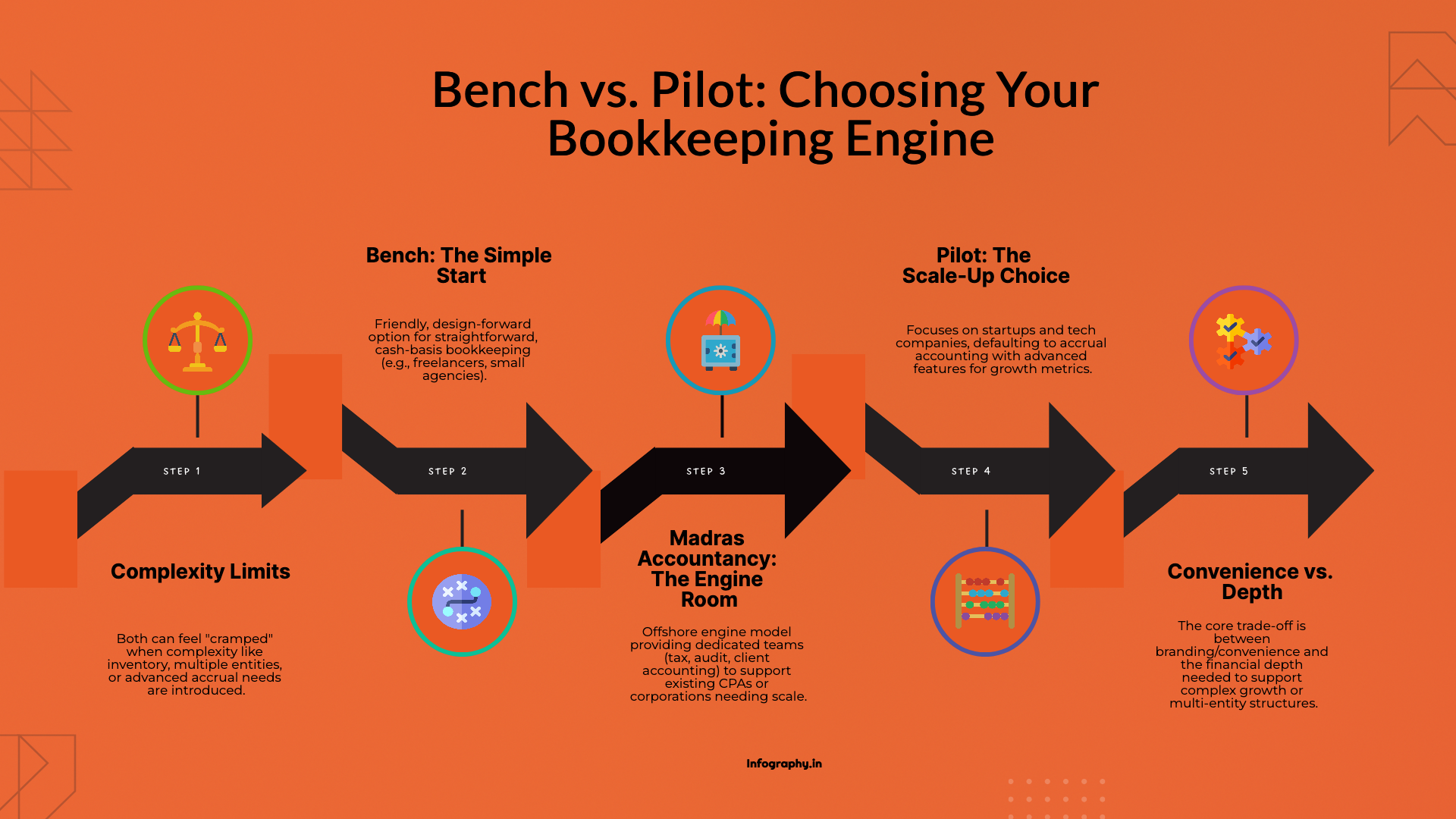
Bench is the friendly, design-forward option. You get a simple portal, a dedicated bookkeeping team, monthly financial statements, and a tidy year-end package for your tax preparer.
They’re very good at what they explicitly promise: cash-basis bookkeeping for small, mostly straightforward businesses. Service providers, agencies, freelancers – that crowd. The platform makes it easy to ignore the back office until month-end, then check in without needing an accounting dictionary open on a second screen.
As soon as you add real complexity – inventory, multiple entities, advanced accrual needs, heavy custom reporting – Bench can start to feel like living in a studio flat with three teenagers. Reviews and comparison articles regularly point out those limitations.
If you’re dreaming about sophisticated scenario planning, debt covenants, or answering picky investor questions, Bench alone probably won’t cut it.
Pilot took a different route: they went after startups, ecommerce, and venture-backed tech. Accrual accounting is the default. They talk in terms of SaaS metrics, fundraising, and board packages. It’s all a bit more… Silicon Valley.
They also offer tax and fractional CFO services on top, which means you can, in theory, go from “we just incorporated” to “we’re preparing for a Series B” without swapping providers.
If your business is a local service company or a micro-business without ambitious growth plans, Pilot’s pricing and positioning may feel like you’ve been invited to a black-tie dinner when you really wanted a coffee.
You’ll pay more than basic bookkeeping options, and you might not use half the bells and whistles.
Bench vs Pilot often gets framed as a simple either/or. But for CPA firms and more complex small businesses, there’s a different angle: keep your relationship with a trusted CPA or controller, and plug in an offshore engine behind them.
Madras Accountancy is a good example of that model. Instead of being the front-end app, Madras builds teams for US and UK CPA firms and corporations: tax pods, audit teams, client accounting staff, and yes, fractional CFO support on top.
The value proposition is less about having another shiny portal and more about:
It’s not a “swipe your card, get an account in 10 minutes” experience. Onboarding is more deliberate. But if you’re running a firm or a business with real scale, that’s often a feature, not a bug.
Two names often mentioned in the same breath as Bench and Pilot are Bookkeeper360 and BooXkeeping.
Bookkeeper360 builds on Xero or QuickBooks Online, adds strong software integrations and dashboards, and then layers in advisory or CFO-style services. It’s a nice option if you like your existing accounting platform but want something more thoughtful than bare-minimum bookkeeping.
BooXkeeping takes a slightly different route, operating more like a franchise model. That can mean a more personal, local-feeling relationship while still being remote-friendly. It also means quality can vary by location, so due diligence matters.
Here’s a simple way to think about it:
If you strip away the branding, the Bench vs Pilot debate is really a question about what you value more:For some owners, that convenience is absolutely worth it. For others – especially those already working with a CPA firm or juggling multiple entities – it’s more important to build a finance function that won’t fall over the first time you add a new state, a new investor, or a new product line.
In that world, offshore partners like Madras Accountancy or more flexible firms like Bookkeeper360 often make more sense than simply ticking the Bench or Pilot box and hoping for the best.
Section 4960's 21% excise tax now reaches far more nonprofit employees. See who is a covered employee in 2026 and what changed.

The Section 45S paid family leave credit is permanent for 2026 with new options. See who qualifies, the amounts, and how to claim it.
Opportunity zones become permanent in 2027 under the One Big Beautiful Bill. See the new deferral, rural bonus, and the 2026 handoff.



