


If you are a business owner who has maxed out a 401(k) and still wants to shelter more income from taxes, a cash balance plan is probably the tool you have not heard enough about. It lets high earners set aside far more for retirement than a standard plan allows, and the contributions are tax-deductible.
A cash balance plan is a type of defined benefit plan, the same legal category as an old-fashioned pension. What makes it feel modern is that each person has their own account balance they can watch grow, the way a 401(k) works. So it sits in an interesting middle ground, part pension and part personal account, which is exactly why it confuses people at first.
Here is the short version before the detail. The plan credits your account each year with a set contribution plus a guaranteed interest amount, and because it is a defined benefit plan, the annual limits are much higher than a 401(k) or a SEP. For a profitable owner in their 50s, that can mean putting away well over $200,000 a year, tax-deferred. The rest of this guide explains how it works, how it differs from the plans you already know, and who it actually suits.
A cash balance plan, sometimes called a cash balance pension plan, is a defined benefit pension plan with a twist. In the eyes of the IRS it is the same type of qualified retirement plan as a traditional pension, but instead of promising a monthly check at retirement, it gives each participant a hypothetical account balance that grows every year. The IRS defines it as a defined benefit plan that borrows features from a defined contribution plan.
That word hypothetical matters. The account is not a real, separate investment account the way your 401(k) is. It is a bookkeeping figure that tracks what you are owed, funded by one pooled pot of plan assets that the employer manages. You see a growing balance, but behind the scenes the money sits in a single trust, invested and overseen by the plan sponsor.
So a cash balance plan is a type of defined benefit plan that looks and feels like a defined contribution plan. Holding both ideas at once is the key to understanding everything that follows. Once you accept that it is a pension wearing the clothes of a personal account, the rest clicks into place.
Every year, your account gets two credits, and this is the heart of how these plans work. The first is the pay credit, which is the actual employer contribution. It is usually a set percentage of your pay or a flat dollar amount written into the plan. The second is the interest credit, a guaranteed growth rate applied to your balance no matter what the investments actually earned.
That interest credit is either a fixed rate, like 4 percent a year, or a variable rate tied to an index such as the yield on 30-year Treasury bonds. It is spelled out in the plan document up front. Add the contributions and interest together, year after year across your years of service, and the account grows in a steady, predictable way that a market-based 401(k) never can.
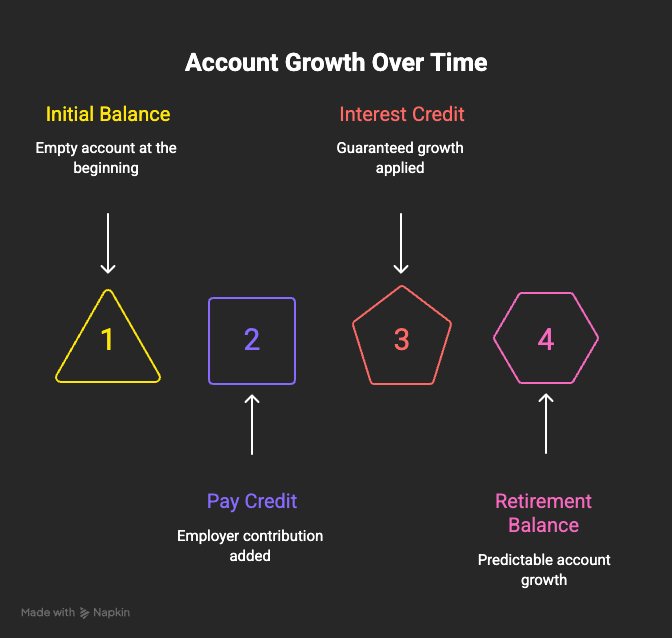
The predictability is the point. You are not guessing what your balance will be at retirement, because the pay credit and interest credit are both defined in advance. This steady, formula-driven growth is what separates the plan from anything that rides on market returns.
The clearest way to understand a cash balance plan is to hold it next to the two plans you already know. Against a 401(k), which is a defined contribution plan, the big difference is who carries the investment risk. In a 401(k), you do. If the market drops, your balance drops. In a cash balance plan, the plan sponsor carries that risk instead. Your interest credit is guaranteed, so if the plan investments underperform, the employer has to make up the shortfall, and if they do well, future employer contributions can shrink.
Against a traditional defined benefit plan, the difference is how the benefit is expressed. A traditional pension plan promises a monthly income for life based on your final salary and years of service, which is hard to picture until you are nearly retired. A cash balance plan shows you a single account balance you can understand today, and unlike traditional defined benefit plans, it is easy to take as a lump sum and roll into an IRA when you leave. That portability is a big reason these plans replaced so many old pensions. If you want to see where large retirement contributions fit into an owner's overall pay, our guide on how much to pay yourself as a firm owner puts real numbers to it.
Here is the reason business owners set these up in the first place. Because a cash balance plan is a defined benefit plan, its contribution limits are not the flat dollar caps you see on a 401(k) or a SEP. They are calculated by an actuary based on your age and a target retirement benefit, which means the older you are, the more you can put in.
The numbers get large fast. A 401(k) with profit sharing caps annual contributions in the high five figures. The plan can allow an annual contribution of well over $100,000, and often $200,000 or more for an owner in their 50s or 60s with strong income. Every dollar is a tax-deductible employer contribution, so the plan doubles as one of the most powerful tax-deferral tools available to profitable small business owners. Many owners run a cash balance plan alongside a 401(k) to push total retirement savings even higher. Because the tax impact is significant, this belongs in a real tax planning conversation, and our piece on business tax write-offs shows how deductions like this stack up.
Cash balance plans come with a layer of protection that defined contribution plans do not. Because they are defined benefit plans, most are insured by the Pension Benefit Guaranty Corporation, a federal agency that steps in if a plan cannot pay what it promised. You can read what the PBGC covers on its site. One exception worth noting: certain small professional-service plans with a limited number of participants are not covered by the PBGC, so this is a detail to confirm for your specific plan.
Vesting works on a schedule too. Cash balance plan benefits typically vest after three years, meaning a participant has to stay that long to fully own the employer contributions credited to their account. For an owner-only plan this rarely matters, but once you have employees who are plan participants, vesting and the cost of funding their benefits become part of the math.
A cash balance plan is not for everyone, and being honest about that is part of the value. It fits best when a few things are true: you own a profitable business or work as a high-income professional, you are usually 40 or older, your income is stable, and you have already maxed out simpler options. Doctors, lawyers, consultants, and established firm owners are the classic candidates.
The trade-off is commitment and complexity. Setting up a cash balance plan means hiring an actuary and a plan administrator, agreeing on a plan design, and funding the promised benefit fairly consistently each year, since this is not a plan you can skip whenever cash is tight. At retirement age, you take the money as a lump sum rolled into an IRA or as one of the lifetime annuities the plan must offer. If you are earlier in that journey and comparing options, our guide on setting aside taxes on 1099 income covers the SEP and solo 401(k) routes, and our quarterly estimated tax guide helps with the planning around them.
The honest takeaway is that these plans are powerful but specialized, so the decision belongs with an actuary and a CPA who can run your specific numbers rather than a blog alone.
Worth saying plainly. A cash balance plan only delivers its tax benefit when the accounting and tax work behind it is clean. The deduction has to flow correctly through your books and your return, the contributions have to be timed right, and the whole thing has to line up with the rest of your tax plan.
That is the part we handle at Madras Accountancy. We are not your actuary, and we do not sell the plan. Since 2015 we have run the offshore accounting and bookkeeping and tax preparation support for U.S. CPA firms and the business owners they serve, making sure large deductions like a cash balance contribution are recorded properly and reflected in the numbers. If your firm is coordinating one of these plans for a client, talk to our team and we will keep the books and filings tight.
What is a cash balance plan? A cash balance plan, or cash balance pension plan, is a type of defined benefit retirement plan that gives each participant a hypothetical account balance instead of a promised monthly pension. It combines features of defined benefit and defined contribution plans, since it is legally a pension but shows an individual account that grows each year. Business owners and high-income professionals use these plans because they allow much larger tax-deductible contributions than a 401(k) or a SEP, making them a strong tool for both retirement savings and tax deferral.
How does a cash balance plan work? Each year your account receives two credits. The pay credit is the employer contribution, usually a set percentage of pay or a flat dollar amount. The interest credit is a guaranteed growth rate, either a fixed rate or a variable rate tied to an index like the 30-year Treasury yield. These contributions and interest build the account balance in a predictable way over your years of service. Because the interest is guaranteed, the plan sponsor, not the participant, carries the investment risk on the plan assets.
How is a cash balance plan different from a 401(k)? The main difference is who bears the risk and how much you can contribute. A 401(k) is a defined contribution plan where you choose investments and carry the market risk. A cash balance plan is a defined benefit plan where the interest credit is guaranteed and the employer carries the risk. Contribution limits are also far higher in a cash balance plan because they are based on age and a target benefit rather than a flat cap, which is why high earners often add one on top of a 401(k).
How much can you contribute to a cash balance plan? There is no single flat limit. An actuary calculates your maximum annual contribution based on your age, income, and the target retirement benefit, so older owners can contribute more. In practice, contributions often exceed $100,000 a year and can reach $200,000 or more for an owner in their 50s or 60s. Every dollar is a tax-deductible employer contribution, which is the main reason profitable business owners use these plans to shelter income while building retirement savings.
Who should consider a cash balance plan? A cash balance plan fits profitable business owners and high-income professionals, usually age 40 or older, with steady income who have already maxed out a 401(k) or SEP. Doctors, lawyers, consultants, and established firm owners are common candidates. It works best when your income is consistent, because you have to fund the promised benefit fairly regularly rather than only in good years. If your income is unpredictable or you want maximum flexibility, a simpler plan may be a better fit.
Is a cash balance plan insured by the PBGC? Most are. Because a cash balance plan is a defined benefit plan, it is generally insured by the Pension Benefit Guaranty Corporation, the federal agency that protects pension benefits if a plan cannot meet its obligations. This is a layer of protection that a 401(k) does not have. There is an exception for certain small professional-service plans with a limited number of participants, which may fall outside PBGC coverage, so it is worth confirming the status of your specific plan with your administrator.
Can you take a lump sum from a cash balance plan? Yes, and this is one of the plan's biggest advantages over a traditional pension. When you retire or leave, you can usually take your entire account balance as a lump sum and roll it into an IRA, which keeps the money growing tax-deferred and under your control. A cash balance plan must also offer lifetime annuities as an option, so you can choose an annuity for steady income instead if you prefer. The lump sum flexibility is a major reason these plans are popular.
How does Madras Accountancy help with a cash balance plan? Madras Accountancy handles the accounting and tax side, not the plan itself. As an offshore partner to U.S. CPA firms and the businesses they serve, we make sure a cash balance plan contribution is recorded correctly in the books, deducted properly on the return, and coordinated with the rest of the tax plan. We work alongside the actuary and advisor who design and manage the plan. Since 2015 we have helped firms keep this kind of high-stakes work accurate and compliant. You can reach our team through the contact link above.
The 2026 1099 reporting threshold changed: 1099-NEC and 1099-MISC now start at $2,000, and 1099-K is back to $20,000. Here is what you must file.
A plain guide to how a 2026 sales tax holiday works, which items are exempt, and the rules on price caps, refunds, and rain checks.
Form 7004 buys a 6-month extension of time to file business returns like 1065, 1120-S and 1120. Deadlines, e-file steps and the payment trap.



