



For years, most people who gave to charity got nothing back at tax time. If you took the standard deduction, and about 9 in 10 filers do, your donations did not lower your tax bill at all. That is finally changing.
Starting with the 2026 tax year, the One Big Beautiful Bill Act brings back a charitable deduction for non-itemizers. You can deduct up to $1,000 if you file single, or $2,000 if you are married filing jointly, for cash gifts to charity, even while claiming the standard deduction. And this time it is permanent, not a one-year experiment.
Here is what the rule actually says, who it helps, and how to get the most out of it.
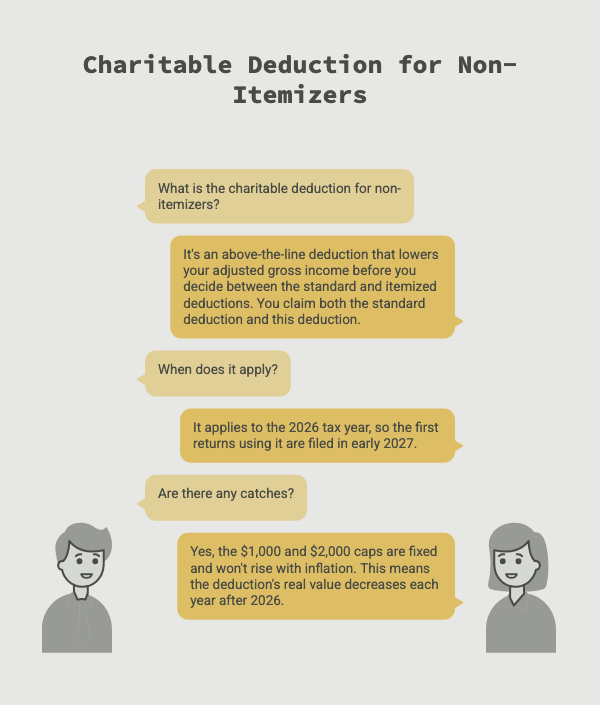
This is an above-the-line deduction, which is just a plain way of saying it lowers your adjusted gross income before you ever reach the standard-versus-itemize decision. You claim the standard deduction and this deduction. You do not pick one or the other.
It applies to the 2026 tax year, so the first returns that use it are the ones you file in early 2027. The law made it permanent this time, not a temporary measure, but there is one catch worth knowing today. The $1,000 and $2,000 caps are fixed and will not rise with inflation. In real terms, the deduction is worth the most in 2026 and loses a little value each year after as prices climb.
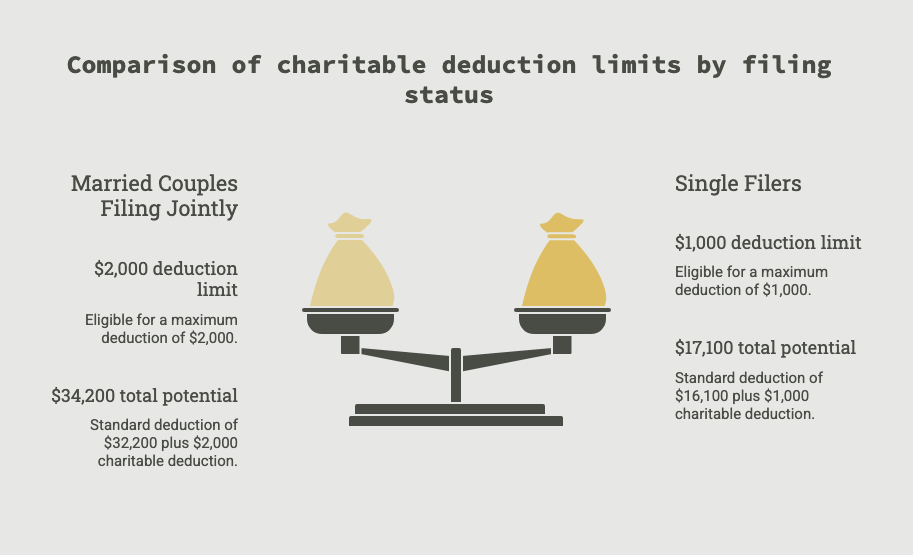
The numbers are refreshingly simple. Single filers can deduct up to $1,000. Married couples filing jointly can deduct up to $2,000. No phase-in, and no income test to trip over.
For context, the 2026 standard deduction is $16,100 for single filers and $32,200 for married couples filing jointly, according to the IRS inflation figures in Revenue Procedure 2025-32. This charitable deduction sits right on top. So a married couple could claim the full $32,200 and another $2,000 for the causes they support.
This helps the everyday giver most. Think of the family that gives weekly at church, mails a check to the local food bank, or chips in after a natural disaster and never had enough deductions to itemize.
This is where people slip up, so it is worth slowing down.
The deduction only covers cash gifts. Cash here means a check, card, bank transfer, or payroll deduction. Gifts of stock, clothing, canned goods, or a used car do not qualify for this particular break, since non-cash gifts follow a separate set of rules.
The money also has to go directly to a qualifying public charity, the kind recognized under Section 501(c)(3). A few popular giving routes are left out on purpose:
One more detail that surprises people: the cap is per return with no carryforward. If you give $3,000 in cash as a couple, you deduct $2,000 and the extra $1,000 does not roll into next year.
If this rings a bell, you are thinking of the CARES Act. Back in 2020 and 2021, non-itemizers could deduct $300, later $600 for couples. Roughly 90 million taxpayers used it, which says a lot about how much people wanted it back.
The 2026 version, sometimes called the universal charitable deduction, more than triples those old caps. Better still, unlike the temporary CARES break, it is here to stay. The only real trade-off is that fixed dollar limit, which is exactly why a gift made in 2026 stretches your tax benefit further than the same gift will a few years down the line.
The same law that helped non-itemizers made itemizing a bit less generous, so it is worth a look even if you write larger checks.
Beginning in 2026, itemizers can only deduct charitable gifts above 0.5% of their AGI. The first slice of your giving, up to that 0.5%, no longer counts. On $400,000 of AGI, for example, the first $2,000 of donations is not deductible, and only the amount above that reduces your tax.
There is also a ceiling for top earners. If you land in the 37% bracket, the value of your itemized charitable deduction is capped at the equivalent of 35 cents on the dollar. And companies now face their own 1% floor before corporate gifts become deductible at all.
For most people, the math just got simpler. If your itemized deductions were already hovering near the standard deduction, the new above-the-line break plus the standard deduction usually wins, and it is far easier at filing time because you skip Schedule A entirely.
Where it still pays to run the numbers is a big giving year, or when you carry large deductions like mortgage interest and state and local tax. Quick example: a married couple with $150,000 in AGI who gives $2,500 in cash and has no other major deductions is usually better off taking the standard deduction and the $2,000 write-off than itemizing.
Retirees have one more lever. If you are 70 and a half or older, giving straight from an IRA through a qualified charitable distribution can beat both routes, because it keeps the money out of your taxable income in the first place.
You will take the deduction right on Form 1040, with no extra schedule to fill out. The filing effort is light, but the recordkeeping still counts.
Hold on to proof for every gift, whether that is a bank record or a written note from the charity. For any single donation of $250 or more, the IRS expects a written acknowledgment from the organization, so do not toss those year-end thank-you letters. If you give a little each month, a simple running list of dates, amounts, and who received the money will save you a scramble next spring.
The reinstated charitable deduction for non-itemizers is that rare tax change that rewards something people already do. Put a little thought into how and when you give this year, keep clean records, and you can back the causes you love while trimming your federal tax bill. Looking a bit further out, a new federal tax credit of up to $1,700 for gifts to K-12 scholarship-granting organizations is set to arrive in 2027, so there is more on the way for givers.
If your finances are more involved, or you run a business, this is a smart moment to line your giving up against your full 2026 tax picture. Madras Accountancy works alongside US CPA firms to keep planning like this accurate, current, and simple to act on.
What is the charitable deduction for non-itemizers? It is a new above-the-line deduction that lets people who take the standard deduction still write off cash gifts to charity. It starts in the 2026 tax year under the One Big Beautiful Bill Act.
How much can I deduct in 2026? Up to $1,000 if you file single and up to $2,000 if you are married filing jointly. These are hard caps per return, and any cash given beyond them cannot be carried into a future year.
Can I claim it and take the standard deduction too? Yes, and that is the whole point. You do not have to itemize. The deduction lowers your adjusted gross income on top of the standard deduction you already take.
What kinds of donations qualify? Only cash gifts, meaning check, card, bank transfer, or payroll deduction, given directly to a qualifying 501(c)(3) public charity. Gifts of stock, goods, or other property do not count toward this deduction.
Do gifts to a donor advised fund count? No. Donor advised funds are excluded, along with private non-operating foundations and Section 509(a)(3) supporting organizations. The gift has to go straight to the charity.
Is this charitable deduction permanent? Yes. Unlike the temporary CARES Act version from 2020 and 2021, the One Big Beautiful Bill Act made it permanent. Just remember the dollar caps are fixed and are not adjusted for inflation.
Does the new 0.5% AGI floor affect me if I take the standard deduction? No. The 0.5% floor applies only to people who itemize on Schedule A. If you use the above-the-line deduction as a non-itemizer, the floor does not touch you.
How do I claim it on my tax return? You report it directly on Form 1040 for the 2026 tax year, which you file in early 2027. Keep a bank record or written acknowledgment for each gift, and a receipt from the charity for any single donation of $250 or more.

The 2026 1099 reporting threshold changed: 1099-NEC and 1099-MISC now start at $2,000, and 1099-K is back to $20,000. Here is what you must file.

A plain guide to how a 2026 sales tax holiday works, which items are exempt, and the rules on price caps, refunds, and rain checks.

Form 7004 buys a 6-month extension of time to file business returns like 1065, 1120-S and 1120. Deadlines, e-file steps and the payment trap.