


Picking an outsourcing partner feels like hiring. The resume looks impressive, the references check out, and the sales pitch addresses all your concerns. Then week three arrives, and you discover gaps between what was promised and what is delivered. The team is less experienced than expected. Communication breaks down. Quality issues emerge. The cost savings evaporate into rework. By the time you realize the fit is wrong, you have invested time training the team, disrupted your workflows, and lost momentum you cannot easily recover.
This is a decision-stage checklist designed to help you avoid that outcome. It is not meant to be polite or diplomatic. It is meant to surface deal-breakers early, before you commit to a partner who cannot deliver what your firm needs. Use these criteria to evaluate providers systematically rather than choosing based on whoever has the best sales presentation or the lowest price.
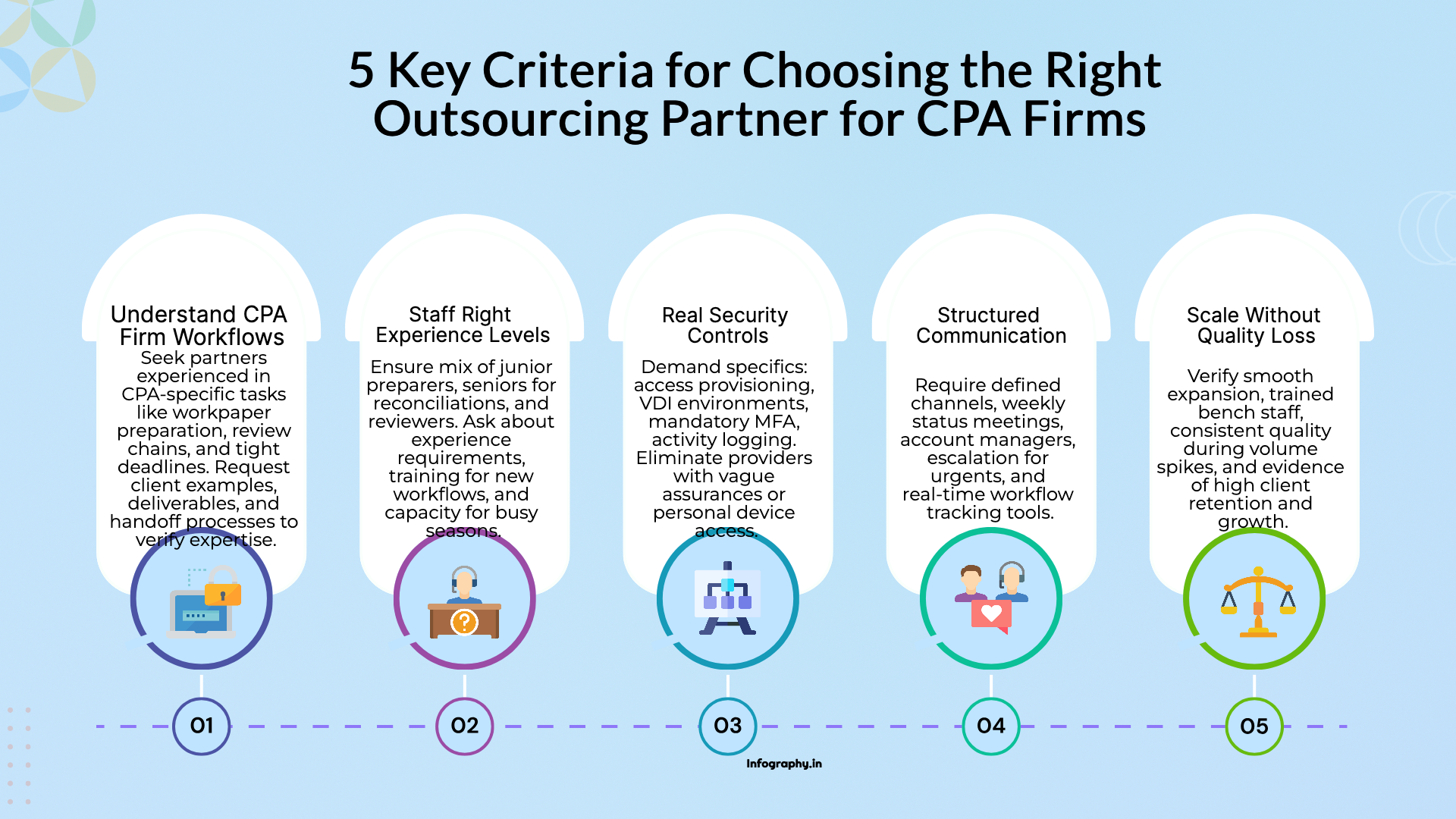
General outsourcing providers talk about accounting support in vague terms. They claim to handle bookkeeping, reconciliations, and financial reporting. When you dig deeper, you discover they have no experience with CPA firm workflows. They do not understand workpaper preparation standards, review chains, the distinction between draft and final deliverables, or the tight deadlines that tax season and month-end close create.
CPA firms need partners who understand the specific workflows that accounting firms execute daily. Workpaper preparation for tax returns follows different standards than bookkeeping for a single company. Audit workpapers require documentation discipline that general bookkeeping does not. The partner should demonstrate knowledge of these workflows through client examples, process documentation, and staff training programs that address firm-specific needs.
Ask which accounting and tax workflows they support currently. Request examples of deliverables they produce for other CPA firms. Inquire about how they handle review notes and rework when quality does not meet standards on the first submission. A partner with CPA firm experience will have clear answers. A general provider will give vague responses about flexibility and adaptability without specifics.
Ask what a typical handoff packet looks like for a tax return or month-end close. The answer should include specifics about what documentation is required, how tasks are assigned, what quality checks are performed before submission, and how exceptions are flagged. If the answer is that it depends on the client and they will figure it out as they go, that is a warning sign.
If the offshore team consists entirely of junior-level staff, your managers will spend their time fixing errors and providing detailed guidance rather than doing high-value review work. This defeats the purpose of outsourcing, which is to free senior capacity, not create more supervision burden.
A capable partner can provide a mix of experience levels that matches your internal structure. Preparers handle data entry and routine tasks. Seniors handle reconciliations and workpaper drafting. Reviewers perform initial quality checks before work is submitted to your team. This layered structure mirrors how your firm operates and creates appropriate quality gates.
Ask about the typical experience level for each role. How many years of accounting experience do preparers have? What qualifications do seniors possess? Are there internal reviewers who check work before it reaches your firm? If the provider cannot articulate clear experience requirements for different roles, they are likely staffing based on availability rather than fit.
Inquire about how training is handled for new client workflows. When your firm onboards with the provider, who trains the offshore team? How long does training take? What materials are required from your firm versus what the provider supplies? A mature provider will have training frameworks, example deliverables, and quality checklists that accelerate onboarding.
Ask what happens when volume spikes during busy season. Can they add capacity without degrading quality? Do they have bench staff trained and ready, or will they scramble to recruit? Firms that scale poorly during busy season create more problems than they solve.
Security claims are cheap. Every provider will assure you that data is encrypted, access is controlled, and security is their top priority. These assurances mean nothing without specifics about how security is implemented, monitored, and enforced.
Ask about how access is granted and removed. When a new team member joins, what is the provisioning process? When someone leaves or moves to a different client, how quickly is access revoked? The answer should include specifics about identity management systems, approval workflows, and audit trails.
Inquire about whether they use virtual desktop infrastructure or similar controlled environments. VDI prevents local downloads, limits copy-paste operations, and ensures that work happens in a secure environment rather than on personal devices. If the offshore team is accessing your data through their personal laptops, security is weak regardless of what other controls exist.
Ask about multi-factor authentication. Is it required for all systems? Is it enforced automatically or left to individual preference? MFA is table stakes for secure remote access, and any provider who treats it as optional should be eliminated from consideration.
Request information about activity logging and review. Are file accesses logged? Are unusual patterns monitored? Who reviews the logs and how often? Security is not just about preventing access. It is about detecting anomalies quickly when they occur.
If communication depends on one person being awake and available at the right time, the relationship will break down as soon as that person is sick, on vacation, or overwhelmed. Structured communication means defined channels, consistent cadence, clear ownership, and documented escalation paths.
Ask about the weekly cadence for status updates and reviews. Is there a standing meeting? Is there a daily sync on work status? How are questions raised and answered? A mature provider will have established rhythms rather than expecting you to chase them for updates.
Inquire about who owns the workflow on their side. Is there an account manager responsible for your firm's success? Is there a team lead who coordinates the work and ensures quality? Single points of contact create bottlenecks. Structured teams with clear roles provide better continuity.
Ask how urgent issues are handled. If your firm discovers a critical error at 4 PM Eastern and needs immediate attention, what is the escalation process? Is there a hotline? An emergency email? A designated contact who can mobilize resources quickly? The time zone difference means urgent issues cannot always wait twelve hours for a response.
Request information about the workflow tracking system. Do they use a task management tool that provides real-time visibility? Can your team see work status without sending inquiry emails? Transparency reduces communication overhead and prevents work from falling through cracks.
Most firms start with a pilot engagement for five to ten clients and expand when results are positive. A capable partner should be able to add capacity smoothly without requiring you to rebuild processes or retrain teams. Scaling should be an increment, not a restart.
Ask how they handle capacity expansion. When you need to add clients or increase hours, how long does it take? Do new team members get trained using documented procedures, or does training start from scratch? Can they maintain the same quality standards and turnaround times as volume increases?
Inquire about their bench depth. Do they maintain trained staff ready to onboard, or do they recruit only when needed? Providers with shallow benches struggle during busy season when every client is trying to scale simultaneously.
Ask about client retention and tenure. How long do typical clients stay? What percentage of clients expand their scope after the first year? High retention and expansion rates suggest the provider delivers consistent quality. High churn suggests problems that emerge after the honeymoon period.
Use this checklist as a filtering mechanism. Eliminate providers who cannot demonstrate CPA firm expertise, who only offer junior capacity, who give vague security answers, who lack structured communication, or who show no evidence of successful scaling. The remaining candidates are worth deeper evaluation through reference checks, pilot engagements, and detailed contract review.
Do not choose based on price alone. The cheapest provider often delivers the lowest quality, which creates rework that costs more than you saved. Do not choose based on the smoothest sales pitch. Evaluate based on evidence of execution: client references, example deliverables, documented processes, and specific answers to hard questions.
The right outsourcing partner becomes an extension of your firm that strengthens your capacity and quality. The wrong partner becomes a drain on your time and a source of client service problems. The due diligence you invest upfront prevents the regret that comes from discovering the wrong fit three months into the relationship.

Section 4960's 21% excise tax now reaches far more nonprofit employees. See who is a covered employee in 2026 and what changed.

The Section 45S paid family leave credit is permanent for 2026 with new options. See who qualifies, the amounts, and how to claim it.

Opportunity zones become permanent in 2027 under the One Big Beautiful Bill. See the new deferral, rural bonus, and the 2026 handoff.