


Tax season does not begin when January arrives. It begins the day a partner accepts one more client than the firm has capacity to serve well. The consequences do not show up immediately. They accumulate gradually through late nights, missed family commitments, and managers doing work that should be handled by staff two levels below them. This pattern is treated as noble sacrifice, proof of dedication to clients. In reality, it is expensive, unsustainable, and increases error risk during the period when clients are most sensitive to mistakes.
Offshore teams can change this pattern by absorbing preparation work, enabling faster turnaround, and reducing the overtime that burns out staff. But only if the workflow is structured properly with clear handoffs, documented standards, and disciplined review processes. Treating offshore support as ad hoc help during crisis periods creates more chaos than relief.
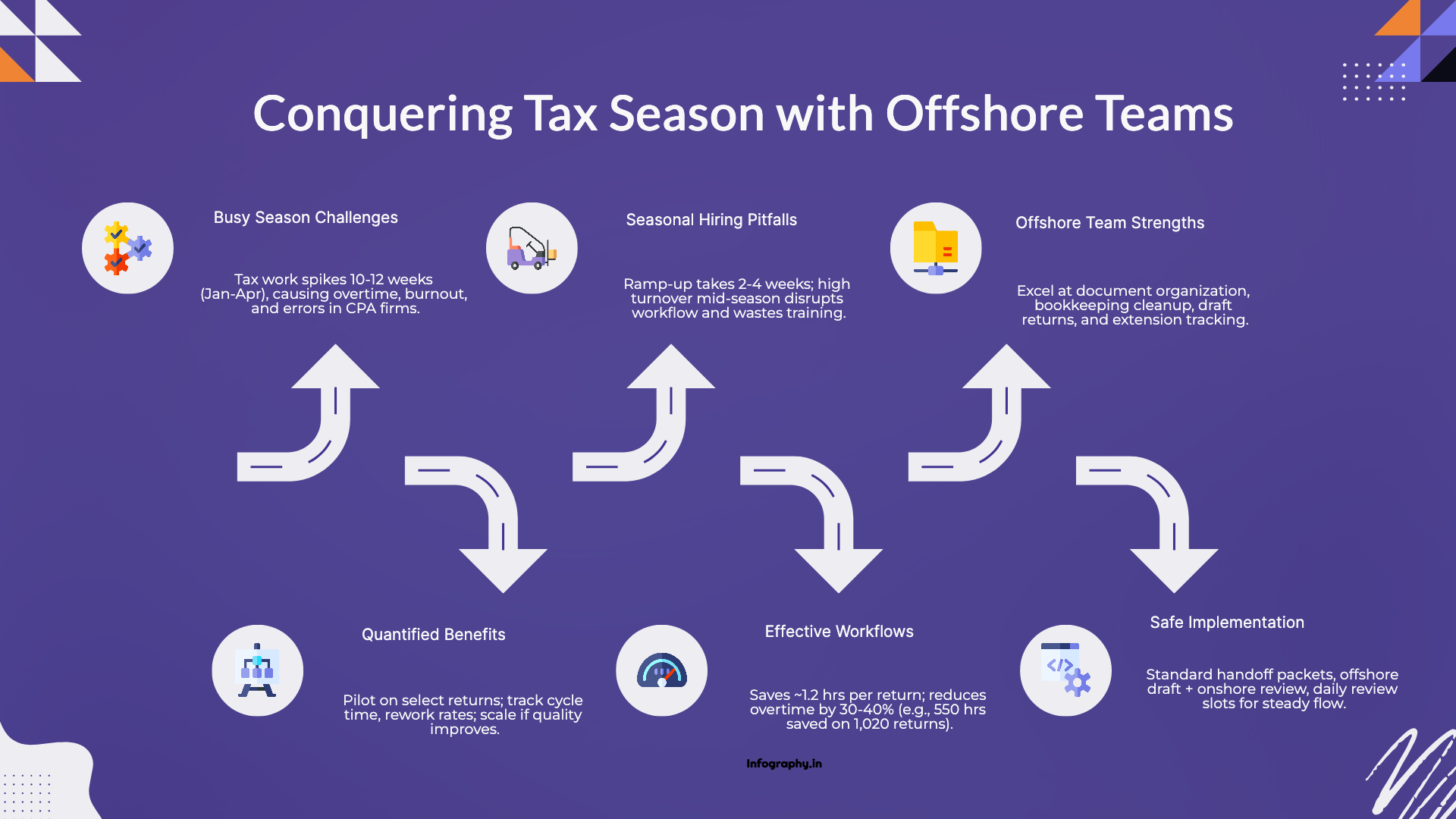
Small and mid-sized CPA firms face a predictable capacity problem during tax season. Work volume spikes for ten to twelve weeks, concentrated between mid-January and mid-April. Client returns arrive unevenly, with clusters around deadline periods. The firm needs surge capacity to handle this volume without compromising quality or destroying staff work-life balance.
Hiring seasonal workers is the traditional solution, but it introduces problems of its own. Recruiting takes time that the firm does not have during peak season. Seasonal hires need training and supervision, which pulls managers and seniors away from review work. Even after training, seasonal workers produce inconsistent quality because they lack experience with the firm's standards and clients.
Review work shifts upward as a result. Seniors and managers spend time assembling tax returns, organizing workpapers, and correcting errors that should have been caught during preparation. The work gets done, but at a cost structure that erodes profitability. Partner time gets consumed by tasks that could be delegated if qualified capacity existed.
The result is extensive overtime, review that gets rushed because partners are exhausted, and higher error risk during the period when mistakes are most damaging to client relationships and firm reputation.
Seasonal hiring addresses the volume problem but creates its own inefficiencies that limit the benefit.
Ramp time consumes a significant portion of the season. If a seasonal hire needs two to four weeks to produce consistent work without constant supervision, that represents a meaningful chunk of a twelve-week season. During the ramp period, managers are training rather than reviewing, which defeats part of the purpose of adding capacity. Some seasonal hires never reach full productivity before the season ends.
Capacity can disappear during the weeks you need it most. People get sick, receive better offers from other firms, or quit because the pressure is too intense. March and April do not pause for staffing disruptions. When a seasonal worker departs mid-season, the work shifts back to the existing team and training investment is lost.
Offshore support is most effective for tasks that can be executed according to documented procedures with quality verified through structured review. The team should work on preparation, not final judgment or client communication.
Organizing source documents and building complete workpaper packages eliminates one of the most time-consuming administrative tasks. The offshore team receives client-provided documents, organizes them according to the firm's file structure, prepares the organizer, and ensures all required schedules are present before the return moves to technical preparation. CPAs start review with organized files rather than spending billable time on document management.
Bookkeeping cleanup and trial balance preparation before return work begins is critical for business returns. The offshore team reconciles accounts, codes transactions correctly, and produces a clean trial balance. The CPA preparing the return works from accurate numbers rather than spending time fixing bookkeeping issues during return preparation.
Drafting returns for recurring clients with consistent patterns can be supported offshore. The team uses prior-year returns as templates, enters current-year data, performs calculations, and prepares a draft return. The US CPA reviews the draft, makes technical determinations, addresses unusual items, and signs. The preparation work happens faster because it is done by a team that does not get interrupted by client calls or internal meetings.
Extension tracking, estimated payment schedules, and status dashboards provide visibility into engagement progress. The offshore team tracks which returns are complete, which are in progress, which are waiting for client information, and which need extensions. This visibility allows partners to manage workflow and set client expectations accurately.
Most firms fail to capture the full value of offshore support during tax season because they treat it like ad hoc help rather than a structured workflow. The offshore team gets random assignments without clear standards, quality suffers, and rework consumes any time savings.
Define a standard handoff packet that includes everything the offshore team needs to complete the work independently. For tax return preparation, this includes the organizer with all requested information, the prior-year return, notes about changes in the client's situation, and source documents organized and labeled. Incomplete packets create delays and rework.
Implement a draft-offshore-review-onshore process. Offshore staff prepare the first draft and attach all supporting documentation. Onshore senior accountants review the draft for accuracy and technical compliance. Managers handle exceptions and complex technical questions. Partners perform final review and sign. This layered approach maintains quality while creating efficiency.
Lock a daily review window during tax season. If review happens whenever people have time, returns pile up and bottlenecks form. If review is scheduled at the same time each day, flow stays stable and the offshore team knows when to expect feedback. Predictable review rhythms prevent the accumulation that creates end-of-season panic.
Consider a firm that processes nine hundred individual returns and one hundred twenty business returns during tax season. The firm implements offshore support for workpaper organization on seventy percent of returns and draft preparation for forty-five percent of returns that fit repeatable patterns like W-2 wage earners or straightforward LLC operating agreements.
If offshore support reduces onshore preparation time by an average of 1.2 hours per return for the returns in scope, the total time savings calculates as follows. Nine hundred plus one hundred twenty returns equals one thousand twenty total returns. Forty-five percent of one thousand twenty returns equals four hundred fifty-nine returns receiving draft support. Four hundred fifty-nine returns multiplied by 1.2 hours saved equals approximately five hundred fifty hours of freed onshore capacity.
Those hours do not disappear. They shift from preparation to review, client communication, and problem solving. If the firm converts half of those saved hours into avoided overtime, that represents approximately two hundred seventy-five overtime hours eliminated. Some firms report that this translates to a thirty to forty percent reduction in overtime hours once the workflow stabilizes and the offshore team is fully trained.
This is a worked example with stated assumptions. Actual results depend on return complexity, staff efficiency, and how well processes are documented. The principle is consistent: offshore preparation creates onshore capacity that can reduce overtime and improve work quality.
Unclear review standards cause the offshore team to produce work that does not meet firm expectations. If they do not know what supporting documentation is required or what level of detail is expected, every return becomes a scavenger hunt for missing items. Document the standards explicitly in checklists before the season starts.
Using too many tools scatters information and creates coordination overhead. Keep the technology simple. One secure portal for documents, one tracker for return status, one chat channel for questions. Tool proliferation makes communication harder, not easier.
Scope creep during busy season guarantees failure. Tax season is not the time to add ten new workflows or experiment with untested processes. Start with one or two clearly defined workflows and execute them well. After the season, evaluate results and consider expansion for next year.
Pilot offshore support with a slice of your return volume before committing fully. One entity type, one partner's client group, or one return complexity tier works well. The pilot should represent actual tax season work, not theoretical practice returns.
Track cycle time from intake to first draft and from first draft to final signed return. These metrics reveal whether the workflow is actually faster or just redistributed across more steps.
Measure rework rate as the primary quality indicator. If rework declines over the first four weeks of the season, the offshore team is learning and improving. If rework stays constant or increases, the process definition or training needs work.
If the pilot demonstrates time savings and acceptable quality, expand scope for the remainder of the season. If results are disappointing, fix the intake packet and review standards before scaling. Offshore support does not fix broken processes. It amplifies whatever process exists, good or bad.

Section 4960's 21% excise tax now reaches far more nonprofit employees. See who is a covered employee in 2026 and what changed.

The Section 45S paid family leave credit is permanent for 2026 with new options. See who qualifies, the amounts, and how to claim it.

Opportunity zones become permanent in 2027 under the One Big Beautiful Bill. See the new deferral, rural bonus, and the 2026 handoff.



