

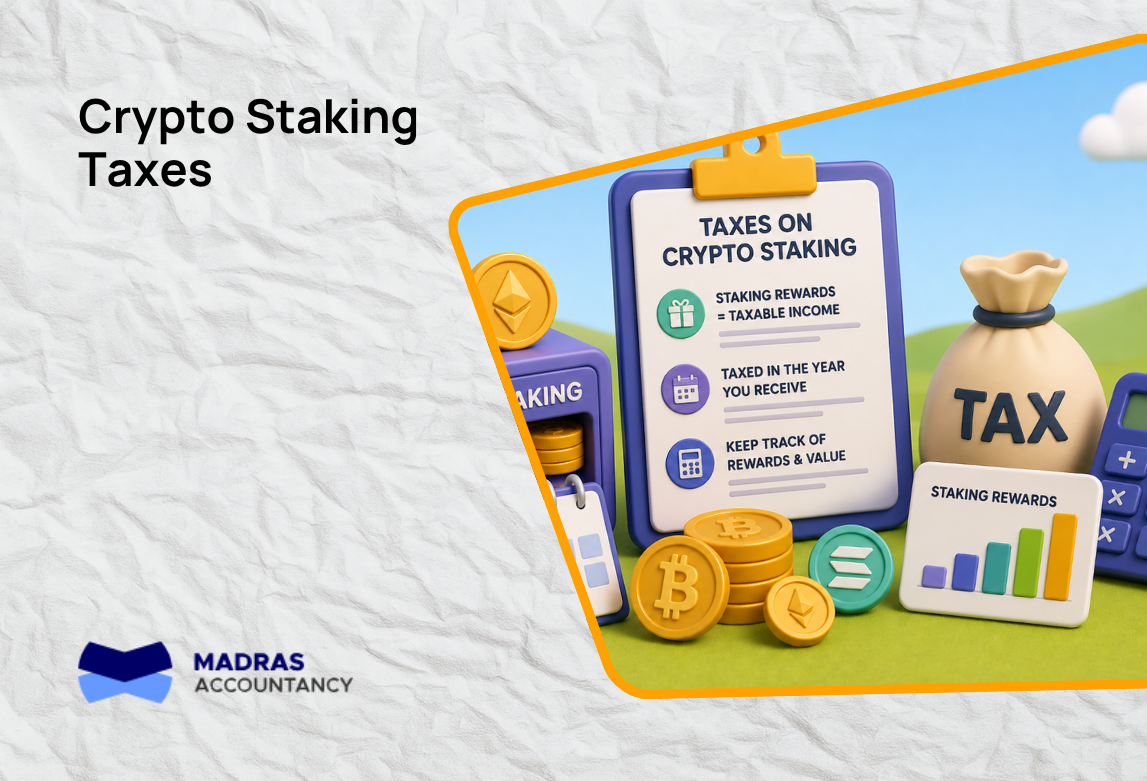

If you stake crypto and earn rewards, the IRS wants its share, and the rules catch a lot of people by surprise. Staking rewards are taxable, and they can actually get taxed twice: once when you receive them, and again when you sell them.
Here is the short version. When staking rewards land in your wallet, their fair market value counts as ordinary income for that tax year. Later, when you sell or swap those same coins, you owe capital gains tax on any increase in value since you received them. So one batch of rewards creates two separate taxable events, and missing either one is how people end up with a surprise bill or a tax notice.
None of this means staking is a bad idea. It just means you need to track your rewards and report them correctly. This guide walks through exactly how crypto staking is taxed, how to report staking rewards on your return, and the tricky spots like liquid staking and self-employment tax. One thing up front: crypto tax rules are still evolving, and lawmakers have floated changes, so treat this as a solid starting point and confirm the current details with a tax professional.
Before the tax part, a quick refresher. Staking is when you lock up your crypto to help run a proof-of-stake blockchain, and in return the network pays you staking rewards, usually in more of the same coin. Think of it a little like earning interest for putting your assets to work, except the payment is crypto rather than cash.
You can stake in a few ways. Some people stake directly by running their own validator, others stake through an exchange like Coinbase or Kraken, and many use pools or DeFi protocols. The method changes the experience, but for tax purposes the core question is the same: when you earn staking rewards, the IRS treats that as income. How you got there matters less than the fact that you received something of value.
This is the rule that trips up most crypto investors, so it is worth getting right. When you receive staking rewards and gain control over them, meaning you can sell, swap, or move them, their fair market value on that date is treated as ordinary income. IRS guidance, specifically Revenue Ruling 2023-14, confirms that the rewards count as income the moment you have control of them.
Fair market value is simply what the coins were worth in dollars at the time you received them. If you earned 1 coin worth $40 the day it hit your wallet, you have $40 of staking income to report for that tax year, taxed at your ordinary income tax rate. This applies whether or not you sell. Just receiving the reward creates the income, which surprises people who assume nothing is owed until they cash out.
That $40 also does a second job. It becomes your cost basis in those coins, which matters a lot for the next taxable event. You can see how the IRS frames this on its digital assets page, which spells out that rewards from staking count as reportable income.
Here is where the "taxed twice" part comes in, though it is not as bad as it sounds once you understand it. You already paid ordinary income tax on the fair market value when you received the reward. That value is now your cost basis, so you are not taxed on the same dollars again. You are only taxed on the change in value after that.
When you later sell, swap, or spend those staked coins, you have a capital gain or loss. The math is straightforward: sale price minus your cost basis. If that $40 coin is worth $60 when you sell, you have a $20 capital gain. If it drops to $30, you have a $10 capital loss you can use to offset other gains. Hold the coins longer than a year and you pay the lower long-term capital gains tax rate. Sell within a year and the gain is taxed at ordinary rates. These are the same property rules that apply to all crypto, which our guide on business cryptocurrency tax implications breaks down in more detail.
Reporting happens in two places, matching the two taxable events. The staking income you earned goes on your tax return as ordinary income. For most people who stake as investors, that lands on Schedule 1 of Form 1040 as other income. If your staking rises to the level of a business, it goes on Schedule C instead, which we will get to in a moment.
The capital gains and losses from selling your rewards go on Form 8949 and carry over to Schedule D. You will also need to answer the digital asset question at the top of your Form 1040, which asks whether you received or disposed of digital assets during the year. The honest answer, if you staked, is yes. The IRS is clear that you must report digital asset income on your individual income tax return. Some exchanges now send a 1099 form for staking rewards, but even if you do not get one, the income is still reportable.
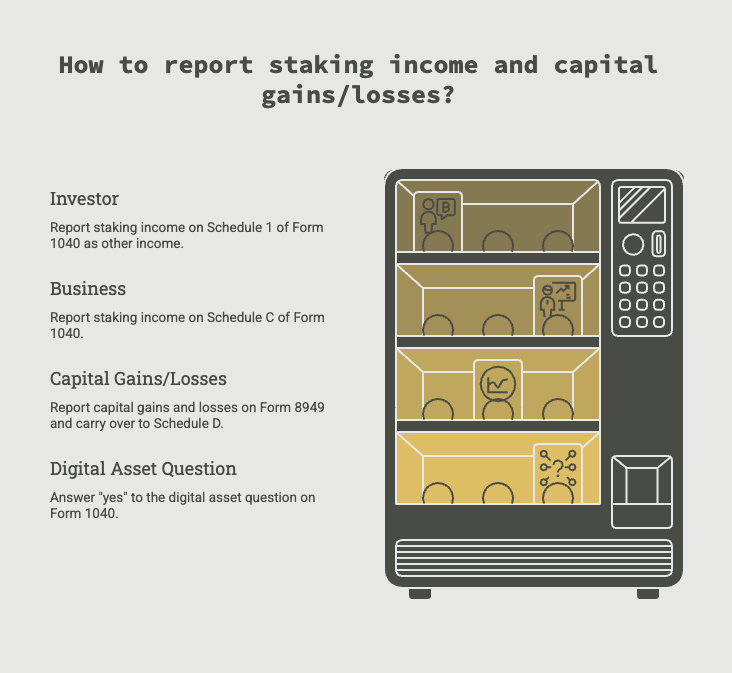
Most people who stake as a side activity or investment report their rewards as ordinary income and stop there. No self-employment tax applies, because it is treated like investment income rather than a business.
It changes if your staking looks like a real trade or business. If you run validators at scale, stake professionally, or operate staking as an ongoing commercial activity, the IRS may treat that staking income as business income. In that case it goes on Schedule C and is subject to self-employment tax on top of income tax, which covers Social Security and Medicare. Where the line falls is a judgment call based on how regular and business-like your activity is, and it is exactly the kind of question worth putting to a tax professional rather than guessing.
Not all staking is equally simple to tax, and this is where even experienced crypto investors get stuck. Exchange staking, the kind you do through Coinbase or Kraken, is the cleanest. The rewards are ordinary income at fair market value when you receive them, full stop.
Liquid staking and DeFi staking are murkier. With liquid staking, you stake a coin and get a different token back that represents your stake, and there is genuine debate about whether receiving that token is itself a taxable event or not. DeFi staking can layer in extra transactions, each with its own potential tax consequences. The IRS has not given clean answers on every one of these situations, so the tax implications depend on the specifics of the protocol you used. If you are deep into liquid staking or DeFi, this is not a place to guess, and good crypto accounting records will save you when it is time to sort it out.
The single most useful habit is tracking your crypto as you go. Because every staking reward creates income at its value on the day you receive it, you need a record of the date, the amount, and the dollar value of each one. Miss that, and calculating your crypto taxes accurately becomes nearly impossible, especially if you receive rewards daily.
Crypto tax software helps enormously here. Tools that connect to your wallets and exchanges can pull your staking transactions, calculate staking rewards at fair market value, and generate the tax forms you need. Beyond the software, remember that staking income is not withheld like a paycheck, so you may owe quarterly estimated payments to avoid a penalty, and our quarterly estimated tax guide covers that. Knowing how much to set aside for taxes as you earn keeps you from scrambling at tax season and lowers your odds of a tax audit down the road.
Worth saying plainly. Crypto staking taxes are fiddly, and the fiddliness is exactly where mistakes and penalties come from. Every reward has to be valued on the right date, income and capital gains have to land on the right forms, and the whole thing has to hold up if the IRS ever looks closely.
That is the part we handle at Madras Accountancy. As an offshore tax preparation and accounting and bookkeeping partner to U.S. CPA firms, we help sort messy crypto transactions, value staking rewards correctly, and get them onto the right forms so nothing slips through. Since 2015 we have kept firms and their clients compliant on complicated returns. If your firm has clients with staking income and you want the reporting done cleanly, talk to our team and we will take it from there.
Are crypto staking rewards taxable? Yes. In the United States, crypto staking rewards are taxable income. When you receive staking rewards and gain control over them, their fair market value in dollars counts as ordinary income for that tax year, whether or not you sell. You then owe capital gains tax later if you sell the coins for more than that value. So staking rewards are taxed both as income when earned and as a capital gain or loss when disposed of. Reporting both is required.
How are staking rewards taxed in the US? Staking rewards are taxed in two steps. First, the fair market value of the rewards when you receive them is treated as ordinary income, taxed at your regular income tax rate. Second, when you sell or swap those coins, you pay capital gains tax on any increase in value since you received them, or claim a loss if they dropped. IRS guidance in Revenue Ruling 2023-14 established that staking rewards are income when you gain control of them.
When do I owe tax on staking rewards? You owe income tax the moment you gain control of the rewards, meaning when you can sell, swap, or move them. That is the point where their dollar value becomes taxable income, even if you leave the coins untouched. You then owe capital gains tax separately, but only when you actually dispose of the coins by selling, trading, or spending them. Many people wrongly assume no tax is due until they cash out, which leads to underreported income.
Do I pay tax twice on staking rewards? In a sense, but not on the same dollars. You pay ordinary income tax on the value of the rewards when you receive them. That value becomes your cost basis. When you later sell, you only pay capital gains tax on the gain above that basis, not on the full amount again. So the two taxes hit different things: the first taxes the income you earned, and the second taxes the growth in value after you received it.
How do I report crypto staking rewards on my taxes? Report the staking income as ordinary income, usually on Schedule 1 of Form 1040 for investors, or on Schedule C if your staking is a business. Report any capital gains or losses from selling the rewards on Form 8949 and Schedule D. You also have to answer yes to the digital asset question on your Form 1040. Even if an exchange does not send you a 1099 form, you are still responsible for reporting all rewards and related transactions.
Are staking rewards subject to self-employment tax? Usually not. If you stake as an investor or a casual activity, the rewards are ordinary income but not subject to self-employment tax. That changes if your staking amounts to a trade or business, such as running validators as an ongoing commercial operation. In that case the income goes on Schedule C and is subject to self-employment tax on top of regular income tax. Whether your activity crosses that line is a judgment call best confirmed with a tax professional.
How is liquid staking or DeFi staking taxed? This is a gray area. With standard staking, rewards are ordinary income at fair market value when received. Liquid staking, where you receive a separate token representing your stake, raises unsettled questions about whether that token receipt is itself taxable. DeFi staking can add more transactions, each with possible tax consequences. The IRS has not addressed every scenario, so treatment depends on the specific protocol. If you use liquid staking or DeFi, keep detailed records and get advice from a crypto-savvy tax professional.
How does Madras Accountancy help with crypto staking taxes? Madras Accountancy handles the reporting side of crypto staking taxes. As an offshore partner to U.S. CPA firms, we help untangle crypto transactions, value staking rewards at the correct fair market value, calculate the resulting income and capital gains, and place everything on the right tax forms. We work behind the scenes so firms can serve clients with staking activity without drowning in the detail. Since 2015 we have kept complex returns accurate and compliant. You can reach our team through the contact link above.

The 2026 1099 reporting threshold changed: 1099-NEC and 1099-MISC now start at $2,000, and 1099-K is back to $20,000. Here is what you must file.

A plain guide to how a 2026 sales tax holiday works, which items are exempt, and the rules on price caps, refunds, and rain checks.

Form 7004 buys a 6-month extension of time to file business returns like 1065, 1120-S and 1120. Deadlines, e-file steps and the payment trap.