

.png)

A Dallas real estate accounting firm specializes in helping property investors, developers, and real estate professionals maximize tax deductions through cost segregation studies, 1031 exchanges, entity structuring, and depreciation strategies. These specialized CPA services typically save Dallas clients $15,000 to $40,000 annually while ensuring compliance with federal tax law. Your Dallas real estate portfolio is growing, but when tax season hits, you realize generic accountants don't understand real estate taxation's complexity. You're overpaying by thousands because your CPA doesn't know cost segregation, can't execute proper 1031 exchanges, or misclassifies repairs versus improvements.
Dallas's booming real estate market, with property values appreciating 8-12% annually and $45 billion in transactions in 2024, creates significant tax implications requiring specialized expertise. The difference between a general accountant and a qualified real estate CPA means $15,000 to $40,000 in additional annual tax savings.
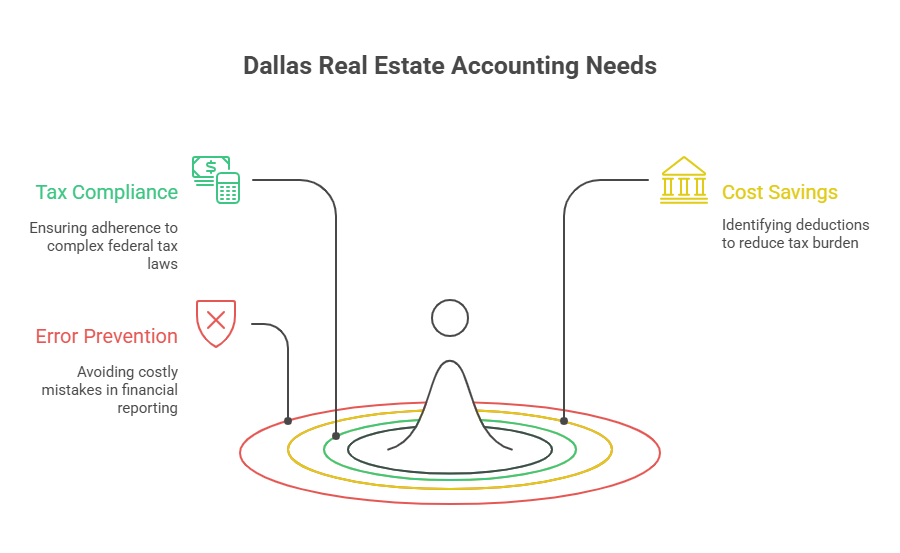
Real estate taxation in Dallas differs dramatically from other industries. Texas has no state income tax, but investors face complex federal compliance around depreciation recapture, passive loss limitations, and entity structuring that generic accountants routinely mishandle.
Common mistakes cost Dallas investors $12,000+ per property annually: misclassifying improvements as repairs, failing to maximize depreciation through cost segregation, not documenting real estate professional status properly, and botching 1031 exchanges. A specialized accounting firm handles this complexity while identifying deductions that save 30-40% more than self-filing.
Qualified real estate CPAs deliver comprehensive strategies beyond basic tax prep. Tax planning services include optimizing Schedule E filing, advising on entity structure (LLC, S-corp, partnership), implementing strategic tax planning approaches that reduce overall burden, and handling multi-state compliance.
Cost segregation studies represent one of the most powerful strategies available. Standard depreciation spans 39 years (commercial) or 27.5 years (residential). Cost segregation reclassifies 25-40% of components into 5, 7, or 15-year categories. For a $3 million Dallas commercial property, this generates $120,000-180,000 in additional first-year deductions, worth $30,000-45,000 in immediate tax savings.
1031 exchange facilitation enables investors to defer capital gains when selling properties. With Dallas appreciation averaging 8-12% annually, a properly executed 1031 on a $1.5 million sale defers $150,000-200,000 in capital gains taxes. Your CPA coordinates with qualified intermediaries, ensures 45/180-day compliance, and structures replacement acquisitions optimally.
Real estate professional status qualification unlocks significant advantages. With 750+ hours annually in real estate activities, you can deduct unlimited rental losses against other income, bypassing the $25,000 passive loss limitation. Your Dallas CPA documents qualifying hours and defends status during audits.
Entity structure dramatically impacts tax liability. Single-member LLCs provide liability protection with pass-through taxation, ideal for investors with 1-5 properties under $150,000 net income. Partnerships and multi-member LLCs suit investors pooling resources, offering flexible profit distribution.
S-corporations benefit active real estate professionals (agents, brokers, flippers) with significant income. Taking reasonable salary and distributing remaining profits as dividends avoids 15.3% self-employment tax. For a Dallas realtor earning $200,000, proper S-corp structuring saves $18,000-25,000 annually.
Your Dallas CPA should analyze property types, income levels, and growth plans to recommend optimal structure based on your specific situation.
No state income tax means investors avoid 9-13% state-level taxation on rental income and capital gains, a massive advantage. However, Dallas businesses must navigate franchise tax for entities with revenue exceeding $2.47 million annually.
Property tax optimization represents significant opportunity. Dallas County property taxes average 2.0-2.3%, among Texas's highest. CPAs coordinate with consultants to file protests and reduce assessments. For a $2 million property, reducing assessed value by 15% saves $6,000-7,000 annually. Dallas opportunity zones offer additional benefits through Qualified Opportunity Funds, deferring and potentially eliminating portions of capital gains taxes.
Combining cost segregation with bonus depreciation creates powerful first-year deductions. Current tax law provides 60% bonus depreciation in 2024 (40% in 2025). A $4 million Dallas apartment with cost segregation might generate $500,000 in accelerated depreciation, worth $125,000-150,000 in tax savings for immediate reinvestment.
Strategic 1031 exchanges into Delaware Statutory Trusts allow passive investors to defer gains while diversifying into institutional-grade properties without management headaches. Real estate professional status combined with short-term rentals (average stays under 7 days) unlocks exceptional benefits, properties with substantial services aren't subject to passive loss limitations, letting you deduct unlimited losses against W-2 income.
Understanding depreciation rules and bonus deduction opportunities on equipment and furnishings further enhances tax savings for furnished rentals and real estate offices.
Look for CPAs with proven real estate experience (5-8 client references), knowledge of cost segregation and 1031 exchanges, and familiarity with Texas franchise tax. Many top firms leverage outsourced accounting teams for competitive pricing.
Essential questions: How many real estate clients do you serve? What's your cost segregation and 1031 experience? Can you document real estate professional status for audits? How do you stay current with tax law? What's your proactive planning process?
Avoid CPAs offering one-size-fits-all advice, lacking advanced strategy knowledge, unable to provide audit representation, or charging suspiciously low fees. Pricing ranges from $1,500-3,500 (1-5 properties) to $4,000-8,000 (6-15 properties) to $10,000-25,000+ (large portfolios). Quality services deliver 3-5x ROI through identified savings.
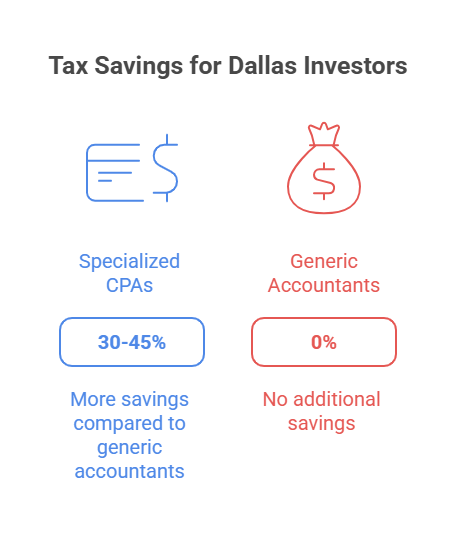
Dallas investors working with specialized CPAs consistently save 30-45% more compared to generic accountants.
Typical scenario: A $2.5 million Dallas commercial building generating $180,000 net income before depreciation. Standard depreciation ($64,000) creates $116,000 taxable income and a $40,000-45,000 tax bill.
With a specialized firm, you implement a cost segregation study ($6,500) that reclassifies $900,000 into accelerated categories, generating an additional $90,000 in first-year depreciation. Combined with proper entity structuring and maximized deductions, taxable income drops to $15,000-25,000. Tax liability falls to $8,000-12,000, saving $28,000-37,000 in year one. Cost segregation benefits continue 5-7 years, creating $85,000-120,000 in cumulative savings.
1031 exchange execution provides even more dramatic results. On a $3 million sale with $1.2 million in gains, proper 1031 execution defers $300,000-360,000 in federal capital gains taxes, capital that stays invested and compounds wealth.
Hire immediately when you've acquired your first investment property, are planning a sale and want 1031 exchange options, own 3+ properties and spend excessive time on compliance, face an IRS audit, or generate significant income but are uncertain about maximizing tax benefits.
Year-round advisory generates superior results. Your Dallas CPA should provide quarterly strategy sessions, advise on timing of improvements for maximum benefit, calculate estimated payments, and adjust strategies based on tax law changes.
Smaller portfolios (1-5 properties) cost $1,500-3,500 annually. Mid-size investors (6-15 properties) pay $4,000-8,000. Large portfolios run $10,000-25,000+. Specialized firms save clients $15,000-40,000 annually, delivering 3-5x ROI.
Real estate CPAs specialize in cost segregation, 1031 exchanges, depreciation strategies, and entity structuring for investors and developers. Regular CPAs handle general taxation but lack expertise in advanced real estate strategies generating significant savings.
LLCs provide liability protection separating personal assets from property risks. Tax treatment remains pass-through (Schedule E) for single-member LLCs. As portfolios grow beyond 5 properties or generate significant income, discuss sophisticated entity structures with your CPA.
Engineers and CPAs identify building components qualifying for accelerated 5, 7, or 15-year depreciation instead of 39-year schedules. Studies cost $5,000-15,000 and generate $80,000-250,000 in additional first-year deductions depending on property value.
Yes. As an offshore accounting partner to U.S. CPA firms since 2015, Madras Accountancy delivers specialized real estate services, tax preparation, cost segregation coordination, 1031 support, and bookkeeping, at 40% lower costs while maintaining CPA-level quality.
Dallas's dynamic real estate market offers tremendous wealth-building opportunities, but only if you keep more of what you earn. Most investors overpay $10,000-35,000 annually without specialized accounting expertise.
A qualified Dallas real estate accounting firm pays for itself many times over through cost segregation, proper 1031 execution, strategic entity structuring, maximized depreciation, and year-round advisory preventing costly mistakes.
Since 2015, Madras Accountancy has helped U.S. CPA firms and their real estate clients reduce tax liabilities while maintaining full compliance. Our offshore model delivers CPA-quality services at 40% lower costs, without sacrificing expertise or results.
Ready to stop overpaying on real estate taxes? Contact Madras Accountancy today for a consultation on how our specialized services can save you tens of thousands this tax year.

Section 4960's 21% excise tax now reaches far more nonprofit employees. See who is a covered employee in 2026 and what changed.

The Section 45S paid family leave credit is permanent for 2026 with new options. See who qualifies, the amounts, and how to claim it.

Opportunity zones become permanent in 2027 under the One Big Beautiful Bill. See the new deferral, rural bonus, and the 2026 handoff.