


The first month of working with an offshore accounting team is messy. Anyone who tells you implementation will be perfect from day one is either extraordinarily lucky or not telling the truth. Errors will occur. Communication will be imperfect. Review will take longer than you hoped because you are learning what the team can handle and they are learning your standards. The goal of the first ninety days is not perfection. The goal is establishing control through stable workflows, clear review rules, and measurable progress that proves the model can work at scale.
Most firms want speed and quality simultaneously. In practice, these outcomes develop in stages as the offshore team builds competence and the workflow stabilizes.
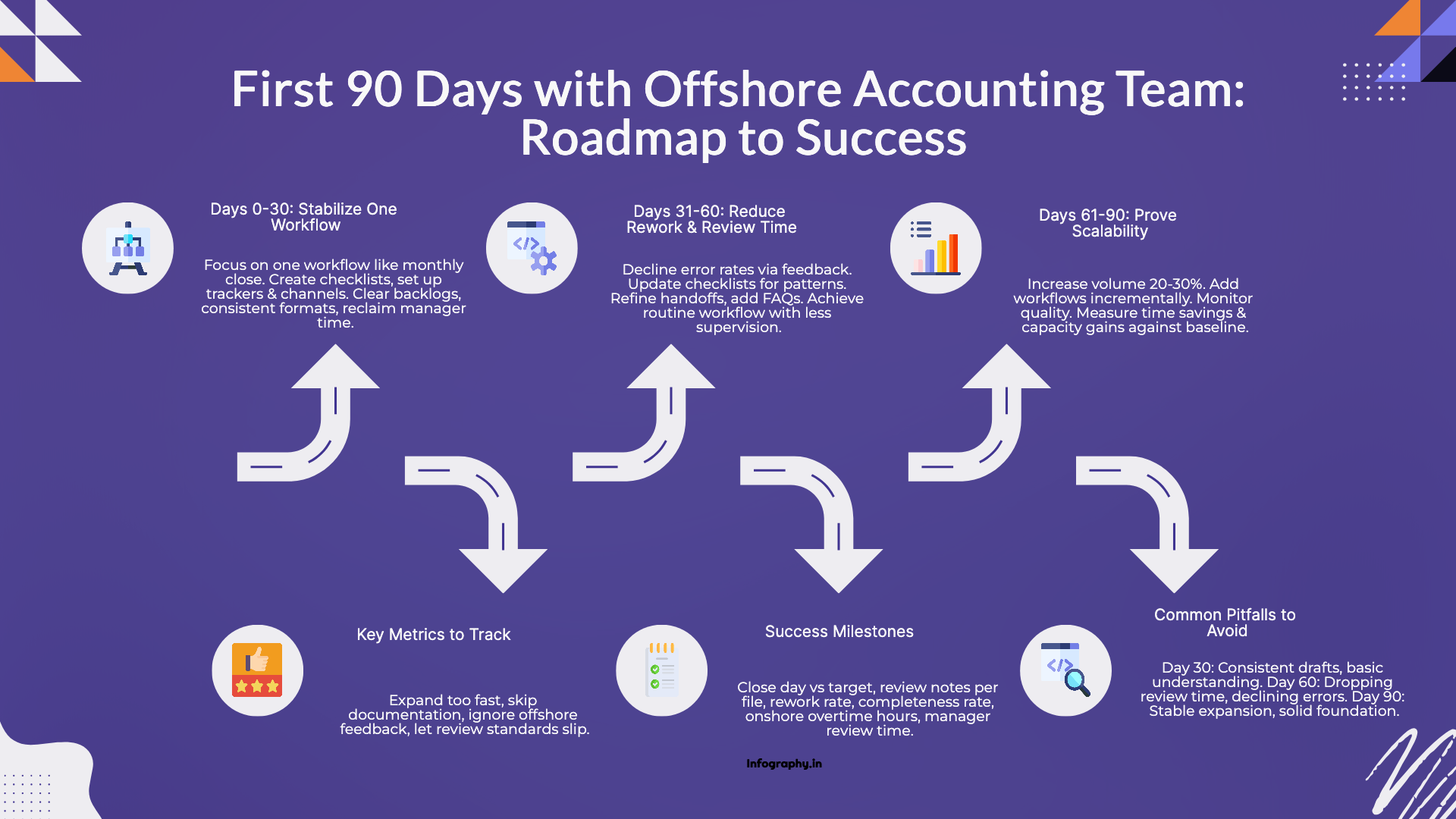
By day thirty, the offshore team should be producing consistent drafts for a defined scope without needing constant clarification. They may not be perfect, but they should demonstrate that they understand the basic workflow, can follow checklists, and know when to escalate questions. If the team is still confused about fundamental procedures after thirty days, something is wrong with training or documentation.
By day sixty, review time should start dropping because drafts arrive in predictable formats with required documentation attached. Reviewers spend less time fixing formatting issues, hunting for missing support, or correcting obvious errors. The offshore team is learning from feedback and applying it to subsequent work. Error rates should be declining measurably.
By day ninety, the firm should be able to expand scope without the whole system becoming unstable. Adding new clients or new workflows should feel incremental rather than starting over from scratch. The foundation is solid enough to build on. If expanding scope at day ninety creates the same chaos as day one, the initial implementation was not properly stabilized.
If you track too many metrics, you effectively track none because the data becomes noise. Pick a few key performance indicators that directly reflect whether the outsourcing relationship is delivering value for the work you delegated.
For close and bookkeeping work, useful metrics include close day achieved relative to target, the number of unreconciled accounts at close that require follow-up, the number of review notes per file as a proxy for quality, and cycle time from bank feed close to first draft financial statements. These metrics reveal whether the offshore team is delivering faster, cleaner work over time.
For tax support, track workpaper package completeness rate to see what percentage of submissions include all required documentation on first attempt. Measure turnaround time from intake packet to first draft to confirm that work is progressing at acceptable speed. Monitor rework rate, which is the percentage of files returned for missing items or errors, as the primary quality indicator.
For capacity and staff impact, track weekly overtime hours for onshore staff to confirm that workload pressure is decreasing. Measure manager review hours per client file to see whether review is becoming more efficient. These people-focused metrics reveal whether the promised benefits to work-life balance are materializing or whether stress has simply shifted without decreasing.
Start with one workflow rather than trying to outsource multiple types of work simultaneously. Monthly close for a set of similar clients is a common starting point because the workflow is recurring, the procedures are documented, and results are visible quickly.
In the first thirty days, focus on establishing basic operational discipline. Write a one-page checklist for the workflow that lists every required step and what done looks like. Define what supporting documentation must be attached to the deliverable and where it should be stored. Set up one workflow tracker for status visibility and one communication channel for questions so information does not scatter across multiple platforms. Run a weekly review meeting where errors and process issues are discussed and the checklist is updated to prevent recurrence.
Quick wins that many firms see in the first thirty days include backlogged reconciliations getting cleared as the offshore team works through accumulated work, financial statements arriving in consistent formats rather than varying by who prepared them, and managers reclaiming evening hours they previously spent hunting for missing documentation or fixing errors.
The second month should show measurable improvement in quality and efficiency. Error rates should decline as the offshore team learns from feedback. Review time per file should decrease as drafts arrive cleaner and more complete. Communication should become more efficient as common questions get answered in updated documentation rather than through repeated explanations.
Focus on identifying patterns in errors and fixing root causes. If multiple files have the same type of error, update the checklist or provide additional training rather than treating each occurrence as an isolated mistake. If review notes repeat across multiple files, add those items to the standard quality criteria so the offshore team knows to check them before submission.
Refine the handoff process based on what causes delays. If tasks frequently stall because inputs are incomplete, tighten the intake requirements and make completeness checks mandatory before assignment. If questions pile up overnight, add FAQ documentation that answers common scenarios.
By the end of sixty days, the workflow should feel more routine than experimental. The offshore team should require less supervision, rework rates should be acceptable, and reviewers should have confidence that submitted work meets baseline standards.
The third month tests whether the workflow can handle expansion. Add clients gradually, increasing volume by 20 to 30 percent. Monitor whether quality holds as volume increases. If error rates climb when volume grows, the team is at capacity and needs additional resources or better processes before further expansion.
Consider adding a second workflow type if the first one is stable. If close work is running smoothly, add tax workpaper preparation or accounts payable processing. The goal is to prove that the operational model can handle multiple workflows without quality degrading. Stacking workflows too quickly creates chaos. Adding them incrementally after proving stability creates sustainable growth.
Measure time savings and capacity gains against the initial baseline. Are managers actually spending less time on cleanup? Is review happening faster? Has close day improved? If the metrics show improvement, document the success and use it to justify further investment. If the metrics are flat or declining, diagnose the problem before expanding.
Expanding scope too quickly before the foundation is solid creates cascading quality issues. Resist the temptation to hand off everything at once. Incremental expansion is slower but more sustainable.
Skipping documentation because you are in a hurry to start producing results backfires. The time you save by skipping process documentation gets consumed many times over in rework and repeated explanations. Do the documentation work upfront.
Failing to protect review time and standards as volume increases allows quality to slip. If review becomes cursory because reviewers are overwhelmed, errors reach clients and trust erodes. Maintain review discipline even when it feels like a constraint on growth.
Ignoring feedback from the offshore team about confusing instructions or unclear standards wastes opportunities to improve processes. The offshore team sees your workflows with fresh eyes and often identifies inefficiencies or ambiguities that insiders miss. Listen to their questions and treat them as process improvement opportunities.
The first ninety days establish the foundation for everything that follows. If the foundation is solid, scaling becomes straightforward. If the foundation is shaky, every expansion attempt will be difficult and risky.
Invest the time to build proper checklists, document procedures, establish review rhythms, and measure results honestly. The firms that succeed with outsourcing are not the ones with the best offshore teams. They are the ones with the best processes. Good processes make average teams produce great work. Weak processes make even talented teams produce inconsistent results.
By day ninety, you should know whether the outsourcing relationship will work long-term. If quality is improving, communication is efficient, and capacity is expanding, scale with confidence. If these indicators are not present, address the gaps before investing more resources. The first ninety days are the proving ground. Use them to build a foundation that can support sustainable growth.

Section 4960's 21% excise tax now reaches far more nonprofit employees. See who is a covered employee in 2026 and what changed.

The Section 45S paid family leave credit is permanent for 2026 with new options. See who qualifies, the amounts, and how to claim it.

Opportunity zones become permanent in 2027 under the One Big Beautiful Bill. See the new deferral, rural bonus, and the 2026 handoff.