

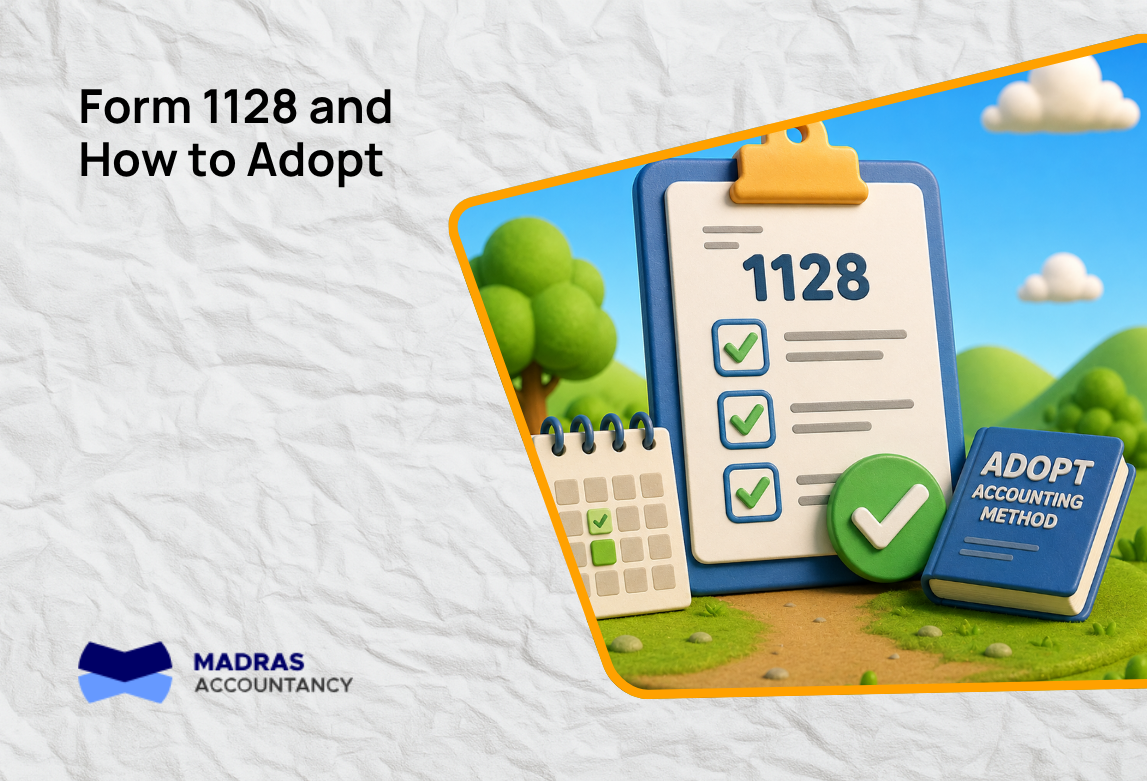

Form 1128, Application To Adopt, Change, or Retain a Tax Year, is how you ask the Internal Revenue Service for permission to use a specific annual accounting period. Section 442 of the Internal Revenue Code says approval is required before you settle on one. Part II of the form covers automatic approval, which is free. Part III is a letter ruling request, which takes longer and carries a user fee.
Most people who land here are in one of two spots. Either they picked a year-end that turned out to be wrong for their entity type, or they want one that matches how the business actually runs. Both are fixable. The trick is knowing which lane you are in before you fill anything out.
Your tax year is the annual accounting period you use to keep records and report income. There are three shapes it can take.
A calendar year runs the 12 consecutive months ending December 31. A fiscal year ends on the last day of any month except December. A 52-53-week tax year always ends on the same day of the week, so its length varies from 52 to 53 weeks, closing either on the last time that weekday falls in a month or on the date nearest the end of that calendar month.
Retailers like the 52-53-week version because it keeps comparable weeks in comparable periods. A seasonal business usually wants a close that lands after the rush, not inside it. Closing your books when the warehouse is empty and the receivables are in produces cleaner financial statements than closing during peak week.
This is the step a lot of new entities can skip entirely. A newly formed entity generally adopts its first tax year by filing its first federal income tax return using that year. No application, no approval, no fee. A new corporation, an estate, and a partnership taking its required year all sit outside the requirement.
Incorporate in March, want to close on September 30, and you may get it by filing that first return and nothing else. The freedom only exists once, though, and only for entities that have flexibility in choosing. Founders sorting out their early accounting setup should settle this before that return goes out, because undoing it later costs a stub-year filing and a form.
Outside that first-year exception, taxpayers must file Form 1128 to change their annual accounting period. That covers a company moving from a fiscal to a calendar year, a partnership that wants to keep a year other than its required one, a PSC asking to keep the year it already uses, and a trust moving to a new one.
Two structural notes. When a group files a consolidated return, the common parent files one application for the whole group rather than one per member. And tax-exempt organizations often have a lighter path, though the ones that changed recently or report unrelated business income usually cannot skip it. If you are still standing up the entity, the exemption application comes first, and our walkthrough of Form 1023-EZ covers that step. Part I asks for the applicant's name, address, and identification number, and every filer completes it.
Some entities do not get a free pick. A partnership generally uses the year of its majority-interest partners, then its principal partners, then the year producing the least aggregate deferral of income. An S corporation and a personal service corporation generally use a calendar year. Those defaults exist so income cannot be parked in whichever period suits the owners.
You can move off the required tax year with a reason the IRS accepts. The cleanest is a natural business year, proven with a gross receipts test showing that a large share of revenue lands in the same two months every year across a 47-month lookback. Shareholder convenience does not qualify. If you are electing S status and picking a close date in the same stretch of work, both land on the Form 2553 election, which has its own section on the tax year question.
Part II is where you want to be. Corporations use Rev. Proc. 2006-45. Partnerships, S corporations, PSCs, and many trusts use Rev. Proc. 2006-46. Individuals moving to a calendar year have their own route. Nobody is evaluating your business judgment here, only checking that you fit the box, and there is no fee.
The boxes have edges. A company that already made a change in tax year within the past 48 months usually cannot use Part II again. Certain net operating loss and credit carryover situations rule you out too. An entity in the middle of a classification change, like one filing Form 8832, has to sequence the two carefully.
Miss those criteria and you move to Part III, handled by the IRS National Office. A user fee is required, the amount resets every year in the first revenue procedure of the year, and receipt is acknowledged within about 45 days. Check the current instructions for Form 1128 before you write the check, since last year's number will be stale.
For Part II, file by the deadline for the short period return, extensions included. That deadline is generous and people still miss it.
Ruling requests run tighter: the deadline for the return covering the first effective year, with no extensions counted. Tax-exempt organizations generally get until the 15th day of the 5th calendar month after the short period ends.
Addresses differ by part, and mixing them up will stall you. Part II goes to the IRS service center where you file your return, marked Attention: Entity Control. Part III goes to the Associate Chief Counsel, Income Tax and Accounting, in Washington, DC. A late filing made within 90 days can still be treated as timely if you show you acted reasonably and in good faith and that relief will not prejudice the government.
Changing your tax year creates a gap, and the gap gets its own return. Move from December 31 to June 30 and you file a short period tax return covering January 1 through June 30, then start the new cycle on July 1.
You also attach a copy of the application to that return. When it is e-filed, the copy rides along as an attachment while the standalone request still goes to the service center on paper. Stub years compress every closing task into a few months, so books that are already clean going in cost less to work through than books rebuilt after the fact.
These get confused constantly. One is a request for approval of your annual accounting period. Form 8716 is a section 444 election that lets a partnership, S corporation, or PSC use a fiscal year with a limited deferral period without asking permission, in exchange for required payments or distribution limits.
Different timing, different consequences. Filing one when you needed the other is a common and expensive mix-up, so confirm which mechanism your facts call for before anything gets mailed. That is a good question to put in front of a preparer who runs the 1040, 1065, and 1120 workflow every season.
What is Form 1128 used for? It is the application to adopt, change, or retain a tax year. You file it to get IRS approval for the annual accounting period you plan to use.
Who must file Form 1128? Corporations, partnerships, S corporations, PSCs, trusts, and individuals changing their accounting period generally must. The main exception is an entity adopting its first year, which does so by filing its first return using that year.
Is there a user fee? Part II requests carry none. Part III ruling requests do, and the amount changes annually, so check the current instructions rather than a figure you saw last year.
What is the due date for Form 1128? Part II is due when the short period return is due, extensions included. Part III is due when the return for the first effective year is due, without extensions.
Can I file late? Sometimes. A filing made within 90 days after the deadline may be treated as timely if you establish that you acted reasonably and in good faith and that relief will not harm the government's interests.
What is a 52-53-week tax year? It ends on the same day of the week rather than the same date, so it varies from 52 to 53 weeks. Companies switching to or from one often qualify under Part II.
Does a new corporation need approval to pick its first year? Usually not. It adopts by filing its first income tax return using that year. Approval becomes necessary later, when it wants to change.
Can the form be e-filed? The copy attached to your short period return goes in as an attachment to that e-filed return. The request itself is filed on paper, either with the service center or the National Office.
Getting the year-end right the first time is cheaper than fixing it, and the fix always costs a stub-year filing plus a form. If you are weighing a change, we support US CPA firms through outsourced tax preparation, including the extra return a switch creates.
The 2026 1099 reporting threshold changed: 1099-NEC and 1099-MISC now start at $2,000, and 1099-K is back to $20,000. Here is what you must file.
A plain guide to how a 2026 sales tax holiday works, which items are exempt, and the rules on price caps, refunds, and rain checks.
Form 7004 buys a 6-month extension of time to file business returns like 1065, 1120-S and 1120. Deadlines, e-file steps and the payment trap.



