



You have decided to close your corporation. The board signed the paperwork, the deal is done, and it finally feels like the hard part is behind you. Here is the twist most owners do not see coming. The moment your corporation adopts a plan to dissolve or liquidate, a 30-day clock starts ticking with the IRS, and that clock is Form 966.
Miss it and you leave a loose end that can follow the business for years. So let us keep this simple. This guide covers what Form 966 is, who has to file Form 966, the 30-day deadline, and how the form fits with the rest of dissolving or liquidating your company in 2026.
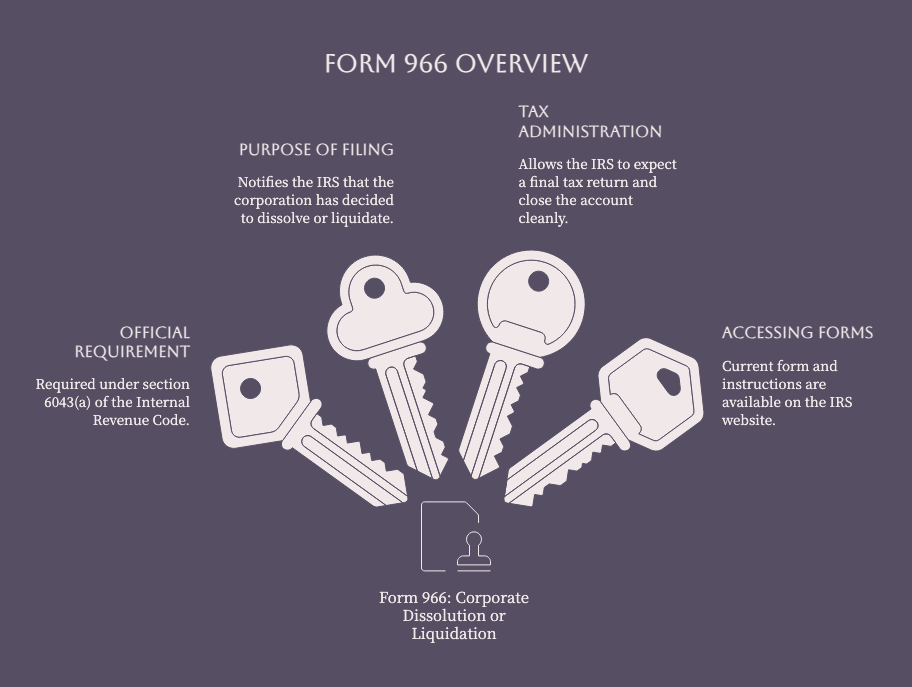
Form 966, officially titled Corporate Dissolution or Liquidation, is the notice a corporation files with the IRS after it adopts a resolution or plan to dissolve the corporation or liquidate any of its stock. It is required under section 6043(a) of the Internal Revenue Code.
The purpose of Form 966 is straightforward. It exists to notify the IRS that your corporation has decided to dissolve or liquidate, so the Internal Revenue Service can expect your final tax return and close out the corporation's account cleanly. In plain terms, Form 966 is how you inform the IRS that the company is winding down. You can pull the current form and instructions straight from the IRS website.
Not every business that closes files this form. Form 966 is a corporate filing. That means domestic C corporations and S corporations, along with LLCs taxed as corporations and farmers' cooperatives. If any of these adopt a plan to dissolve the corporation or liquidate any of its stock, they are required to file Form 966.
A few closures do not need it. Sole proprietorships and partnerships do not file Form 966. Tax-exempt organizations do not use it either, and neither do qualified subchapter S subsidiaries or deemed liquidations, such as one triggered by a section 338 election. If you are unsure whether your closure counts, that is a good moment to confirm with a tax professional before submitting Form 966.
Here is the rule that catches most people. Form 966 must be filed within 30 days after the corporation adopts the resolution or plan to dissolve or liquidate. The countdown runs from the adoption date, not from the day you stop operating, not from when you file your state dissolution papers, and not from your final distribution of assets or your date of dissolution.
So if your directors or shareholders sign the resolution on the 3rd, the form is due 30 days after that adoption. Keep your minutes and voting records, because the adoption of the plan is what sets the date.
One more piece people forget. If you later amend or supplement the plan, you file another Form 966 within 30 days of adopting that change. A single amendment can mean a second filing, so treat every change to the plan as its own 30-day trigger.
Filling it out is not complicated once you have your records together. The required information on Form 966 includes the corporation's name, its employer identification number (EIN), address, the state where the corporation was incorporated, the date it was incorporated, the type of liquidation (complete or partial), the date the resolution or plan was adopted, and the Internal Revenue Code section that applies, usually section 331 for a complete liquidation or section 332 for an 80 percent subsidiary liquidation.
Attach a certified copy of the resolution or plan to dissolve or liquidate. Make sure the form is properly signed by an authorized officer of the corporation, such as the president or treasurer. Then you mail it. Form 966 is filed with the IRS service center where the corporation files its income tax return, the same place you send Form 1120. Confirm the current address in the Form 1120 or 1120-S instructions before submitting Form 966, since service center addresses change.
Filing the form does not finish the job. Notifying the IRS is one piece of a longer dissolution or liquidation process, and skipping the rest leaves the closure half done.
You still file a final income tax return. For a C corporation that is a final Form 1120, and for an S corporation a final Form 1120-S, each with the final return box checked and due based on your short tax year. If you sold business property on the way out, those sales usually get reported on Form 4797. Then there are final payroll and employment tax returns, the distribution of assets to shareholders, and closing your EIN account with the IRS. State dissolution is a separate track entirely, handled through your state, not the IRS. Getting all of these to line up is what actually finishes dissolving or liquidating the corporation.
Plenty of owners assume that if they closed the doors, the IRS will figure it out. It does not work that way. Failing to file Form 966 may lead to penalties, and it can leave open issues with the IRS, because the agency still shows an active corporation that never formally reported its plan to dissolve or liquidate. Late or incomplete filings may result in penalties too.
More practically, an unfiled Form 966 leaves your corporate tax file open, which can complicate the final return and your overall tax obligations. Filing on time is the cleanest way to comply with the requirements and ensure compliance with tax rules as you wind down.
What is Form 966 used for?
Form 966, Corporate Dissolution or Liquidation, is used to notify the IRS that a corporation has adopted a resolution or plan to dissolve the corporation or liquidate any of its stock. It is filed under Internal Revenue Code section 6043(a) and helps the IRS track the final return.
When must Form 966 be filed?
Form 966 must be filed within 30 days after the corporation adopts the resolution or plan to dissolve or liquidate. The 30 days run from the adoption date, not from when operations stop. Amending the plan triggers another Form 966 within 30 days.
Who is required to file Form 966?
C corporations and S corporations, plus LLCs taxed as corporations and farmers' cooperatives, are required to file Form 966 when they decide to dissolve or liquidate. Sole proprietorships, partnerships, and tax-exempt organizations do not file it.
Do I file Form 966 for an LLC?
Only if the LLC is taxed as a corporation. A single-member or partnership-taxed LLC does not file Form 966. An LLC that elected corporate tax treatment and then decides to dissolve or liquidate does file it.
Where do I file Form 966?
You mail Form 966 to the IRS service center where the corporation files its income tax return, the same center that receives your Form 1120 or 1120-S. Confirm the current address in those instructions before submitting Form 966.
What do I attach to Form 966?
Attach a certified copy of the resolution or plan to dissolve or liquidate. Make sure the form is properly signed by an authorized officer of the corporation, and include the required information such as the EIN and the date the plan was adopted.
What happens if I do not file Form 966?
Not filing may lead to penalties and leaves open issues with the IRS, since the corporation still appears active. It can also complicate your final income tax return, so filing on time keeps you in compliance with tax rules.
Is Form 966 the same as my final tax return?
No. Form 966 notifies the IRS of the decision to dissolve or liquidate. Your final tax return, a final Form 1120 or 1120-S with the final return box checked, is a separate filing. You need both to close cleanly.
Closing a corporation cleanly is mostly about timing and sequence, filing Form 966 within 30 days, lining up the final income tax return, and clearing every last tax obligation before the entity goes dark. That is the work Madras Accountancy does for US CPA firms, handling corporate dissolution or liquidation filings and final returns end to end, backed by full-cycle accounting and bookkeeping support. You can reach out here.
This is general information, not tax advice, so confirm the specifics for any client with their preparer.
Section 4960's 21% excise tax now reaches far more nonprofit employees. See who is a covered employee in 2026 and what changed.

The Section 45S paid family leave credit is permanent for 2026 with new options. See who qualifies, the amounts, and how to claim it.

Opportunity zones become permanent in 2027 under the One Big Beautiful Bill. See the new deferral, rural bonus, and the 2026 handoff.



