

A fractional CFO for dental practices is a part-time finance lead who turns your production, collections and overhead numbers into decisions on hiring, equipment, owner pay and tax. A typical engagement runs a few days a month, which suits single-office and small group practices that do not need a full-time CFO.
This guide covers what a fractional CFO for dental practices should own, the dental KPIs worth reviewing every month, the entity and tax rules that changed for 2026, and how to tell whether your practice is ready for this level of support.
A fractional CFO works for several clients at once and gives each one a set number of hours or days. Your bookkeeper records transactions and your tax preparer files returns. The CFO sits above both and answers forward-looking questions: whether the practice can carry another associate, what a new CBCT unit does to cash for the next 12 months, and how much the owner can safely draw.
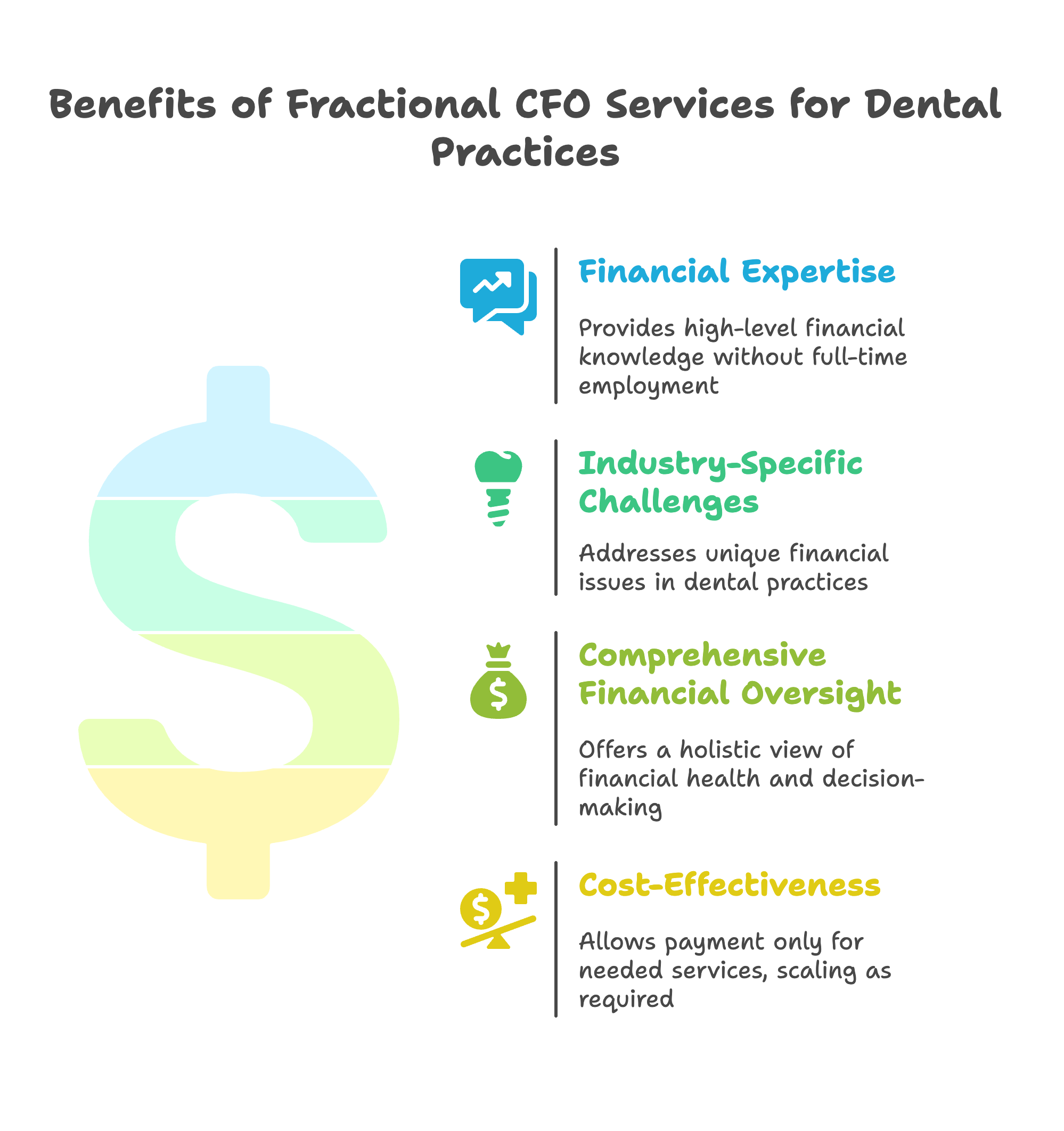
For a dental office, the work usually falls into four areas:
Dental owners carry this load on top of clinical work. The Bureau of Labor Statistics notes that "Some dentists have their own business and work alone or with a small staff," while "Other dentists have partners in their practice" (BLS Occupational Outlook Handbook). In private practice the dentist also handles administrative tasks such as bookkeeping and buying equipment, which is the gap a part-time CFO is meant to fill.
The broader medical side of this work, including physician groups and revenue cycle issues, is covered in our guide to a fractional CFO for healthcare and medical practices. This page stays with the problems specific to dental offices.
Production alone hides most of what matters. A dental CFO pack separates gross production, contractual adjustments and actual cash, then tracks costs against what was collected. For a fuller list of practice metrics, see our article on dental practice financial management.
The three numbers that drive most conversations are listed below.
Collection ratio. Collections divided by net production (gross production less PPO and other contractual write-offs). A falling ratio points to claim denials, slow patient balances or write-offs that were never approved.
Overhead ratio. Operating expenses, excluding the owner dentist's compensation and debt principal, divided by collections. Measuring against collections instead of production keeps write-offs from flattering the figure.
Hygiene production share. Hygiene department production divided by total gross production. It shows how much of the schedule comes from recall and periodontal maintenance, which matters when deciding whether to add a hygienist or hygiene days.
Beyond these, a CFO will usually watch accounts receivable over 90 days by payer, new patient count, case acceptance on treatment plans over a set dollar amount, and associate compensation as a share of the associate's own collections.
The figures below are illustrative for a single-location practice.
| Line | Amount |
|---|---|
| Gross production | $180,000 |
| PPO and other contractual adjustments | $36,000 |
| Net production | $144,000 |
| Collections | $139,680 |
| Operating expenses (excluding owner pay and loan principal) | $90,792 |
| Hygiene production | $45,000 |
| Collection ratio ($139,680 / $144,000) | 97.0% |
| Overhead ratio ($90,792 / $139,680) | 65.0% |
| Hygiene share ($45,000 / $180,000) | 25.0% |
A CFO reads these against the practice's own prior 12 months first. If the collection ratio slips from 97% to 92% while production holds steady, the problem is in billing and follow-up. If overhead rises while collections are flat, the review moves to staffing hours, supply spend and lab fees.
Dental cash flow has a timing gap built in. Treatment happens today, insurance pays weeks later and patient balances arrive later still, while payroll runs every two weeks. A CFO builds a forecast that schedules expected insurance receipts by payer from the practice's own payment history, so the owner can see a tight month coming before it arrives.
Equipment is the other large swing. Intraoral scanners, CBCT imaging, chairs and milling units are expensive, and the question is whether added production covers the payment. A CFO models the extra procedures needed per month to break even, the financing cost and the tax effect, then compares that against leasing or delaying the purchase.
Dental practices cannot always use the same entities as other small businesses. Many states regulate who may own a practice that delivers professional services, and many require a professional corporation (PC) or professional limited liability company (PLLC).
Florida is a useful example. Its professional service statute lists "dentists" and "doctors of dentistry" among the professions covered, and it limits membership in a professional LLC to licensed individuals and other professional entities (Florida Statutes, Chapter 621). The same chapter makes each professional "personally liable and accountable only for negligent or wrongful acts or misconduct committed by that person" or by someone under that person's direct supervision and control. In practice, the entity limits a dentist's exposure to a colleague's errors and leaves each dentist answerable for their own clinical work. Rules differ by state, so the dental board and state corporate statute both need checking before forming or converting an entity.
Tax treatment is a separate decision from the state form. A PC or PLLC can often elect S corporation status, which splits the owner's income into W-2 salary and pass-through profit. The IRS expects that salary to be reasonable for the work performed, and our guide to reasonable compensation for S corp owners explains how it is set. For dentists, one reference point is BLS wage data: "The median annual wage for dentists was $176,110 in May 2025" (BLS). Local market pay, hours worked and specialty all move the right figure up or down, so a CFO documents the basis each year.
Many states also offer a pass-through entity tax election, which can move state income tax to the entity level. A CFO models the S corporation, state election and salary together, since each one changes the others.
The qualified business income deduction lets eligible owners deduct up to 20 percent of qualified business income from a pass-through business (IRS). Rev. Proc. 2025-32 notes that the One Big Beautiful Bill Act added a $400 minimum deduction, with at least $1,000 of qualified business income required, for taxable years beginning after December 31, 2025.
Dentistry is a specified service trade or business (SSTB). The Treasury regulation defines services in the field of health as "the provision of medical services by individuals such as physicians, pharmacists, nurses, dentists, veterinarians," and similar professionals (26 CFR 1.199A-5). Once an owner's taxable income passes the threshold, the deduction from an SSTB shrinks and then disappears.
For taxable years beginning in 2026, Rev. Proc. 2025-32 sets these figures (IRS Rev. Proc. 2025-32):
| Filing status | Threshold | Deduction fully phased out at |
|---|---|---|
| Married filing jointly | $403,500 | $553,500 |
| Married filing separately | $201,775 | $276,775 |
| All other returns | $201,750 | $276,750 |
Assume $300,000 of qualified business income after the owner's reasonable salary, and $500,000 of total W-2 wages paid by the practice. The wage limit does not bind in any of the three cases.
| Taxable income (MFJ) | Share of QBI that counts | Deduction |
|---|---|---|
| $380,000 (below threshold) | 100% | $60,000 |
| $478,500 (halfway through range) | 50% | $30,000 |
| $560,000 (above range) | 0% | $0 |
At $478,500, the owner is $75,000 into the $150,000 phase-in range, so only half of the QBI counts: $300,000 x 50% x 20% = $30,000. The overall cap of 20% of taxable income ($95,700) is higher, so it does not reduce the result. The planning point for a dental CFO is that retirement plan contributions, salary level and equipment timing can move taxable income within or below this range. Our 199A deduction guide walks through the full calculation, including the wage and property limits.
Dental chairs, imaging systems, scanners, sterilization equipment and practice software generally count as depreciable business property. Under Rev. Proc. 2025-32, for taxable years beginning in 2026 the §179 expense election "cannot exceed $2,560,000," and that limit is reduced by the amount by which §179 property placed in service during the year exceeds $4,090,000 (IRS Rev. Proc. 2025-32). Few single practices come near the reduction point, though a group buying several offices' worth of equipment in one year should check it.
The §179 deduction cannot exceed taxable income "derived from the active conduct by the taxpayer of any trade or business" for the year (26 U.S.C. §179(b)(3)), while bonus depreciation has no such income limit. The One Big Beautiful Bill Act restored permanent 100% bonus depreciation for qualifying property, and our article on Notice 2026-11 and permanent bonus depreciation covers the transition dates. A CFO's role here is timing. Writing off a large purchase in a year when income is already below the §199A threshold may give less value than spreading the deduction, while a high-income year may favor the full write-off. State conformity to federal depreciation also varies.
Many practices start with clean books and a reliable close before adding CFO hours. If the general ledger is behind, the monthly KPI pack will be wrong. Our implementation guide to outsourced accounting for dental and medical practices covers that groundwork, and the broader medical practice accounting services page explains what a specialist bookkeeping and tax team handles.
A fractional CFO tends to make sense when one or more of these apply:
Fees depend on hours, the number of locations and how much reporting work is included. Our breakdown of fractional CFO rates by industry in 2026 shows how engagements are usually priced. Location matters less than dental experience, since most of the work is remote. A practice owner comparing local options can read how engagements are scoped for fractional CFO services in Dallas-Fort Worth or fractional CFO services in Chicago, and the same scope applies to a dental client.
Ask which practice management systems the CFO has pulled reports from, and how they reconcile production reports to deposits. Ask to see a sample monthly pack with the collection, overhead and hygiene figures defined. Ask how they coordinate with your CPA on entity elections and equipment timing, and who owns the tax return. Ask how they would evaluate an associate hire or DSO letter of intent, including the assumptions they would test.
The answers should show the CFO understands insurance adjustments, state ownership rules for dental entities and the SSTB limits, since those three areas separate dental work from general small business finance.
What does a fractional CFO for dental practices do that a bookkeeper does not? A bookkeeper records transactions and closes the books. A fractional CFO uses those books to forecast cash, track collections and overhead ratios, model hiring and equipment decisions, and plan owner pay and taxes with the practice's CPA.
Is a dental practice a specified service trade or business for the QBI deduction? Yes. Treasury regulations list dentists among the providers of health services, so dental income is SSTB income. For 2026, a married couple filing jointly starts losing the deduction above $403,500 of taxable income and loses it entirely at $553,500.
Should my dental practice be a PC or a PLLC? It depends on your state. Many states require dental practices to use a professional entity owned by licensed dentists, and the permitted forms differ. Either form can usually elect S corporation tax treatment, which is a separate decision.
How much equipment can a dental practice expense under Section 179 in 2026? Up to $2,560,000 for taxable years beginning in 2026, reduced once total §179 property placed in service during the year passes $4,090,000. The deduction is also limited to taxable income from the active business.
How often does a dental practice meet with a fractional CFO? A monthly review of the KPI pack is common, with additional time around tax planning, financing or a major purchase. The schedule depends on the engagement scope agreed at the start.
Madras Accountancy supports dental practices and the CPA firms that serve them with bookkeeping, month-end close, financial reporting, tax preparation and CFO-level planning support. To discuss what your practice or client base needs, contact our team.

The section 4960 excise tax is 21% of nonprofit pay over $1M. From 2026 it covers all employees. See the medical carve-outs, Form 4720 and a worked example.

The paid family and medical leave tax credit is permanent from 2026. See the 12.5% to 25% rates, the premium option, the 6-month rule and how Form 8994 works.

Opportunity zones become permanent in 2027 under the One Big Beautiful Bill. See the new deferral, rural bonus, and the 2026 handoff.