

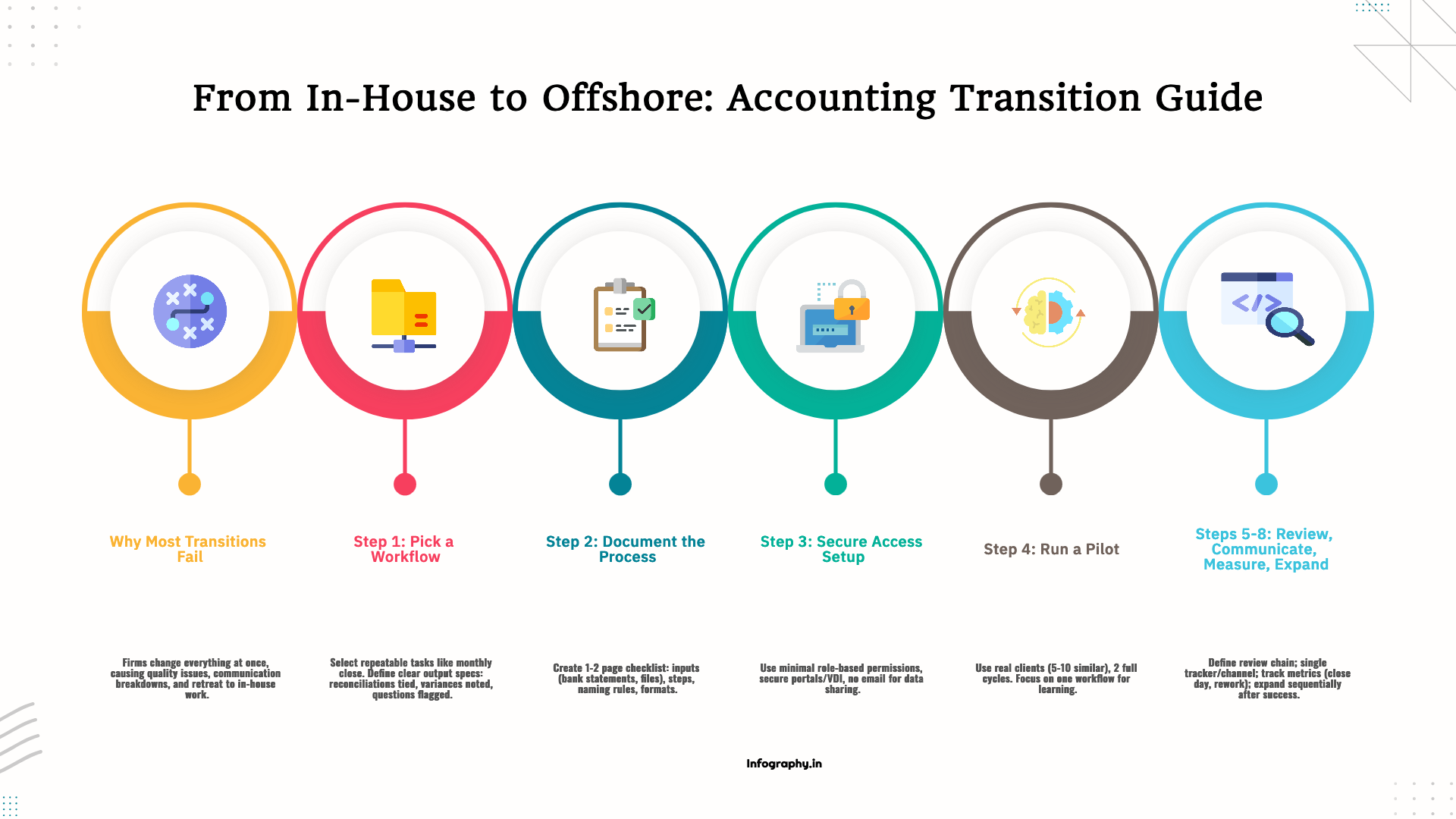

Most transitions from in-house work to offshore support fail for one predictable reason. The firm tries to change everything at once. They hand off multiple workflows simultaneously, disrupt established processes, and expect immediate perfection from a team that is still learning the firm's standards and clients. Within weeks, quality issues emerge, communication breaks down, and the firm retreats to doing everything in-house while declaring that outsourcing does not work.
Successful transitions are boring. They follow a simple playbook: move one repeatable workflow offshore with no disruption to client service, prove the model works, then expand incrementally. This guide assumes that simple goal and provides a step-by-step approach that minimizes risk while building the foundation for sustainable offshore support.
Start with work that has a clear, measurable definition of done. Monthly bookkeeping close is a common starting point because the output is specific. Close must be complete by a target date, reconciliations must tie out to bank statements, variance explanations must be documented, and questions must be flagged for onshore resolution.
Write down the output specification. An example might be: monthly close complete by day ten with all bank and credit card accounts reconciled to statement end date, accounts payable and accounts receivable aging tied to general ledger balances, variance notes drafted for significant changes from prior month, and any unresolved questions flagged in the tracker for manager review.
This written specification becomes the acceptance criteria. If the offshore team delivers work that meets the specification, it passes review. If it does not, it gets returned for correction. The clarity prevents arguments about whether work is good enough and creates objective standards that both teams understand.
Process documentation does not need to be a forty-page standard operating procedure manual. A one or two-page checklist is sufficient for most workflows. What matters is capturing the essential steps, inputs, decision points, and quality checks in a format the offshore team can follow without constant guidance.
List what inputs are needed to start the work. For monthly close, this includes bank statements, transaction files from accounting software, prior month close notes, and client communication about unusual items. Define where files are stored, whether in cloud folders, accounting software, or document management systems. Specify naming rules so files can be located consistently. Document what supporting documentation must be attached to each deliverable and in what format.
This documentation forces clarity about how work actually gets done today. Many firms discover during this step that their current process is inconsistent or exists only in the heads of experienced staff. Documenting for offshore transfer improves consistency for the entire team, not just the offshore workers.
Security setup must happen before any client data is shared. Use the minimum access necessary for the assigned work. If the offshore team is working on close for ten clients, they should have access to those ten client files, not to your entire client base. Role-based permissions and least privilege access limit exposure.
Use a secure portal for document exchange rather than email. Encrypted portals with activity logging provide security and auditability that email cannot match. If the provider offers virtual desktop infrastructure, use it. VDI prevents local downloads and ensures work happens in a controlled environment.
Do not take shortcuts on security setup because you want to start fast. Moving fast on security creates risks that can damage client relationships and create regulatory problems. Set it up correctly from the beginning.
The pilot should use real clients and real deadlines. Theoretical demonstrations and practice assignments do not reveal how the workflow will perform under actual conditions. Real work exposes gaps in documentation, communication issues, and quality problems that need to be addressed.
Pick five to ten clients with similar workflows and complexity levels. Similarity makes training more efficient because the offshore team is learning one pattern rather than ten different variations. Keep the scope tight. If you are piloting monthly close, do not add tax preparation or audit support at the same time. Focus creates learning.
Run the pilot for at least two full cycles of the workflow. For monthly close, that means two months. One cycle is not sufficient to distinguish between first-time confusion and systemic problems. Two cycles show whether the offshore team is learning and improving or whether the same errors keep recurring.
Clarity about who reviews what prevents quality lapses and accountability confusion. Write down the review chain. Offshore staff draft and prepare work. Onshore senior accountants review for accuracy, completeness, and compliance with firm standards. Managers handle exceptions that require judgment or client interaction. Partners perform final sign-off before client delivery.
This layered review ensures that work is checked multiple times and that professional judgment is applied by licensed, experienced staff. It also creates clear accountability. If something goes wrong, the review chain shows where the breakdown occurred and who was responsible for catching it.
Review confusion is expensive. It leads to duplicate work when multiple people review the same file, missed errors when everyone assumes someone else is checking, and frustration when staff do not know whether their review is sufficient or whether additional checks are needed.
Communication must be structured to work across time zones and prevent information from scattering across multiple channels. Use one workflow tracker for status visibility. Everyone updates the same tracker in real time, so work status is always current without needing to send status inquiry emails.
Use one designated channel for questions, whether that is a Slack channel, email address, or tracker comment field. Questions should not scatter across personal email, text messages, and chat platforms where they can get lost or overlooked.
Schedule communication cadence. During the pilot, a daily check-in helps surface issues quickly. After the workflow stabilizes, weekly meetings are usually sufficient. Keep meetings short and focused on exceptions rather than reading the tracker aloud. If the tracker is working properly, status updates do not need to be discussed in meetings.
Pick a few key metrics that reveal whether the transition is delivering value. Close day achieved shows whether the workflow is actually faster. Rework rate indicates quality. Hours saved for seniors and managers reveals whether capacity is actually being freed. Turnaround time per task measures efficiency.
Track these metrics weekly during the pilot. If they improve, the model is working. If they stay flat or decline, something needs adjustment before expansion.
Once the first workflow is stable with acceptable quality and efficiency, add the next workflow. Accounts payable support, tax workpaper preparation, and financial statement drafting are common second steps. Do not stack workflows before the first one is proven. Sequential expansion creates sustainable growth. Simultaneous expansion creates chaos.
Many firms can complete their first offshore close within thirty days if preparation is thorough. Week one focuses on defining scope, creating checklists, and setting up secure access. Week two begins pilot work with real clients. Week three delivers the first full close cycle with review and feedback. Week four refines procedures and expands the client set if results are acceptable.
This timeline assumes the firm invests upfront in documentation and does not try to shortcut security setup. Rushing creates problems that take months to fix. Moving deliberately creates a foundation that scales efficiently.
If the pilot feels chaotic, do not add more work. That is the signal to pause, tighten the checklist, fix the intake process, and clarify review standards. Expanding scope when the foundation is unstable guarantees failure.
Offshore support can run smoothly and deliver consistent results. It requires a process that is written down, used consistently, and enforced through measurement and feedback. Firms that invest in that structure succeed. Firms that wing it and expect the offshore team to figure it out struggle.

Section 4960's 21% excise tax now reaches far more nonprofit employees. See who is a covered employee in 2026 and what changed.

The Section 45S paid family leave credit is permanent for 2026 with new options. See who qualifies, the amounts, and how to claim it.

Opportunity zones become permanent in 2027 under the One Big Beautiful Bill. See the new deferral, rural bonus, and the 2026 handoff.