

.png)

Online accounting services for real estate provide property owners and managers with dedicated financial management through cloud-based platforms and offshore accounting teams. Most U.S. real estate firms reduce overhead costs by 40-50% while maintaining compliance and gaining real-time access to property-level financials. These services handle bookkeeping, tax planning, financial reporting, and cash flow management for residential, commercial, and multi-family properties.
Real estate professionals face a tough reality in 2025. You're managing multiple properties, tracking rent collections across different platforms, reconciling vendor payments, and preparing investor reports—all while dealing with rising insurance premiums and flat rent growth. The typical property management company loses 15-20 hours weekly on manual data entry and reconciliation tasks.
That's where online accounting services for real estate come in. You get specialized expertise without the $65,000+ annual salary of an in-house accountant, plus the technology infrastructure you need to scale without chaos.
Real estate accounting isn't just regular bookkeeping with properties attached. The industry has unique financial complexities that require specialized knowledge.
Property-specific revenue recognition stands out first. You're tracking income from multiple tenants with different lease terms, managing security deposits as liabilities, and accounting for percentage rent in retail properties. A standard accountant might misclassify these transactions, creating audit headaches down the line.
Depreciation rules for real estate assets follow specific IRS schedules. Residential rental property depreciates over 27.5 years, commercial over 39 years. Cost segregation studies can accelerate depreciation on certain property components, potentially saving you tens of thousands in taxes annually. Real estate accountants know these strategies—general bookkeepers don't.
Capital expenditures versus repairs presents another challenge. Replace a roof? That's probably capitalized. Fix a leak? Operating expense. The distinction matters for your tax bill and financial reporting. Property accounting services track these categories properly from day one.
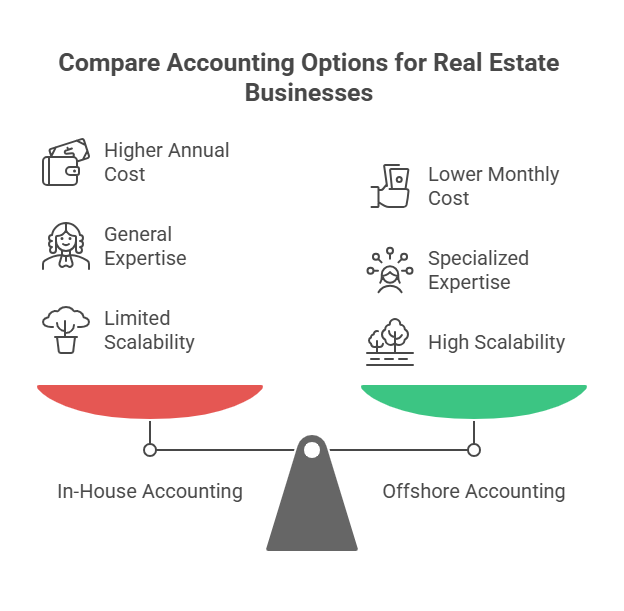
The shift to outsourced accounting for real estate businesses comes down to three factors: cost, expertise, and scalability.
Cost savings hit first. In-house accounting teams cost more than salary. You're paying benefits (add 30%), office space, accounting software licenses, training, and recruitment. For a two-person accounting team, you're looking at $150,000-180,000 annually. Offshore accounting teams deliver the same output for $4,000-6,000 monthly—that's 60% cost reduction including overhead.
Specialized expertise matters more than you think. Real estate accounting involves 1031 exchanges, lease accounting standards (ASC 842), partnership distributions, and real estate-specific tax strategies. Finding accountants with this niche knowledge takes months. Outsourced providers already have teams trained in real estate accounting services, ready to start immediately.
Scalability becomes critical as you grow. Hired a new in-house accountant? That's 3-4 months of recruiting, onboarding, and training before they're productive. Acquiring five new properties next month? Your outsourced team scales instantly without hiring headaches. This flexibility lets you expand your portfolio without expanding your accounting department.
Learn more about the strategic benefits of outsourcing your company's finance department and when it makes sense for your growth stage.
The process starts simpler than you'd expect. Cloud accounting software (QuickBooks Online, AppFolio, Buildium, or Yardi) connects directly to your bank accounts and property management systems. Transactions flow automatically into the system—no more manual entry of every rent payment.
Your offshore accounting team logs in daily through secure, encrypted connections. They're categorizing transactions, reconciling accounts, and tracking property-level expenses while you sleep. Time zone differences become an advantage. Send your documents at 5 PM EST, wake up to completed reconciliations.
Monthly financial reporting follows a consistent schedule. By the 5th business day of each month, you receive property-specific income statements, cash flow reports, and variance analysis. Multi-property owners get consolidated reports showing portfolio performance at a glance.
Real-time access means you're never locked out of your own data. Your bookkeeping service maintains your books, but you can pull reports anytime through the cloud platform. Need to check October's maintenance expenses on a specific property at 10 PM? Two clicks away.
Communication happens through standard business tools: Slack for quick questions, Zoom for monthly reviews, email for document sharing. The best providers assign you a dedicated account manager—someone who learns your portfolio and answers within hours, not days.
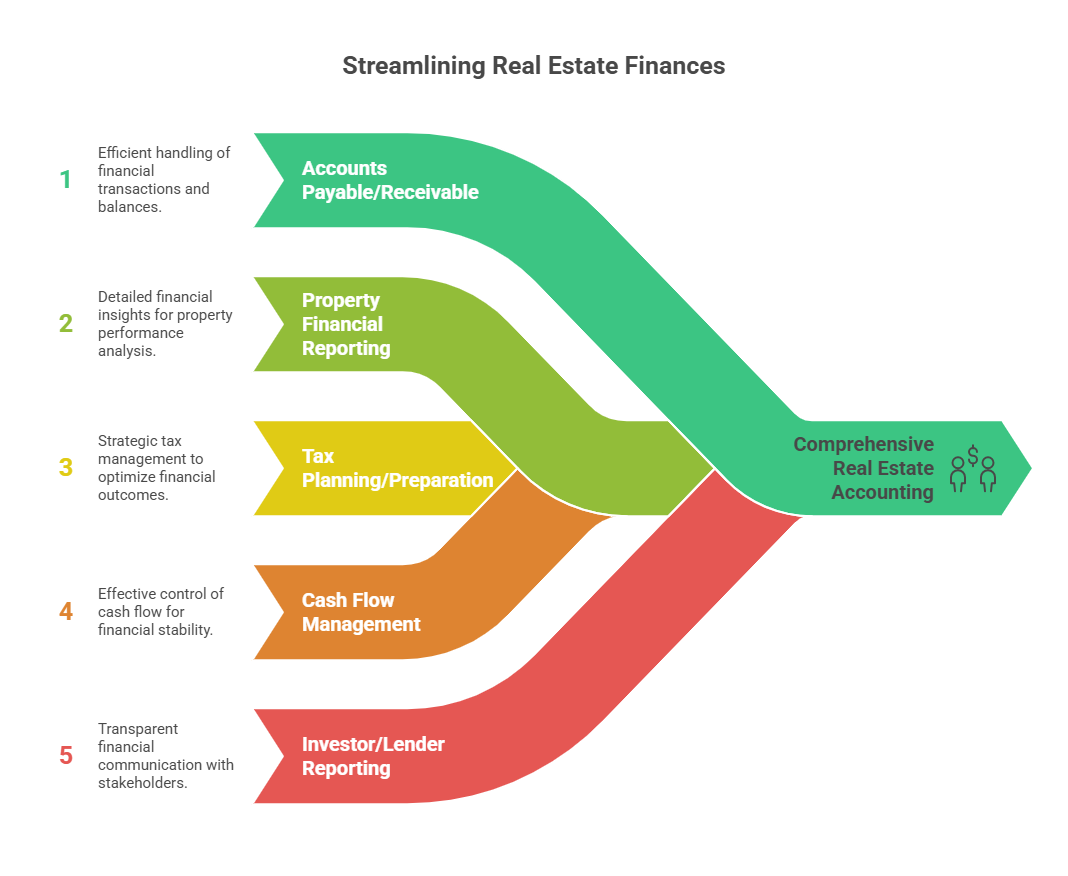
Accounts Payable and Receivable Management
Real estate businesses juggle dozens of monthly transactions per property. Rent collections, security deposit tracking, vendor payments, utility reimbursements, and late fees all need proper categorization. Expert bookkeeping services ensure tenant payments post to the right property and lease period, while accounts payable flows through approval workflows before payment.
Property-Level Financial Reporting
Each property in your portfolio needs its own set of financial statements. Professional accounting services provide income statements by property, showing exactly which assets perform and which drain cash. You'll see occupancy costs, net operating income (NOI), and cap rate calculations that help you make acquisition or disposition decisions.
Tax Planning and Preparation
Real estate tax involves more than filing a return. Strategic tax planning includes timing property improvements to maximize deductions, structuring 1031 exchanges to defer capital gains, and planning entity structures for multi-property portfolios. Real estate accountants also handle quarterly estimated payments so you avoid IRS penalties.
Cash Flow Forecasting and Management
Property businesses live or die on cash flow. Accounting teams track when rents arrive, when mortgages come due, and when major capital expenditures hit. You get 90-day cash flow projections showing whether you can cover that roof replacement or need to tap your line of credit.
Investor and Lender Reporting
Own properties with partners or institutional investors? They want quarterly reports with specific metrics: cash-on-cash return, internal rate of return (IRR), debt service coverage ratio (DSCR). Real estate accounting solutions prepare these reports to LP specifications, keeping your investors informed and happy.
Start with real estate experience. Ask how many property clients they serve and what types—residential, commercial, mixed-use. A provider that handles 200+ real estate clients has seen the scenarios you'll encounter. They won't be learning on your dime.
Technology compatibility matters more than you think. Your provider should work seamlessly with your existing property management software. If you're on AppFolio, they should have AppFolio-certified bookkeepers. If you use Buildium, they need to know its quirks. Switching your entire tech stack to match their preferences creates unnecessary friction.
Check their quality control processes. How do they catch errors before reports go out? The best firms use a two-tier review system—your bookkeeper completes the work, a senior accountant reviews it. Ask about their error rate and response time for corrections.
Security credentials separate serious providers from amateurs. Look for SOC 2 Type II certification, ISO 27001 compliance, and encrypted data transmission. Your financial data travels internationally—it needs enterprise-grade protection.
Understanding data security controls for offshore bookkeeping helps you evaluate providers properly and ask the right questions.
Communication style reveals a lot in the first conversation. Do they explain complex accounting concepts in plain English? Will you get a dedicated contact or a general inbox? Response time expectations matter—waiting three days for answers about month-end close causes real problems.
Account reconciliation tops the list. When you manage ten properties with separate bank accounts plus trust accounts for security deposits, reconciling everything monthly becomes overwhelming. Discrepancies between tenant payments and bank deposits create cash flow confusion. The fix: automated bank feeds paired with daily reconciliation, not monthly cleanup sessions.
Lease classification under ASC 842 confuses many real estate businesses. Operating leases versus finance leases have different balance sheet treatments. Misclassification affects your debt-to-equity ratio and loan covenants. Real estate-specific accounting firms stay current on these standards and ensure compliance.
Vendor payment chaos happens when you're dealing with 30+ vendors per property—landscapers, plumbers, electricians, property managers. Without proper workflow, invoices get paid twice or not at all. Structured accounts payable systems with approval hierarchies eliminate duplicate payments and improve vendor relationships.
Tax compliance across multiple jurisdictions creates headaches for multi-state property owners. Each state has different depreciation rules, some have separate tax returns for each LLC, and sales tax on construction materials varies. Property accounting services with multi-state experience handle these variations smoothly.
Missing depreciation deductions costs real estate owners thousands annually. Cost segregation studies can accelerate depreciation, but they require upfront investment. Most firms skip them, leaving tax savings on the table. Ask your accountant about cost segregation for properties over $500,000—the ROI usually hits 5-10x within three years.
Pricing varies based on portfolio size and complexity. Here's what real estate businesses actually pay in 2025:
Single Property Owners (1-3 units): $300-600 monthly for basic bookkeeping and accounting. Covers transaction categorization, monthly financial statements, and year-end tax preparation support.
Small Portfolio Managers (4-10 properties): $800-1,500 monthly. Includes property-level reporting, accounts payable management, and quarterly tax planning sessions.
Mid-Size Operators (11-50 properties): $2,000-4,000 monthly. Full-service accounting with dedicated team, investor reporting, multi-entity management, and strategic CFO advisory.
Large Portfolio/Commercial (50+ properties): $5,000-10,000 monthly. Complete financial operations including complex partnership accounting, audit preparation, and custom reporting dashboards.
Compare this to in-house costs. A single experienced real estate accountant costs $55,000-75,000 in salary plus 30% for benefits and overhead—that's $71,500-97,500 annually, or $5,960-8,125 monthly for one person. Outsourced accounting services deliver an entire team for less than one employee costs.
Read our detailed breakdown of outsourcing accounting costs to understand what drives pricing and where you can optimize spending.
Property management companies report cutting accounting costs 40-60% within 90 days of outsourcing. A Chicago-based firm managing 35 residential properties reduced monthly accounting expenses from $8,000 (two in-house staff) to $3,200 (outsourced team), saving $57,600 annually.
Time savings matter as much as cost reduction. Real estate professionals save 15-20 hours weekly on financial tasks. That time redirects to property acquisition, tenant relations, and portfolio growth—activities that actually generate revenue.
Error rates drop dramatically with specialized providers. One commercial real estate firm cut month-end close errors from 12-15 per month to 1-2 after switching to expert real estate bookkeeping services. Fewer errors mean better decisions and less time fixing mistakes.
Scalability happens faster than expected. A residential property investor acquired eight new properties in six months. Her outsourced accounting team absorbed the additional volume with no price increase for the first quarter. Try that with in-house staff.
Access to strategic expertise improves decision-making. Fractional CFO services included with many packages provide insights on when to refinance, which properties to sell, and how to structure new acquisitions for tax efficiency. This guidance often saves more than the accounting fees cost.
Discover how working with an offshore accounting team transforms operations through proven best practices and communication strategies.
Start with a current state assessment. Gather your last three months of financial statements, bank statements, and property management reports. This gives your new provider the context they need to set up your account properly.
The onboarding process typically takes 2-4 weeks. Week one involves chart of accounts setup and software configuration. Week two covers historical data migration and team training on your preferences. Week three runs parallel—your old system and new provider both process transactions so you can verify accuracy. Week four goes live fully.
Communication protocols matter from day one. Establish who on your team sends documents (property managers, leasing agents, you). Set up shared folders for invoices, leases, and bank statements. Schedule a weekly check-in call for the first month, then move to monthly.
Expect questions during the transition. Your new team needs to learn your business—which vendors get paid immediately, which properties have special reporting requirements, how you want variance analysis presented. Answer thoroughly the first time so they build accurate processes.
The payoff comes quickly. Most real estate firms see clean financial statements by month two and start making better decisions by month three. By month six, you wonder why you didn't outsource sooner.
How secure is sending financial data overseas for accounting?
Reputable offshore accounting providers use bank-level encryption (256-bit SSL), SOC 2 Type II certified data centers, and role-based access controls. Your data travels through the same secure channels as when you access your bank online. Look for ISO 27001 certification and ask about their security audit history. Most providers have stronger security than small in-house operations.
Can offshore accountants handle U.S. real estate tax laws?
Yes. Specialized real estate accounting firms hire professionals trained in U.S. GAAP, IRS regulations, and real estate-specific tax rules including 1031 exchanges and cost segregation. Many team members hold U.S. accounting certifications or have worked with U.S. firms for 5+ years. They process thousands of U.S. real estate tax returns annually.
What happens if I need to switch providers later?
Your data stays in your cloud accounting system (QuickBooks, Xero, etc.), not the provider's system. You maintain ownership and access always. Switching providers means giving new team login access to your existing software. Historical data stays intact. Most transitions complete within two weeks.
How quickly can an outsourced team start handling my books?
Basic bookkeeping services start within 1-2 weeks for simple portfolios. Complex operations with multiple entities and custom reporting requirements need 3-4 weeks for proper setup. However, once operational, the team handles daily transactions immediately—often faster than in-house staff who juggle multiple responsibilities.
Do I need different accounting services for commercial versus residential properties?
Accounting principles stay similar, but commercial real estate involves more complex lease structures, CAM reconciliations, and tenant improvement accounting. Property accounting services should specify commercial real estate experience if that's your focus. Residential providers may not understand triple-net leases or percentage rent calculations.
Can online accounting services help with property acquisitions?
Yes. Many real estate accounting solutions include due diligence support for acquisitions. They review seller financials, identify red flags in historical performance, and model cash flow projections. Some providers offer fractional CFO services that advise on deal structure and financing options.
What's the difference between property management software and accounting services?
Property management software (Buildium, AppFolio) tracks leases, rent collection, and maintenance requests. Accounting services use that data to create financial statements, manage cash flow, and prepare taxes. Think of property management as operations, accounting as financial strategy. They integrate but serve different functions.
Will I still need a CPA if I use outsourced bookkeeping services?
Many outsourced providers include CPA-level tax preparation and strategic advice. However, some businesses prefer keeping their local CPA for complex tax planning while outsourcing daily bookkeeping and accounting. The choice depends on service scope—ask what's included before deciding.
Real estate accounting doesn't have to drain your time and budget. The firms seeing the biggest results focus on three things: finding providers with deep real estate industry expertise, setting clear communication from day one, and treating their accounting team as strategic partners, not just bookkeepers.
Most property businesses waste 15-20 hours weekly on accounting tasks that specialized teams complete in 3-4 hours. That time difference compounds when you're trying to grow your portfolio or improve property performance.
Madras Accountancy has processed financial statements for 200+ U.S. real estate clients since 2015, from single-property investors to commercial portfolio managers. Our offshore team combines real estate accounting expertise with U.S. CPA oversight, delivering property-level financials, tax planning, and strategic CFO advisory for 40-50% less than in-house alternatives.
Ready to cut accounting costs while improving financial visibility? Let's talk about your portfolio.
Related read: outsource secretarial offshore company secretarial.

Section 4960's 21% excise tax now reaches far more nonprofit employees. See who is a covered employee in 2026 and what changed.

The Section 45S paid family leave credit is permanent for 2026 with new options. See who qualifies, the amounts, and how to claim it.

Opportunity zones become permanent in 2027 under the One Big Beautiful Bill. See the new deferral, rural bonus, and the 2026 handoff.