



Your company lands a government grant. Maybe it is cash to build a facility, a forgivable loan, or a piece of land handed over at no cost. You send it to your accountant with one simple question. How do we record this? For a long time the honest answer was a shrug, because US GAAP had no dedicated rules for it. That finally changed.
On December 4, 2025, the Financial Accounting Standards Board (FASB) issued ASU 2025-10, the first real US framework for accounting for government grants received by business entities. This guide walks through what counts as a government grant, when you recognize it, how the two grant types behave, and what to do before the rules take effect.
Here is the odd part. For over fifty years, generally accepted accounting principles said almost nothing about how a business should account for a government grant. There was a disclosure-only standard, ASC 832, added in 2021, but it stopped at telling readers what you received. It gave no rules on recognition or measurement.
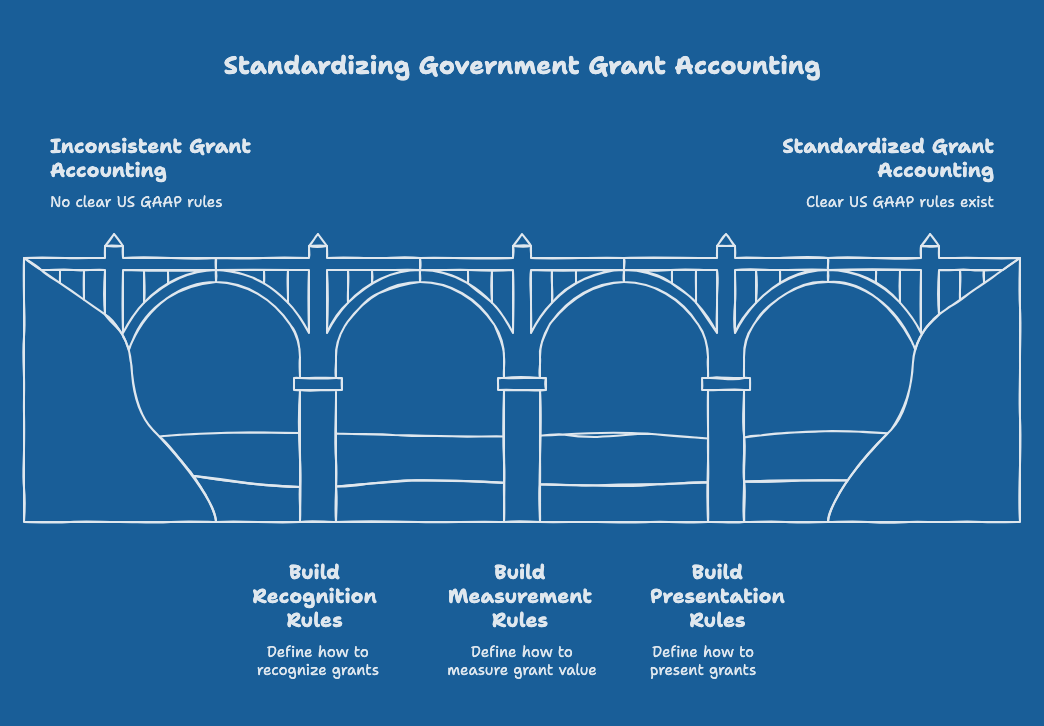
So companies improvised. Most looked to IAS 20, the international accounting standard on government grants and disclosure of government assistance, and applied it by analogy. That is one of several places where US GAAP and IFRS diverge. Others leaned on the not-for-profit contribution model. Same grant, different books, depending on who did the work. ASU 2025-10 closes that gap by building recognition, measurement, and presentation into ASC 832, largely leveraging the principles in IAS 20 with some targeted changes.
ASU 2025-10 defines a government grant as a transfer of a monetary asset or a tangible nonmonetary asset from a government to your business, in something other than an exchange transaction. Plain version: the government gives you money or property and does not get equal value back.
That pulls a few familiar items into scope. A cash grant to hire staff or run a program. A grant of land or the free use of a building, which is the tangible nonmonetary type. And a forgivable loan as a government grant, once forgiveness is realistically on the table.
Some things sit outside the scope of ASC 832 on purpose. Grants of intangible assets, genuine exchange transactions, and anything covered elsewhere, such as income tax credits within the scope of ASC 740. One carve-out worth knowing: unlike IAS 20, these rules do not treat the benefit of a below-market interest rate loan as a government grant. Not-for-profit entities and employee benefit plans are also left out, since they already have their own guidance.
Timing is where a lot of teams slip. Under the new model, you record nothing until it is probable on both counts that your business will comply with the conditions attached to the grant, and that the grant will be received. Fail either test and the grant stays off your books.
Once a grant meets the recognition criteria, the pattern depends on what the money is for. If a grant is intended to compensate you for costs you have not incurred yet, you recognize it as those costs show up. If the grant reimburses expenses or losses you already took, you recognize the grant in earnings as soon as the criteria are met, which can happen before the cash actually lands.
ASU 2025-10 sorts every grant into one of two buckets, a grant related to income or a grant related to an asset. That split drives both measurement and presentation, so getting it right matters.
A grant related to income is the simpler case. You can present it two ways: on its own line, such as other income, or netted against the expense it offsets. Pick one, apply it consistently, and disclose the choice.
A grant related to an asset takes more thought, because here you get a real accounting policy election. Option one is the deferred income approach, where you park the grant as deferred income and move it into earnings over time, usually as you depreciate the asset. Option two is the cost accumulation approach, where you reduce the carrying amount of the asset itself, which quietly trims depreciation across its life. For a grant related to an asset that never depreciates, like land, you spread the benefit over the periods you incur the related costs, and that takes judgment.
Treat these as genuine accounting policies, not throwaway settings. Two companies with the same grant related to an asset can report very different balance sheets and income statements based purely on the method they chose.
One spot the standard deliberately leaves open is the cash flow statement. There is no fixed rule for the cash flow presentation of government grants. You apply the general principles in ASC 230 and use judgment, so grant proceeds can land in different sections depending on the facts. Decide your approach early so it holds steady year to year.
Grants come with strings, and sometimes you have to give the money back. When a government grant becomes repayable, you do not restate the past. For a grant related to income, apply the repayment against any remaining deferred income first, then send the excess to earnings. For a grant related to an asset, you either increase the carrying amount of the asset or cut the deferred income balance, depending on the method you picked, and book the cumulative earnings effect at that point.
The disclosure side of ASC 832 mostly carries over, with tweaks to fit the new model. A reader should come away understanding the nature and terms of the government grants received, the accounting policies used to account for them, the amounts recognized, and the line items affected by the grant. If you received a tangible nonmonetary asset, disclose its fair value even when you use the cost accumulation approach. This is the same disclosure of government assistance discipline firms have kept since 2021, now aimed at the fuller picture.
You have runway, but no reason to coast. For public business entities, ASU 2025-10 applies to annual periods beginning after December 15, 2028. Every other business entity gets an extra year, with periods beginning after December 15, 2029. Early adoption is permitted, which helps if you would rather step off IAS 20 by analogy sooner.
On transition, you get a few paths. A modified prospective approach applies the rules to new grants and to any grants that are not complete at adoption, with no cumulative-effect adjustment to opening equity. A retrospective option instead runs the change through a cumulative-effect adjustment to the earliest period shown. A grant counts as complete once substantially all of its conditions are met and the proceeds have been recognized.
The near-term moves are straightforward. Take an inventory of the grants you hold, settle your accounting policies for each grant type, and decide whether early adoption improves your reporting story.
What is ASU 2025-10?
It is the FASB standard, issued December 4, 2025, that finally gives US GAAP real rules for accounting for government grants received by business entities. It adds recognition, measurement, and presentation guidance to ASC 832, built largely on the principles in IAS 20.
What is a government grant under the new rules?
It is a transfer of a monetary asset or a tangible nonmonetary asset from a government to your business, other than in an exchange transaction. Cash grants, grants of land or facilities, and forgivable loans are common examples that fall in scope.
When do you recognize a government grant?
Only when it is probable both that your business will comply with the conditions attached to the grant and that the grant will be received. A grant that reimburses costs you already incurred is recognized in earnings once those criteria are met.
What is the difference between a grant related to income and a grant related to an asset?
A grant related to income offsets expenses or losses. A grant related to an asset funds a long-lived asset. The asset type carries an accounting policy election between the deferred income approach and reducing the asset's carrying amount.
How do you present a government grant in the financial statements?
An income grant appears either as a separate line, such as other income, or netted against the related expense. An asset grant follows your chosen method. Cash flow presentation of government grants is left to judgment under ASC 230.
Is a forgivable loan a government grant?
Yes. A forgivable loan as a government grant falls within the scope of ASC 832 once it is probable you will meet the forgiveness terms. Until then, it is treated as a liability like any other borrowing.
When does ASU 2025-10 take effect?
For public business entities, annual periods beginning after December 15, 2028. For all other entities, periods beginning after December 15, 2029. Early adoption is permitted, and you can transition using a modified prospective or a retrospective method.
What happens if a government grant becomes repayable?
You adjust going forward, not backward. Income grants absorb the repayment against remaining deferred income first, then earnings. Asset grants adjust either the asset's carrying amount or the deferred income balance, with the cumulative effect hitting earnings at repayment.
Government grants do not come along every day, which is exactly why the accounting trips teams up when one lands. If your firm wants a second set of hands to set the accounting policies, book the entries, and get the disclosures right, Madras Accountancy supports US CPA firms with GAAP-aligned accounting and bookkeeping built for exactly this kind of technical work. You can reach out here.

Public companies must disclose related party transactions over $120,000 under SEC Item 404. See who counts as a related person and what to report.

The at-risk rules cap the loss a taxpayer can deduct to what they truly have on the line. Here is how the at-risk limits work in 2026.

The deduction for business interest is looser in 2026 but the rules moved twice. See the new ATI math, the $32M test, and the capitalized interest trap.



