



Two different sets of rules landed within twelve months of each other, and most planning files still reflect neither.
Here is where things actually stand. The section 163(j) limitation on business interest got noticeably friendlier for tax years beginning after December 31, 2024, then picked up two new restrictions one year later. So the 2025 return you may be finishing on extension right now runs on one version, and the year you are living in runs on another.
The IRS spelled out the split in Fact Sheet FS-2025-09, refreshed in December 2025.
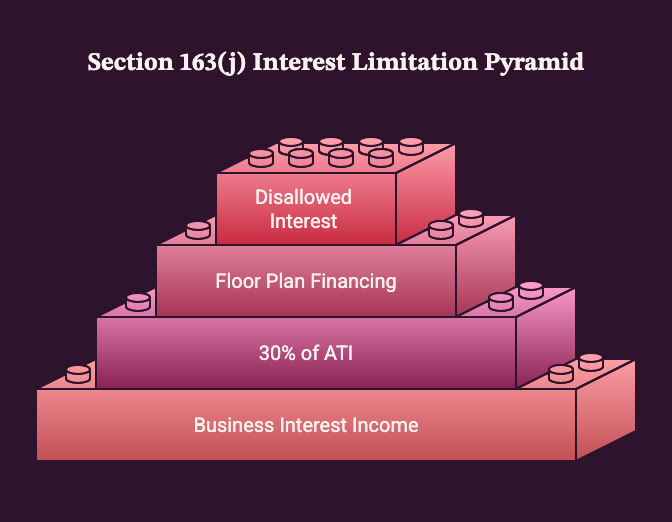
Start with what did not change. The amount of deductible business interest expense in a taxable year cannot exceed the sum of three things:
Whatever sits above that total is the amount of interest disallowed for the year, and it carries forward indefinitely. Nothing is lost permanently, which is the detail that calms most clients down when they first see a large add-back on the workpaper.
Note what stays outside. Investment interest sits under a separate regime, and interest payments have to be properly allocable to a trade or business within the meaning of section 162 before they enter this calculation at all.
This is the headline, and it is genuinely good news.
Adjusted taxable income drives everything. From 2018 through 2021 you added depreciation, amortization and depletion back to taxable income, producing something close to earnings before interest, taxes and those same non-cash charges. The Tax Cuts and Jobs Act let those add-backs lapse, so 2022 through 2024 ran on a tighter EBIT-style base and capital-intensive companies lost a chunk of their interest expense deductions.
The One Big Beautiful Bill Act restored the add-backs permanently for any taxable year beginning after December 31, 2024.
Picture a manufacturer with $4 million of income before interest and tax, $3 million of book depreciation and $2 million of interest paid or accrued. On the old base, 30% of $4 million allows $1.2 million, so $800,000 of interest expense is disallowed. Add the non-cash charges back and the base becomes $7 million, allowing $2.1 million. The entire interest charge stays deductible. Same company, same debt, different arithmetic.
One quieter 2025 item: floor plan financing interest now reaches trailers and campers built as temporary living quarters and designed to be towed by a motor vehicle. Narrow, but RV dealers care.
The limitation applies to any taxpayer with business interest expense unless an exception fits, and a large share of businesses find that one does.
The small business exception works when a taxpayer is not a tax shelter, as defined in section 448(d)(3), and meets the gross receipts test of section 448(c). For tax years beginning in 2026, that means average annual gross receipts of $32 million or less across the three preceding years, up from $31 million the year before. That figure is an ordinary annual inflation adjustment, not something the new law created, which is a distinction several write-ups get wrong.
The trap is aggregation. Commonly controlled entities may have to combine receipts under the section 448(c)(2) rules, so four related LLCs that each look modest can fail together. Test it fresh every year, because passing once means nothing for the next one.
Certain activities can also elect out. A real property trade or business or an electing farming business can step outside the cap altogether, and regulated utilities are excepted by statute. The election is irrevocable and the price is depreciating property under the alternative depreciation system, with slower recovery and no bonus. For a landlord weighing that swap, our guide to rental property deductions fills in the surrounding picture.
Now the part that catches people.
Capitalized interest lost its escape hatch. For a taxable year beginning after December 31, 2025, the limitation is applied before any mandatory or elective interest capitalization provision, with two carve-outs. Interest capitalized under sections 263(g) and 263A(f) is still not treated as interest for purposes of the cap. Everything else is treated as business interest expense and runs through the computation first.
Developers and contractors built real strategies on this. Rolling interest into inventory or construction in progress kept it out of the calculation and protected the income base at the same time. That door is closed. As The Tax Adviser explained, the sequencing in the regulations effectively flipped, so cost-recovery method choices now carry the planning weight that the capitalization provision used to.
Foreign inclusions come out of the base. Also from 2026, a US shareholder's income under section 951(a) and section 951A(a) from a controlled foreign corporation, plus the section 78 gross-up and related deduction portions, no longer increases the income base for purposes of section 163(j). Grant Thornton flagged that this can quietly claw back much of what the depreciation add-back handed a multinational group. If you hold CFCs, model both changes together instead of celebrating one. The NCTI rules interact here too.
The business interest limitation is applied at the entity level first. Whatever survives is deducted there, and whatever does not becomes excess business interest expense pushed out to the partners.
That allocation of excess business interest parks with each partner and cannot be used until the same partnership later throws off excess taxable income or excess business interest income. It does not mingle with the partner's other activity, and it rides along with the partnership interest until then. Partners routinely assume a carryforward is freely usable and get a surprise.
S corporations do not follow this pattern. Interest expense disallowed at the corporate level stays there and carries forward inside the entity.
Anyone subject to this files Form 8990 to compute the amount of business interest allowed, the amount deductible for federal income tax purposes, and the disallowed business interest expense rolling forward. Exempt small businesses generally skip the form, with narrow exceptions for partners and shareholders who receive carryforward amounts. Where the limitation does not apply, there is no business interest deduction to compute and no interest deduction limitation to track.
Do not stop at the federal number. States diverged sharply after the new law, and some that historically conformed are now reconsidering. A group filing in a dozen states can face a different interest expense deduction limitation in several of them, which means the deferred tax picture and the cash forecast will not agree with the federal computation. Eversheds Sutherland's read on the updated IRS guidance is a useful companion.
If you want the base mechanics in more depth, our earlier section 163(j) walkthrough covers the rules that survived all of this.
For CPA firms carrying a stack of leveraged clients into extension season, Madras Accountancy supports the computation and workpaper build so partner hours go to the elections and the modeling.
1. What is the business interest expense limitation? Section 163(j) caps how much interest a business can deduct at business interest income plus 30% of ATI plus any floor plan financing. Amounts above the cap are disallowed and carried forward.
2. Who is exempt? Taxpayers meeting the section 448(c) test who are not tax shelters, plus regulated utilities and businesses electing out as a real property or farming trade or business.
3. What is the threshold for 2026? Average annual gross receipts of $32 million or less over the three prior years, measured after the aggregation rules.
4. Did the income base change? Yes. Depreciation, amortization and depletion are added back again for any year beginning after 2024, which raises the base and lets a taxpayer deduct interest that would previously have been deferred.
5. Can I still capitalize interest to sidestep the cap? Not from 2026. The rule now runs before elective or mandatory capitalization, other than amounts under sections 263(g) and 263A(f).
6. How long do disallowed amounts carry forward? Indefinitely, though partnership-level amounts follow the separate partner tracking rules described above.
7. Does this affect my section 199A deduction? Only indirectly. The deduction under section 199A is computed from taxable income or loss after interest is settled, so a bigger disallowance changes the figures flowing into it.
8. Which form reports it? Form 8990, filed with the return, showing the computation, the allowed amount and the carryforward.
This article is general guidance, not tax advice. Several elections here are irrevocable, so model them with your advisor before filing.

Public companies must disclose related party transactions over $120,000 under SEC Item 404. See who counts as a related person and what to report.

The at-risk rules cap the loss a taxpayer can deduct to what they truly have on the line. Here is how the at-risk limits work in 2026.

Confused about cloud computing arrangement costs? See when to capitalize implementation costs and when to expense them under ASU 2018-15.