


Almost every business runs on cloud software now, from the CRM to payroll to the accounting system itself. But the moment you sign one of those deals and start paying to set it up, a simple question lands on the books: do you capitalize those costs, or expense them right away? The answer is not obvious, and getting it wrong can quietly distort your financial statements.
Here is the good news. The rules are clearer than they used to be. Once you know which bucket your contract falls into, the accounting mostly follows a set path. Let us walk through it in plain terms.
Everything starts here. Back in 2015, the FASB issued ASU 2015-05 to help customers answer one thing: does your cloud computing arrangement (CCA) hand you a software license, or is it just a service you pay to use?
The test is whether you have the contractual right to take possession of the software at any time during the hosting period without a significant penalty, and you could either run the software on your own hardware or hire another vendor to host it. If yes, the arrangement includes a software license, and you treat that license as internal-use software, which is an intangible asset under ASC 350-40. If no, you do not control any software. You are buying access, so the deal is a service contract, and the fees for the hosted software are expensed as you use it.
Most modern SaaS subscriptions, think a cloud CRM or an online payroll tool, land in the service contract camp.
For a while, that split created a gap. If your cloud computing arrangement was a service contract, the guidance on the setup work was murky, and plenty of companies just expensed everything. That felt harsh, since a big implementation clearly benefits future periods.
So in 2018 the FASB issued ASU 2018-15. In short, ASU 2018-15 aligns the accounting for implementation costs incurred in a service-contract arrangement with the long-standing rules for developing or obtaining internal-use software, as laid out in Deloitte's accounting research tool. Now, even when your hosting arrangement is a service contract with no software license, you apply ASC 350-40 to decide which implementation costs to capitalize and which to expense. Same playbook, whether or not a license is involved.
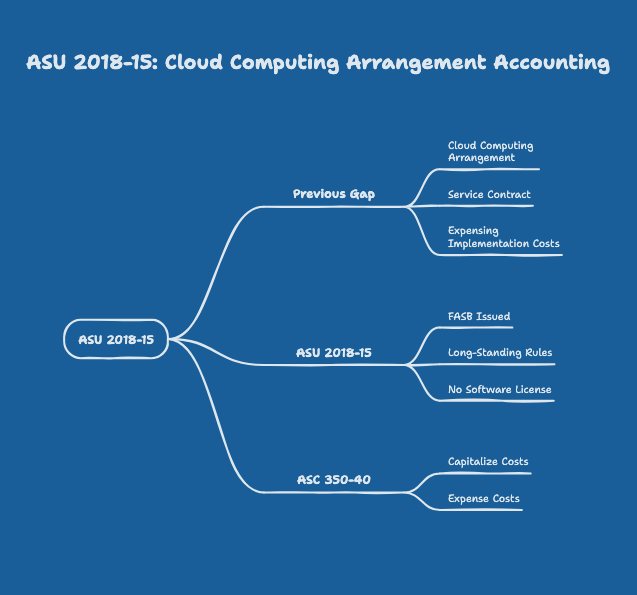
This is where your timekeeping matters. Under Subtopic 350-40, costs fall into stages, and the stage decides the treatment. RSM's guidance breaks this down well.
Costs you generally capitalize, all from the application-development stage:
Costs you expense as incurred:
These costs can be internal or external, so employee time on the project can be capitalized right alongside a consultant's invoice, as long as the work sits in the development stage. The classic trap is sweeping training or data conversion into the capitalized bucket. Those setup costs are expensed, full stop.
Once you have a pool of capitalized implementation costs, you amortize them straight-line over the term of the CCA, including any renewal periods you are reasonably certain to use. You do not speed up or slow down the amortization based on usage, like the number of users or transactions.
Where these amounts appear tends to surprise people. Even though the capitalized cost behaves like an intangible asset, you do not park it on a separate intangible line. You present it in the same line item as a prepayment of the hosting fees. The amortization then runs through the same expense line as the subscription itself, and the related cash flows sit within operating activities on the statement of cash flows. If you want a quick refresher on how the financial statements connect, that is a useful side trip.
Say your company signs a three-year CCA for a CRM at $2,000 a month, and you spend $36,000 up front. Of that, $30,000 is qualifying configuration and integration work, and $6,000 is training and data conversion.
Item
Treatment
$2,000 monthly subscription
Expensed each month
$30,000 development-stage work
Capitalized, amortized over 36 months (about $833 a month)
$6,000 training and data conversion
Expensed as incurred
Same cash out the door, very different timing on the income statement.
Here is what most older articles miss. In September 2025, the FASB issued ASU 2025-06, which modernizes ASC 350-40 itself. BDO's summary is a solid starting point. Because your CCA cost decisions key off Subtopic 350-40, this one matters to you.
The headline change is that the old, rigid project-stage model is gone. In its place is a principles-based approach that fits agile development better. You start capitalizing once management has committed to funding the project and it is probable the software will be completed and work as intended. The update also folds website development costs into ASC 350-40 and moves the related disclosures to the property, plant, and equipment rules, as Eide Bailly explains.
It applies to all entities and takes effect for annual periods beginning after December 15, 2027, so calendar-year companies feel it in 2028, with early adoption allowed. You do not have to change anything today. But if you are writing a capitalization policy right now, build it with the new principles in mind so you are not redoing it in a year.
The whole thing comes down to two moves. Read the contract to settle whether you hold a software license or a service, then track your implementation work by stage so the capitalize-versus-expense calls stay clean. Honestly, good project timekeeping is half the battle.
For teams juggling several cloud rollouts at once, this is exactly the kind of detailed, repeatable accounting work that offshore support handles well. Madras Accountancy helps US CPA firms keep these judgments consistent and the documentation audit ready, so nothing slips when the reviewers show up.
Sort the classification early, lean on ASC 350-40 for the cost calls, and your cloud computing arrangement accounting stops being a guessing game.
What is a cloud computing arrangement in accounting? It is a contract where you access software hosted by a vendor instead of installing it yourself. It either includes a software license, treated as internal-use software, or it is a service contract, depending on whether you can take possession of the software.
Can you capitalize cloud computing costs? Yes, some of them. Under ASU 2018-15 and ASC 350-40, you capitalize qualifying implementation costs from the application-development stage, such as configuration and integration, while subscription fees and training are expensed.
What is ASU 2018-15? It is the FASB update that tells customers how to account for implementation costs in a cloud computing arrangement that is a service contract. It aligns those costs with the internal-use software rules in ASC 350-40.
Which cloud implementation costs must be expensed? Preliminary planning, vendor selection, training, data conversion, and ongoing maintenance are expensed as incurred. Only development-stage work that builds or configures the software can be capitalized.
How do you amortize capitalized cloud computing costs? Straight-line over the term of the hosting arrangement, including renewals you are reasonably certain to exercise. Usage measures such as user counts are not used to drive the amortization.
Where do capitalized cloud costs appear on the financial statements? Not as a separate intangible asset. They sit in the same line item as a prepayment of the hosting fees, with amortization in the same expense line as the subscription and the cash flows in operating activities.
Is a SaaS subscription a service contract or a software license? Most SaaS subscriptions are service contracts, because you cannot take possession of the software and run it elsewhere. If the contract lets you take possession without significant penalty, it includes a software license instead.
Does ASU 2025-06 change cloud computing arrangement accounting? It updates ASC 350-40, which the cloud rules rely on, by replacing the project-stage model with a principles-based approach. It is effective for fiscal years beginning after December 15, 2027, so plan any new capitalization policy with it in mind.
The section 4960 excise tax is 21% of nonprofit pay over $1M. From 2026 it covers all employees. See the medical carve-outs, Form 4720 and a worked example.

The paid family and medical leave tax credit is permanent from 2026. See the 12.5% to 25% rates, the premium option, the 6-month rule and how Form 8994 works.
Opportunity zones become permanent in 2027 under the One Big Beautiful Bill. See the new deferral, rural bonus, and the 2026 handoff.