



Every business ends up doing deals with people close to it. A company leases office space from a director. It hires the CEO's sister as a contractor. It buys supplies from a firm a big shareholder owns. None of that is automatically wrong. The problem starts when a transaction like that happens quietly and nobody tells investors.
That is the whole point of the rules on related party transactions. They exist so investors can see when a company is doing business with its own insiders, judge whether the terms are fair, and spot a potential conflict of interest before it turns into a real one. Let us break down what counts, who counts, and exactly what has to be disclosed.
A related party transaction is any deal between a company and someone connected to it, where that person stands to benefit. Think purchases, sales, loans, leases, guarantees, or paying a related person for services.
For public companies, the SEC draws a bright line. Under Item 404(a) of Regulation S-K, a company must disclose any transaction since the beginning of its last fiscal year that tops $120,000 and in which a related person had a direct or indirect material interest. Smaller reporting companies get a slightly different test, the lesser of $120,000 or 1% of their average total assets over the last two years, which you can confirm in the SEC's rule text.
The dollar threshold is the easy part. The trickier judgment is whether the related person has a material interest, and who even counts as a related person in the first place.
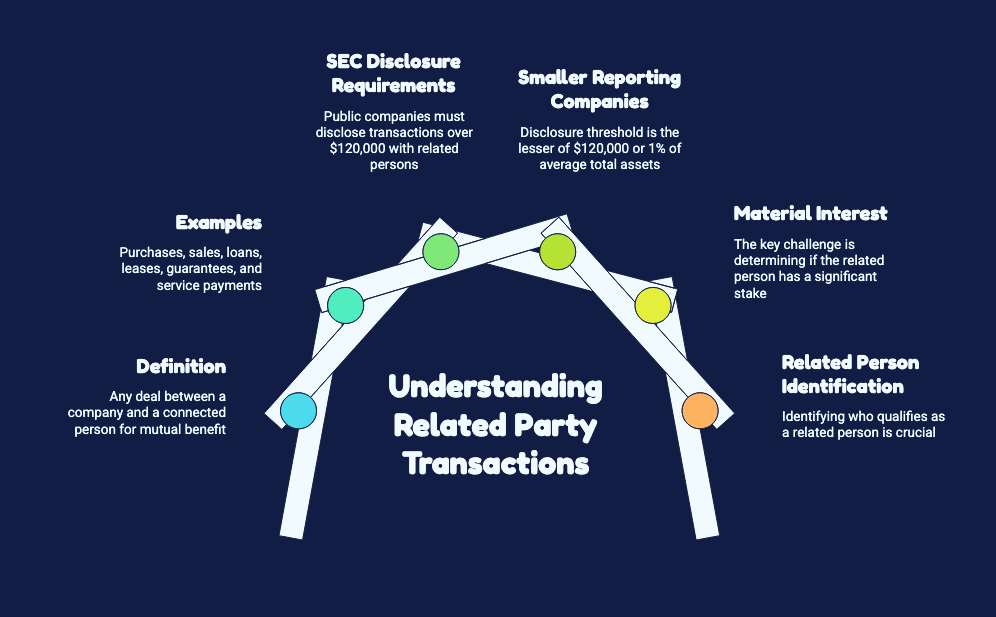
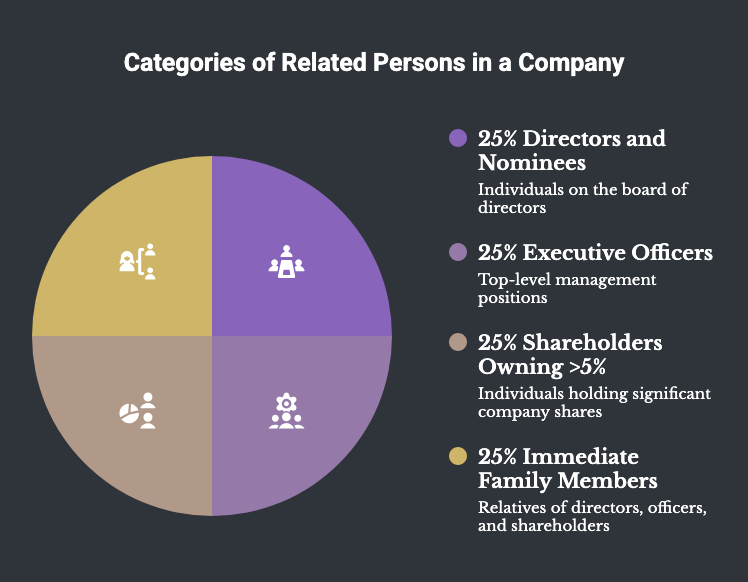
This is where companies trip up most often, because the definition reaches further than people expect. A related person includes any:
That immediate family member piece is broad on purpose. It covers a spouse, child, stepchild, parent, stepparent, sibling, and the in-law versions of those, plus anyone else sharing the household other than a tenant or employee. So a payment to a director's son-in-law can be a reportable related party transaction, even though the director never touched a dollar of it.
That exact situation has bitten real companies. In January 2025 the SEC settled an enforcement action against a public company for failing to disclose roughly $4.7 million paid over three years to siblings and children of its officers and directors. The lesson is simple. If a family member is on the payroll or holds a contract, someone needs to be asking whether it crosses the line.
This rule is the home base for related party disclosure, and it has three parts worth knowing.
Item 404(a) is the main event. It requires the transaction disclosure itself: the name of the related person, their relationship to the company, the nature of their interest, and the dollar amount involved in the transaction. You typically see this in the annual proxy statement or, for a company going public, in its registration statement.
Item 404(b) asks companies to describe their policies and procedures for reviewing and approving these deals. Smaller reporting companies get a pass on this one.
Item 404(c) covers promoters and certain control persons, which mainly comes up in registration statements for newer companies.
A few things are carved out. Compensation that is already disclosed in the executive pay tables does not get double-counted here. Neither do routine banking transactions where the related person's interest arises solely from deposits or loans made in the ordinary course of business under Federal Reserve rules. The goal is signal, not noise.
Here is a piece many people miss. Even if a company never files anything with the SEC, US GAAP still requires it to disclose related party transactions in its financial statements. That rule lives in ASC 850, and it applies to private companies too, as this overview of ASC 850 lays out.
Under ASC 850, the financial statements need to spell out the nature of the relationship, a description of the transactions, the dollar amounts involved, and any amounts still owed to or from related parties at period end. The reason is the same one driving the SEC rules: related parties may not deal at arm's length, so the price on paper might not reflect what two strangers would have agreed to. Readers deserve to know that.
If you have ever sat through an audit, you know related party transactions get outsized attention. There is a good reason. These deals are a classic vehicle for fraud and earnings manipulation, because the usual tension of arm's-length bargaining is missing and a conflict of interest can hide in plain sight.
For public company audits, PCAOB Auditing Standard 2410 sets the bar. It requires the auditor to understand the company's process for identifying related parties, to inquire beyond just management, and to hunt for relationships and transactions that were never disclosed. Auditors are told to look for undisclosed related party transactions, not just tick off the ones management hands over. If they find one that slipped through, it can point to a weakness in the company's controls. You can read the standard itself on the PCAOB site, and there is a plain-English walkthrough of the audit procedures here.
Missing a disclosure is not a small slip. It can bring SEC enforcement actions, financial penalties, restatements, and a real hit to credibility with investors. The frustrating part is that most misses are not fraud. They are honest gaps, a family employment relationship nobody flagged, or a vendor quietly owned by a 5% shareholder.
Good policies and procedures are what keep those gaps from opening. The strongest programs share a few habits. Directors and executive officers get a plain reminder that they must report potential related party transactions the moment they see one. The company runs an annual questionnaire to surface relationships. And a committee reviews and either approves or ratifies each transaction, with the terms compared against what an outside party would accept.
That last habit matters most. When you can show a related party transaction was reviewed and priced like an arm's-length deal, you protect the company on both the disclosure and the fairness fronts.
Related party transactions are not something to fear or hide. Handled openly, with clear reporting and a real review process, they are just part of doing business. If your team is stretched thin during proxy or audit season, Madras Accountancy supports US CPA firms with exactly this kind of detailed disclosure and audit work, so nothing quietly falls through the cracks.
What is a related party transaction? It is a deal between a company and someone closely tied to it, such as a director, executive officer, large shareholder, or their family, where that person has a financial interest. Common examples include leases, loans, service contracts, and purchases.
What is the SEC threshold for disclosing a related party transaction? Public companies must disclose transactions over $120,000 in which a related person has a direct or indirect material interest. Smaller reporting companies use the lesser of $120,000 or 1% of average total assets over the last two fiscal years.
Who counts as a related person under Item 404? Directors, director nominees, executive officers, and shareholders owning more than 5%, plus their immediate family members and anyone sharing their household. Immediate family includes spouses, children, parents, siblings, and in-laws.
Where are related party transactions disclosed? For public companies, in the annual proxy statement or in a registration statement, under Item 404 of Regulation S-K. Under US GAAP, they also appear in the notes to the financial statements through ASC 850.
Do private companies have to disclose related party transactions? Yes. Even without SEC filings, ASC 850 requires related party transactions to be disclosed in the financial statements, including the relationship, the amounts involved, and any balances owed.
What must be included in the disclosure? The name of the related person, their relationship to the company, the nature and extent of their interest, and the dollar amount involved in the transaction. The description should give investors enough to judge the deal.
Why do auditors focus on related party transactions? Because they carry a higher risk of fraud and misstatement, since the parties are not bargaining at arm's length. PCAOB AS 2410 requires auditors to identify related parties and test whether transactions are properly accounted for and disclosed.
What happens if a company fails to disclose a related party transaction? It can face SEC enforcement actions, monetary penalties, restatements, and lost investor trust. Strong review policies and procedures, plus annual questionnaires, are the best way to catch transactions before they go unreported.
The at-risk rules cap the loss a taxpayer can deduct to what they truly have on the line. Here is how the at-risk limits work in 2026.

The deduction for business interest is looser in 2026 but the rules moved twice. See the new ATI math, the $32M test, and the capitalized interest trap.
Confused about cloud computing arrangement costs? See when to capitalize implementation costs and when to expense them under ASU 2018-15.



