



You get your Schedule K-1 or your Schedule E, there is a nice fat loss on it, and you are already picturing a smaller tax bill. Then your preparer says you can only deduct part of it this year. Your basis is fine, so what gives? Nine times out of ten, the answer is the at-risk rules.
They are one of the least understood corners of the tax code, and they quietly trip up more real estate investors and pass-through owners than the passive rules that get all the attention. Let us walk through what the at-risk rules do, how your at-risk amount is figured, the one exception every property owner should know, and what happens to the loss you cannot use right now.
The at-risk rules come from Section 465, and the idea behind them is simple. They cap the loss you can deduct from an activity to the amount you truly have on the line in it. In plain terms, the at-risk rules prevent taxpayers from deducting losses that were funded with money they are not actually on the hook to repay.
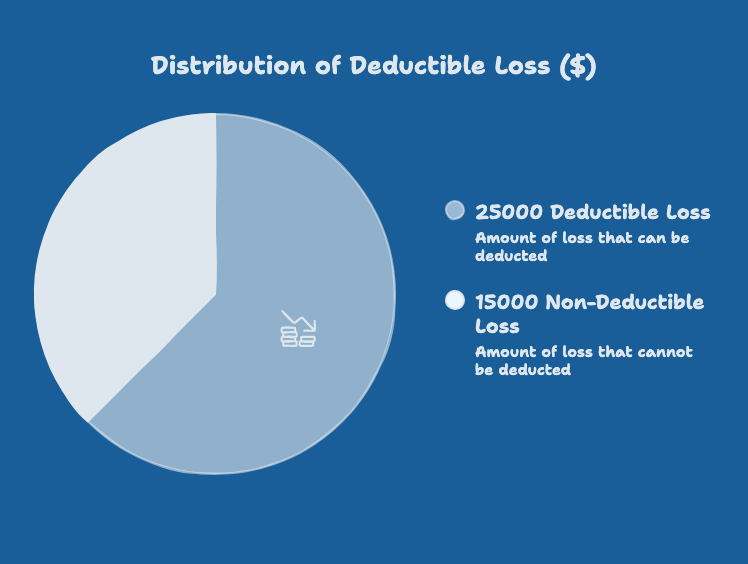
Say your share of a loss from an activity is $40,000 but your at-risk amount is only $25,000. The at-risk limitation lets you deduct $25,000 this year. The other $15,000 does not vanish, but it waits. You report all of this on Form 6198, which walks you through the profit or loss from the activity, your amount at risk, and the deductible loss for the current tax year.
Here is the part generic articles skip, and it is the part that actually matters. A loss from a partnership or S corporation has to clear four separate filters, in a fixed order, before it reduces your taxable income. First the tax basis limitation. Then the at-risk limits. Then the passive activity loss rules. And finally, for individuals, the excess business loss limitation.
Order matters because a loss can survive one test and still get stopped by the next. You might have plenty of basis in the partnership, sail through the basis limitation, and then hit a wall at the at-risk step because a chunk of your investment was borrowed money you are not personally liable for. Basis and at-risk sound like the same thing, but they are not, and treating them as one is a common and expensive mistake.
Your at-risk amount is basically your real economic stake in the activity. It goes up and down over time, so it is worth tracking each year rather than guessing.
A few things increase your at-risk amount. Cash you put into the activity. The adjusted basis of property you contribute. Money you borrow for use in the activity, but only to the extent you are personally liable for repayment, or you have pledged property not used in the activity as security. Income from the activity bumps it up too.
Some things pull it back down. Distributions you take, deductible losses you have already used, and debt that shifts from recourse to nonrecourse. When the amount at risk is reduced, so is the loss you can claim. This is why two owners who invested the same dollars can end up with very different deductible losses, depending on how each one financed the deal.
This is where real property gets its own special treatment. As a rule, nonrecourse debt does not count toward your at-risk amount, because you are not personally on the hook if things go south. That would be brutal for real estate, where nonrecourse mortgages are normal.
So the law carves out an exception. For the activity of holding real property, you are considered at risk for qualified nonrecourse financing secured by the real property, as long as it comes from a commercial lender like a bank rather than the seller or a promoter. Picture a rental bought for $300,000 with $50,000 of your own cash and a $250,000 qualified nonrecourse loan from a bank. Because that financing secured by real property qualifies, you are at risk for the full $300,000, not just your $50,000 down. Swap in a nonqualified nonrecourse loan and your at-risk amount would sit at $50,000, which changes the loss you can deduct in a big way.
A loss blocked this year is not lost. Amounts suspended under the at-risk rules carry forward with no expiration date, waiting for the year your at-risk amount increases. Put more cash in, take on recourse debt, or earn income from the activity, and some of those parked losses free up.
One thing to keep on your radar. If your at-risk amount ever drops below zero, say you pull out big distributions after already deducting losses, Section 465(e) can force you to recapture some of those earlier deductions as income. And even after a suspended loss clears the at-risk gate, it still has to face the passive rules before it reaches your return. Clearing one filter does not mean clearing them all.
The at-risk rules apply to individuals, which includes partners in partnerships and S corporations, plus estates and trusts. Certain closely held C corporations are subject to the at-risk rules too, specifically where five or fewer individuals own more than half the stock. Widely held corporations generally get a pass.
The rules apply on an activity-by-activity basis, so you cannot use a strong at-risk amount in one venture to rescue losses from another. And here is a point that surprises people: qualifying as a real estate professional gets you out of passive treatment, but it does not get you out of the at-risk rules. Material participation solves a different problem. When you are preparing your tax return, expect a separate Form 6198 for each activity that had a loss and amounts not at risk, and keep a running at-risk schedule so nothing slips. This is fiddly work, and a good tax professional earns their fee here.
What are the at-risk rules?
They are Section 465 rules that limit the loss you can deduct from an activity to the amount you have economically at risk in it. The goal is to stop taxpayers from deducting losses financed by money they are not personally liable to repay.
What is my at-risk amount?
It is your real stake in the activity: cash you contributed, the adjusted basis of property you put in, and borrowed amounts you are personally liable for. It rises with income and new investment and falls with distributions and deducted losses.
What is the difference between basis and at-risk limits?
Basis measures your total investment for tax purposes. At-risk narrows that to what you could actually lose. You can have enough basis to clear the basis limitation and still be capped by the at-risk limits if part of your investment was nonrecourse borrowed money.
Do the at-risk rules apply to rental real estate?
Yes, but real property gets a break. Qualified nonrecourse financing secured by the property counts toward your at-risk amount, even though nonrecourse debt normally does not. The loan generally has to come from a commercial lender.
What happens to losses disallowed by the at-risk rules?
They are suspended and carry forward indefinitely. They become deductible in a later year when your at-risk amount increases, and even then they still have to pass the passive activity rules before you can use them.
Do at-risk rules apply before or after passive activity rules?
Before. The order is basis, then at-risk, then passive, then the excess business loss limitation. A loss has to survive each step in that sequence to reduce your taxable income.
Who has to file Form 6198?
Individuals, estates, trusts, and certain closely held C corporations that have a loss from an at-risk activity with amounts not at risk. It is filed per activity, so several activities can mean several forms.
Does nonrecourse debt count toward my at-risk amount?
Usually no, because you are not personally liable for it. The main exception is qualified nonrecourse financing on real property, which does increase your at-risk amount.
At-risk tracking is the kind of quiet, multi-year detail that gets messy fast once a client holds several activities, each with its own schedule and its own carryforwards. That is exactly the work Madras Accountancy handles for US CPA firms, keeping clean at-risk and basis schedules and coordinating them with the passive and excess business loss rules, backed by fractional CFO support when a loss year needs real planning. You can reach out here.
This is general information, not tax advice, so confirm the specifics for any client with their preparer.

The section 4960 excise tax is 21% of nonprofit pay over $1M. From 2026 it covers all employees. See the medical carve-outs, Form 4720 and a worked example.

The paid family and medical leave tax credit is permanent from 2026. See the 12.5% to 25% rates, the premium option, the 6-month rule and how Form 8994 works.

Opportunity zones become permanent in 2027 under the One Big Beautiful Bill. See the new deferral, rural bonus, and the 2026 handoff.



