



Payroll is about to cut a year-end bonus, a fat commission check, or a severance payout, and someone asks the question that stops the room. Do we withhold a flat 22%, or run it through the regular tables? Both can be right. It comes down to the type of pay and how you hand it out.
These off-cycle payments are what the IRS calls supplemental wages, and they follow their own withholding playbook. Get it wrong and you either shrink someone's check more than needed or set them up for a surprise at filing. Here is how supplemental wage withholding actually works in 2026, in plain language.
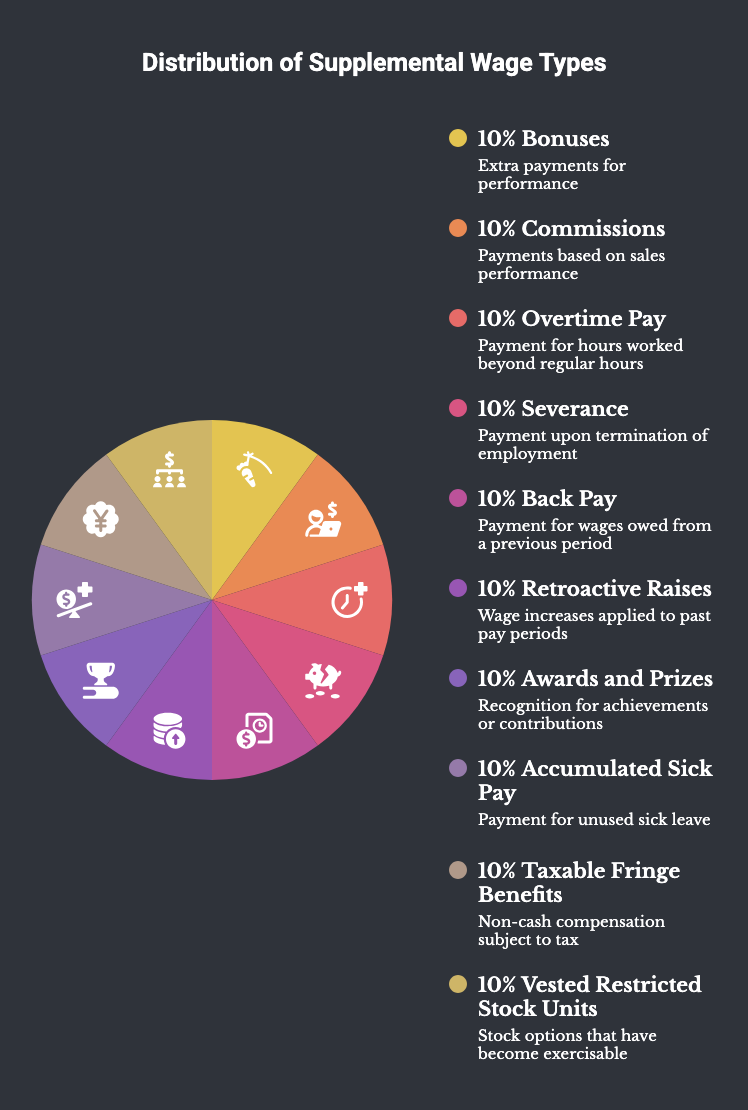
Supplemental wages are wage payments that fall outside an employee's normal, scheduled pay. Section 7 of IRS Publication 15 lists the usual suspects: bonuses, commissions, overtime pay, severance, back pay, retroactive raises, awards and prizes, accumulated sick pay, taxable fringe benefits, and even the value of vested restricted stock units.
A quick gut check helps. If the payment is the steady salary or hourly amount an employee expects each period, it is a regular wage. If it is extra, tied to performance, a one-off, or an add-on to the paycheck, treat it as a supplemental wage. When you are stuck deciding between a regular wage payment and something else, most of these extras land in the supplemental bucket.
For the income tax piece, the IRS gives employers two methods, and you get to pick the one that fits the situation.
The flat percentage method is the crowd favorite. If you pay supplemental wages separately from regular wages, or you identify the supplemental amount separately on the same check, you can withhold federal income tax at a flat 22%. One condition trips people up: you can only use the 22% flat rate if you withheld income tax from that employee's regular wages in the current or prior year. It is clean, predictable, and fast to run across a whole team.
The aggregate method is the other route. Here you add the supplemental wages to the regular wages paid for that payroll period, then withhold on the combined amount using the employee's Form W-4 and the Publication 15-T tables, as if it were one ordinary paycheck. This often pulls more tax up front, because the lump sum makes the paycheck look bigger to the tables than a normal period would. If what you are paying is specifically a year-end bonus, we walk through that math in more detail there.
There is a hard ceiling worth knowing. Once an employee's supplemental wages during the calendar year cross $1 million, the portion above that line stops being optional. You must withhold federal income tax on the excess at a flat 37%, which matches the highest rate of income tax. No 22%, no aggregate choice, just 37% on the amount over a million.
Why 22% and 37% in 2026? Because P.L. 119-21, the One Big Beautiful Bill Act, permanently extended the individual tax rates from the 2017 law. As a result, Publication 15 keeps the supplemental tax rate at 22%, with 37% on anything above a million. Same figures as the last few years, now on a permanent footing instead of a sunset.
This one is worth stating plainly, because it generates a lot of confused emails from employees. The 22% is a withholding rate, not the actual tax rate on that money. The real income tax owed on a bonus or commission gets sorted out on the employee's federal tax return alongside the rest of their income.
So a worker in a lower bracket often has too much tax withheld and gets it back as part of a federal tax refund. Someone near the top bracket can be under-withheld and owe a little more in April. If an employee wants to sanity-check their year, point them to the IRS Tax Withholding Estimator, which shows whether their total withholding is on track.
The special 22% or 37% treatment covers federal income tax only. Every other payroll tax rides along on supplemental wages exactly the way it does on regular pay, so do not let the flat rate fool you into thinking these payments get a break.
That means Social Security tax at 6.2% up to the 2026 wage base of $184,500, Medicare tax at 1.45% on all wages with no cap, and an extra 0.9% Additional Medicare Tax once a worker's wages pass $200,000. On the employer side, you also owe federal unemployment tax, which you report on Form 940. You deposit the money through the Electronic Federal Tax Payment System and report the federal income tax withheld plus Social Security and Medicare on your quarterly Form 941. Keep in mind that taxable fringe benefits are supplemental wages too, so the same employment taxes apply to their value.
Two things come up a lot. First, tips. Even though they are extra money, the IRS generally has you treat tips as regular wages rather than supplemental wages for withholding, so they do not get the flat 22% treatment.
Second, the 2025 tax law added temporary deductions for qualified tips and overtime that employees can claim through 2028. Those are employee deductions taken on the individual tax return, not a change to payroll. They do not change how you, the employer, withhold on a supplemental wage payment. Keep withholding as usual and let the deduction sort itself out when the employee files.
What are supplemental wages?
Supplemental wages are payments outside an employee's regular, scheduled pay, such as bonuses, commissions, overtime, severance, back pay, awards, and taxable fringe benefits. The IRS defines them in Section 7 of Publication 15, and they follow special income tax withholding rules.
What is the supplemental wage withholding rate for 2026?
The flat rate is 22% on supplemental wages up to $1 million paid to one employee in a calendar year, and a mandatory 37% on any amount above $1 million. Those rates held for 2026 because the individual tax rates were made permanent.
When can I use the flat 22% rate?
You can use the 22% flat rate when the supplemental wages are paid separately or identified separately from regular wages, and you withheld income tax from that employee's regular wages in the current or prior year. If not, you use the aggregate method.
What is the aggregate method?
You combine the supplemental wages with the regular wages for the payroll period and withhold federal income tax on the total using the employee's Form W-4 and the Publication 15-T tables, as if it were one normal paycheck. It usually withholds more up front.
Are bonuses taxed at a higher rate than regular wages?
Not really. A bonus is a supplemental wage, and the 22% is only a withholding rate, not the final tax. The actual tax is figured on the employee's return, so many people get part of it back as a refund.
Do Social Security and Medicare apply to supplemental wages?
Yes. Social Security at 6.2% up to the $184,500 wage base for 2026, Medicare at 1.45% on all wages, and the extra 0.9% over $200,000 all apply. Employers also owe FUTA on these wages.
Are tips considered supplemental wages?
Generally no. For withholding purposes, the IRS treats tips as regular wages rather than supplemental wages, so the flat 22% supplemental rate does not apply to them.
Is the 22% withholding the final tax on a bonus?
No. It is a withholding rate that estimates the tax. The final amount is settled on the employee's federal tax return, which can produce a refund or a balance due depending on their total income.
Supplemental wage runs are where clean payroll earns its keep, since one mislabeled bonus or a missed $1 million threshold can throw off a W-2 and a whole quarter of filings. That is the work Madras Accountancy handles for US CPA firms, running accurate payroll, applying the right withholding on every supplemental wage payment, and filing the 941s and 940s on time. You can reach out here.
This is general information, not tax advice, so confirm the specifics for any client with their preparer.

DeFi tax reporting in 2026: which DeFi crypto transactions are taxable, what forms to file, and why no broker reports your digital asset activity.

The 45L tax credit rewards builders of energy-efficient homes. See who is eligible, how much it is worth, and if you can still claim it.

A donor-advised fund is the fastest-growing charitable giving vehicle in the US. Here is how DAFs work, their tax benefits, and the 2026 rules.



