


The cash flow statement is the one financial statement that shows you the actual cash moving through your business, not the profit on paper. Your income statement can look healthy while your bank account runs dry, and the statement of cash flows is what explains the gap.
There are two ways to build it: the direct method and the indirect method. Both arrive at the same answer, they just get there differently. The direct method lists your real cash receipts and cash payments. The indirect method starts with net income and works backward, adjusting for the non-cash items that make profit and cash disagree. Most businesses use the indirect method, and once you see why, the whole statement makes more sense.
This guide is the practical one. It walks through what the cash flow statement contains, how the three sections fit together, the real difference between the direct and indirect method, and how to prepare a cash flow statement step by step. By the end you should be able to build one from your own numbers rather than just nod along when your accountant hands it over.
The cash flow statement, also called the statement of cash flows, is one of the three core financial statements alongside the income statement and balance sheet. Its job is narrow and useful: track the actual cash that came in and went out over a period, and reconcile where your cash started to where it ended.
This is where accrual accounting and cash reality part ways. Under accrual accounting, your income statement records revenue when it is earned and expenses when they are incurred, even if no cash has changed hands. The cash flow statement ignores all that timing and follows the money itself, on a cash basis. That is why a profitable business can still run out of cash, and only this statement will show it clearly. If you want the wider view of how all three reports fit together, our guide on how to read financial statements covers that, and the SEC's plain-language guide to financial statements is a solid reference too.
Every cash flow statement sorts cash movements into three buckets, and understanding them is half the battle. Each one answers a different question about where your cash came from and where it went.
Operating activities cover the cash generated by your core business, the day-to-day cash inflows and outflows from selling to customers and paying suppliers and staff. This is the operating cash flow, and it is the section most people care about, because it shows whether the business itself produces cash. The cash flow from investing activities covers cash tied to long-term assets, like buying equipment or selling property. Financing activities cover cash from loans, investors, and owners, so the cash flow from financing activities captures new debt, repayments, and owner distributions.
Add the three together and you get the net cash flow for the period, which is simply the change in cash from start to finish. Positive means more cash came in than went out. Negative is not automatically bad, since a growing company often shows negative cash flow from investing while it buys assets, but it is always worth understanding why.
Here is the fork in the road. The direct and indirect method differ only in how they present the operating activities section. The investing and financing sections look identical either way. So the whole debate is really about one thing: how you show operating cash flow.
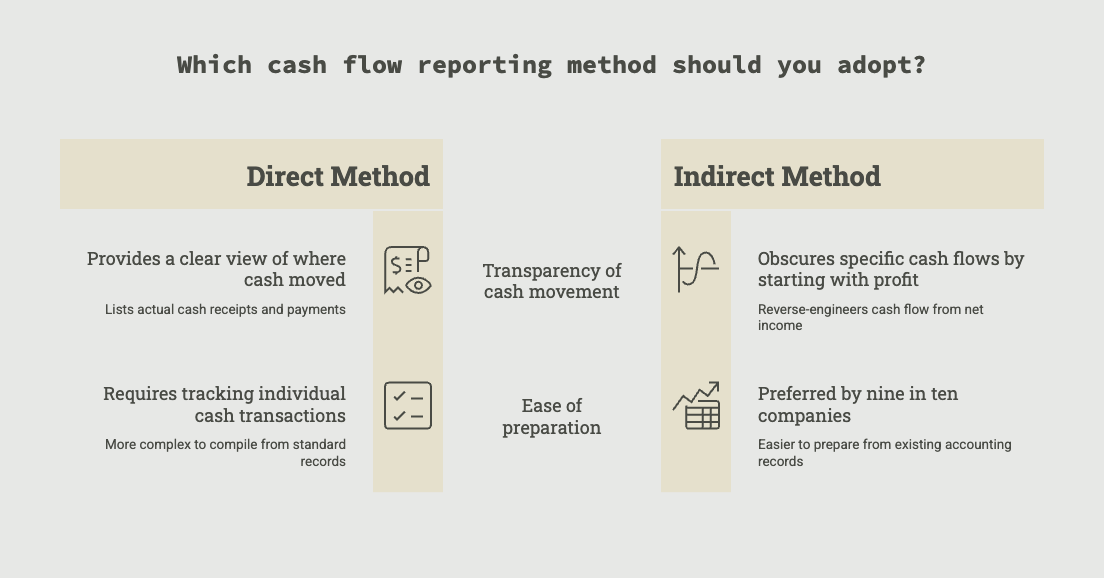
The direct method lists actual cash transactions. It shows cash received from customers, cash paid to suppliers, cash paid to employees, and so on, adding up real cash receipts and cash payments to reach operating cash flow. It is the more transparent view, because you can see exactly where the cash moved.
The indirect method takes a different route. It starts with net income from your income statement, then adjusts that figure to strip out anything that affected profit but not cash. Both methods land on the same operating cash flow total. The difference is that the direct method counts cash directly, while the indirect approach reverse-engineers it from profit. Around nine in ten companies choose the indirect method, mostly because it is easier to prepare from records they already keep.
Since the indirect method is what most businesses actually use, this is the one worth learning to build. You will need two things in front of you: your income statement and balance sheet for the period, since it pulls from both.
Start with net income at the top, straight from the income statement. Then add back non-cash expenses, the costs that lowered profit but did not move any cash. Depreciation and amortization are the big ones, so you add them back in. Next, adjust for changes in working capital, which you find by comparing balance sheet accounts between the start and end of the period. A rise in accounts receivable means customers owe you more and less cash actually arrived, so you subtract it. A rise in accounts payable means you held onto cash longer, so you add it. Work through inventory, receivables, and payables the same way.
Once those adjustments are done, you have your cash flow from operating activities. Then you list the investing activities and financing activities in actual cash terms, add all three sections, and apply that net change to your opening cash and cash equivalents. The result is your ending cash balance, which should tie exactly to the cash line on your balance sheet. When it ties, you know you built it right. If you keep clean books, our balance sheet template and example shows the report those working capital figures come from.
The direct method skips the net income gymnastics and simply reports cash as it moved. Instead of starting with profit, you list the actual cash inflows and outflows in the operating section: cash collected from customers, cash paid to vendors, wages paid, interest paid, taxes paid. Total them up and you have operating cash flow, calculated straight from cash transactions.
The upside is clarity. Anyone reading a direct-method statement can see precisely where cash came from and where it went, with no add-backs to interpret. The downside is effort. Most accounting systems are built around accrual entries, so pulling clean cash receipts and cash payments for every category takes extra work. That effort is the main reason the direct method stays less common, even though standard setters have long encouraged it. Whichever route you take, the operating cash flow total is the same, so the choice is about presentation, not the answer.
A finished cash flow statement is one of the fastest reads on financial health you can get. The single most important line is operating cash flow, or cash flow from operations, because it shows whether the core business generates enough cash to sustain itself without borrowing or selling assets. Strong, steady operating cash flow is the sign of a healthy company.
From there, the net cash flow tells you the overall change in cash for the period, and the ending balance should match the cash and cash equivalents on your balance sheet. Negative cash flow deserves a closer look rather than a panic, since the cause matters. Negative operating cash flow is a warning sign. Negative investing cash flow often just means you invested in growth. Reading the three sections together tells the real story, which is the kind of insight our management reporting support is built to surface, and it is exactly what lenders look for in your audited financial statements.
One quick distinction clears up a common mix-up. The cash flow statement is historical. It reports the cash that already moved during a past period, as part of your financial statements. A cash flow forecast is the opposite direction, projecting the cash you expect in the future so you can plan ahead.
Both are central to good cash flow management, and they feed each other, since a solid forecast is built on the patterns your past statements reveal. If planning ahead is your focus, our guides on cash flow forecasting tools and techniques and forecasting for seasonal businesses pick up where this article leaves off.
Worth saying plainly. A cash flow statement is only as accurate as the bookkeeping underneath it. If transactions are miscoded or the balance sheet is not reconciled, the working capital adjustments go wrong and the statement will not tie, no matter which method you use.
That is the part we handle at Madras Accountancy. Since 2015 we have run offshore accounting and bookkeeping support for U.S. CPA firms and the businesses they serve, keeping the books clean so the cash flow statement, income statement, and balance sheet all agree at close. If your statements never seem to reconcile, or you would rather hand the preparation off entirely, talk to our team and we will take it from there.
What is a cash flow statement? A cash flow statement, or statement of cash flows, is one of the three main financial statements. It tracks the actual cash that flowed into and out of a business over a period and reconciles the opening cash balance to the ending one. Unlike the income statement, which uses accrual accounting, the cash flow statement follows real cash movements. It is split into three sections, operating, investing, and financing activities, and it is the clearest way to see whether a business is generating enough cash.
What are the three sections of a cash flow statement? A cash flow statement has three sections. Operating activities show cash from the core business, like collecting from customers and paying suppliers and staff. Investing activities show cash tied to long-term assets, such as buying or selling equipment. Financing activities show cash from loans, investors, and owner distributions. Adding the cash inflows and outflows across all three gives the net cash flow, the overall change in cash for the period, which ties to the cash and cash equivalents on the balance sheet.
What is the difference between the direct and indirect method? The direct and indirect method only differ in how they present the operating activities section. The direct method lists actual cash receipts and cash payments, such as cash collected from customers and cash paid to suppliers. The indirect method starts with net income and adjusts for non-cash items and changes in working capital to arrive at operating cash flow. Both produce the same operating cash flow total. The investing and financing sections are identical under either method, so the choice is about presentation.
How do you prepare a cash flow statement using the indirect method? Start with net income from the income statement. Add back non-cash expenses like depreciation and amortization. Then adjust for changes in working capital by comparing balance sheet accounts between periods: subtract increases in receivables and inventory, add increases in payables. That gives cash flow from operating activities. Next, list the investing and financing activities in cash terms. Add all three sections to get the net change in cash, apply it to opening cash, and the ending balance should match the cash on your balance sheet.
Why do most companies use the indirect method? Most companies use the indirect method because it is easier to prepare from the records they already keep. Accrual-based accounting systems track net income and balance sheet changes naturally, and this method builds directly on those figures. The direct method requires pulling clean cash receipts and cash payments for every category, which takes extra effort most teams would rather avoid. Around nine in ten public companies use the indirect method, even though standard setters have long expressed a preference for the direct approach.
What is the difference between a cash flow statement and a cash flow forecast? A cash flow statement is a historical financial statement that reports cash movements that already happened during a past period. A cash flow forecast projects expected future cash so you can plan ahead and spot shortfalls before they hit. The statement is about the past and forms part of your financial statements, while the forecast is a planning tool for cash flow management. They work together, since a reliable forecast is built on the patterns that past cash flow statements reveal.
What does negative cash flow on the statement mean? Negative cash flow means more cash left the business than came in during the period, but it is not automatically a problem. The cause matters. Negative operating cash flow is a genuine warning sign, since it means the core business is not generating enough cash. Negative investing cash flow is often healthy, because it usually means the company is buying assets to grow. Negative financing cash flow can simply mean debt is being repaid. Read the three sections together before drawing a conclusion.
How does Madras Accountancy help with the cash flow statement? Madras Accountancy prepares and supports the cash flow statement as part of clean, reconciled financials. As an offshore partner to U.S. CPA firms and the businesses they serve, we handle the bookkeeping, working capital adjustments, and statement preparation so the cash flow statement ties to the balance sheet every time, using the direct or indirect method as needed. Since 2015 we have kept complex financials accurate and on time. You can reach our team through the contact link above.

The section 4960 excise tax is 21% of nonprofit pay over $1M. From 2026 it covers all employees. See the medical carve-outs, Form 4720 and a worked example.

The paid family and medical leave tax credit is permanent from 2026. See the 12.5% to 25% rates, the premium option, the 6-month rule and how Form 8994 works.

Opportunity zones become permanent in 2027 under the One Big Beautiful Bill. See the new deferral, rural bonus, and the 2026 handoff.