

Outsourcing can reduce burnout by removing repetitive, low-value tasks from your team's workload. It can also spike anxiety and resentment if staff interpret the change as a threat to their job security or professional value. Both reactions make sense. The difference between which reaction dominates depends entirely on how the change is communicated, implemented, and managed. If your team hears offshore support and thinks replacement, morale will drop immediately. If they see it as help that lets them do more meaningful work, morale often improves.
Do not pretend the change is invisible or minor. Outsourcing is a significant operational shift that affects how work gets done, who does what, and how staff spend their time. Trying to downplay it or slide it in quietly creates suspicion and rumors. Staff will fill the information void with worst-case assumptions, and those assumptions spread faster than facts.
Explain why you are making the change. The workload is growing faster than the firm can hire. Recruiting is slow, and training new hires takes months before they are productive. Deadlines and quality standards have not changed, but capacity has not kept pace. Outsourcing is how the firm plans to add capacity without waiting for the local hiring market to improve.
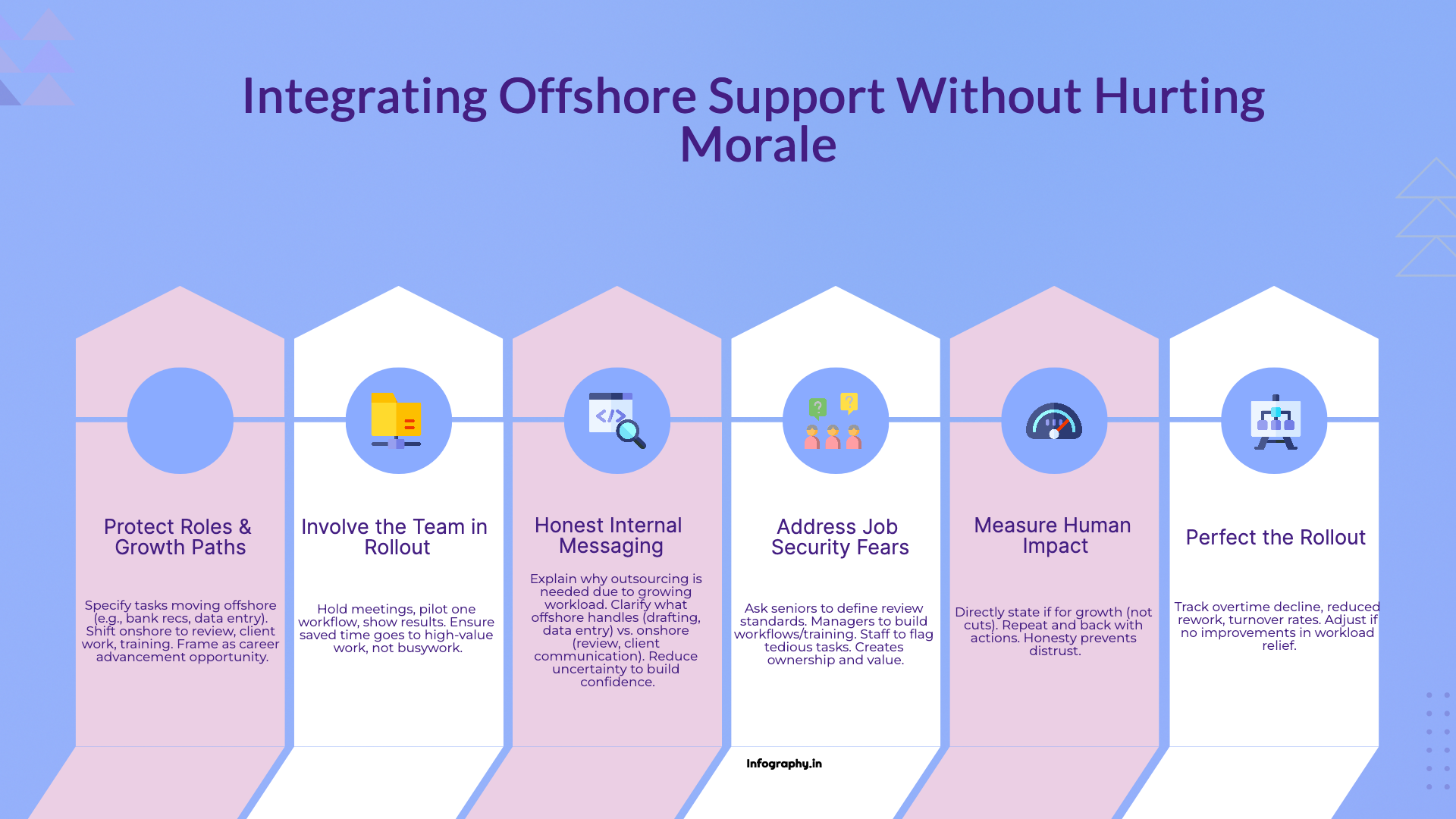
Be explicit about what outsourcing is and what it is not. Offshore support handles drafting, data entry, and production work. Onshore staff keep review, client communication, technical judgment, and final responsibility. The role of the onshore team is not shrinking. It is shifting to higher-value work that requires experience, judgment, and client relationships. Those are skills the offshore team cannot replace.
This clarity prevents the most damaging form of anxiety, which is uncertainty about the future. When staff understand exactly what will change and what will stay the same, they can evaluate the impact on their own role and make informed decisions about whether they support the change. Ambiguity breeds fear. Specificity creates confidence.
Morale drops when people do not know what their job will look like next quarter. If a senior accountant has been preparing tax workpapers for three years and suddenly that work is going offshore, what does the senior accountant do now? If the firm does not answer that question clearly, the senior accountant will assume the worst.
Define what onshore staff will stop doing. Be specific about which tasks are moving offshore. Bank reconciliations, workpaper assembly, and data entry are common candidates. List them explicitly so there is no confusion about scope.
Define what onshore staff will do more of. Review, client calls, training junior staff, and process improvement are typical answers. These are higher-value activities that use the skills the onshore team has developed through experience. Framing the change as a shift from production to review and advisory positions it as a career advancement opportunity, not a demotion.
Show a path forward. Junior staff move to senior roles by taking on more review and client interaction, not by becoming faster at data entry. Senior staff move to manager roles by developing judgment, training others, and managing client relationships. When outsourcing removes the production bottleneck, these advancement paths become more realistic because senior staff have time to mentor and managers have time to develop strategic relationships. Make that connection explicit.
People support what they help build. When you involve onshore staff in designing the outsourcing workflow, they become stakeholders rather than victims of change. Their input shapes the process, and they have ownership over its success.
Ask senior staff to define the review standards. They know what good work looks like and what errors are most common. Their expertise should inform the review checklist and quality metrics. When the offshore team's work is reviewed against standards the senior staff created, the seniors feel valued and respected, not bypassed.
Ask managers to help build the workflow and training materials. They understand the firm's processes, the client expectations, and the edge cases that cause problems. Their knowledge is essential to creating documentation that actually works. When managers contribute to the training, they have a vested interest in the offshore team succeeding because it reflects on their own work.
Let staff flag tasks that drain time and add little learning value. Not all production work is equally tedious. Some tasks are mind-numbing and teach nothing. Others are repetitive but build foundational skills. Ask the team which tasks they would gladly hand off and which tasks are valuable for training. Use that input to prioritize what gets outsourced first.
The unspoken fear in every outsourcing conversation is job loss. Will I lose my job? Will my hours get cut? Is this the first step toward replacing the whole team? If you do not address this fear directly, it festers and dominates every other conversation.
If your intent is to grow capacity without adding full-time staff, say that clearly. Many firms use offshore support to handle growth that would otherwise require hiring three to five additional onshore employees. The existing team stays intact, the workload becomes manageable, and the firm can take on new clients or services without overloading current staff. If that is the plan, put it in plain language and repeat it until people believe it.
If your intent is cost-cutting and headcount reduction, do not pretend otherwise. Dishonesty about layoffs destroys trust permanently. If the firm is restructuring and some roles will be eliminated, communicate that with transparency and treat departing employees with respect. Trying to hide layoffs behind outsourcing language makes the remaining staff distrust every future communication from leadership.
Most firms fall into the first category. They are not cutting staff. They are trying to manage growth and reduce burnout. But staff will not know that unless you say it explicitly, repeatedly, and back it up with actions. If you tell the team that outsourcing is about growth, and then you lay people off six months later, you have destroyed your credibility for years.
Track whether outsourcing is actually improving the employee experience or just redistributing stress. Weekly overtime hours should decline if outsourcing is removing workload. If overtime stays the same or increases, the workflow is not delivering the promised relief.
Time spent on rework and cleanup should decrease as the offshore team's quality improves. If rework time increases, the training or process documentation needs improvement. Rework that consumes more time than the original task would have taken defeats the purpose of outsourcing.
Turnover rate and exit interview themes reveal whether staff morale is improving. If turnover drops after implementing outsourcing, that suggests the workload reduction is making a difference. If turnover increases or exit interviews mention concerns about outsourcing threatening job security, the communication or implementation needs adjustment.
Explain the why and the workflow clearly to the entire team before any work moves offshore. Hold a meeting, answer questions, and provide written documentation they can reference later. Do not rely on informal communication or assume people will figure it out.
Start with one pilot workflow and show results. Let the team see that the offshore support delivers quality work, that review time is reasonable, and that the promised time savings are real. Success with the pilot builds confidence for expanding scope. Failure with the pilot allows you to fix problems before they affect the entire operation.
Make sure the time saved turns into better work, not more chaos. If outsourcing frees up ten hours per week for a senior accountant, those hours should go toward review, training, or client work, not toward filling the time with low-value meetings and administrative busywork. Protect the freed capacity and use it strategically, or the team will conclude that outsourcing changed nothing.
If the rollout is handled well, with honest communication, clear role definitions, and real workload relief, morale improves. Staff stop drowning in repetitive tasks and start doing work that uses their skills and builds their careers. That is the morale outcome you want, and it is achievable if you manage the change thoughtfully rather than treating it as a purely operational decision.

Section 4960's 21% excise tax now reaches far more nonprofit employees. See who is a covered employee in 2026 and what changed.

The Section 45S paid family leave credit is permanent for 2026 with new options. See who qualifies, the amounts, and how to claim it.

Opportunity zones become permanent in 2027 under the One Big Beautiful Bill. See the new deferral, rural bonus, and the 2026 handoff.