

.png)

The IRS treats repairs as immediately deductible expenses that restore property to its original condition, while capital improvements must be capitalized and depreciated over 27.5-39 years.
Repairs fix existing problems without adding value, like patching a leaky roof section. Capital improvements add value, extend useful life, or adapt property to new uses, like replacing the entire roof. The classification determines whether you deduct costs immediately or spread them over decades, potentially impacting your cash flow by thousands of dollars annually.

Repairs are expenses that keep property in ordinary operating condition without materially adding value or substantially prolonging its useful life. The IRS views repairs as maintenance activities that restore property to its previous state. Examples include fixing broken windows, patching drywall holes, replacing damaged floor tiles, repairing plumbing leaks, or painting walls.
These costs are immediately deductible as ordinary business expenses under IRC Section 162. This means property owners can deduct 100% of repair costs in the year paid, providing immediate tax relief. However, the repair must not be part of a larger improvement project.
If you patch a roof leak as part of routine maintenance, it's deductible. If the patch occurs during a complete roof replacement, it becomes part of the capitalized improvement. For property owners managing multiple rental units, maintaining accurate records through proper bookkeeping practices that avoid common accounting mistakes ensures you don't miss valuable repair deductions.
Capital improvements are expenditures that materially add value to property, substantially prolong its useful life, or adapt it to new uses. According to IRS Publication 527, an improvement must meet at least one of three criteria to require capitalization.
The improvement adds value by making the property more desirable, functional, or marketable than before. It extends useful life by substantially prolonging how long the property can serve its intended purpose beyond normal wear. It adapts to new uses by converting the property to serve a different function. Common capital improvements include replacing entire roofs, installing new HVAC systems, adding rooms or square footage, upgrading electrical or plumbing systems, and installing new flooring throughout. These costs must be added to the property's basis and depreciated over 27.5 years for residential rentals or 39 years for commercial property.
The IRS uses the BAR test to determine if an expense must be capitalized. BAR stands for Betterment, Adaptation, and Restoration. If your expense meets any of these three criteria, it must be treated as a capital improvement.
Betterment applies when you materially increase the capacity, productivity, efficiency, strength, or quality of property. Replacing a standard water heater with a tankless system qualifies as betterment. Adaptation occurs when you convert property to a new or different use inconsistent with its original purpose. Converting residential apartments to commercial office space requires capitalization.
Restoration applies when you return property to operating condition after deterioration to a state of disrepair, or replace major components or substantial structural parts. Replacing an entire HVAC system, all windows, or complete electrical wiring constitutes restoration requiring capitalization. Understanding these classifications becomes particularly important when dealing with legitimate tax strategies versus improper tax practices.
The IRS provides three safe harbors that allow immediate deduction of certain expenses that would otherwise require capitalization. The de minimis safe harbor lets you deduct items costing $2,500 or less per invoice ($5,000 with an applicable financial statement). You must have written accounting procedures and make an annual election.
The small taxpayer safe harbor applies if your average annual gross receipts are $10 million or less and the building's unadjusted basis is $1 million or less. You can deduct all repairs, maintenance, and improvements if total annual amounts don't exceed the lesser of $10,000 or 2% of the property's basis. The routine maintenance safe harbor allows immediate deduction of costs to keep property in ordinary operating condition, including inspections, cleaning, testing, and part replacements. The maintenance must be reasonably expected to recur more than once during the property's class life (10 years for buildings). These safe harbors significantly simplify tax treatment for smaller landlords.
Real estate projects often combine repair and improvement work, making classification complex. The IRS requires careful documentation to separate deductible repairs from capitalized improvements. When repair work benefits from or is incurred because of an improvement, it must be capitalized with the improvement.
For example, if you replace bathroom fixtures (improvement) and also fix unrelated drywall damage during the same project, the drywall repair can be deducted separately if it doesn't directly benefit from the fixture replacement. However, if you repaint the bathroom as part of the fixture installation, the painting must be capitalized with the improvement. Document each expense separately, noting whether it's independent maintenance or part of the improvement project. Take before and after photos showing the scope of work. This documentation protects your position if the IRS questions your classification. Property investors managing complex renovation projects should consider implementing comprehensive budget tracking systems that separate repair and capital improvement categories from the start.
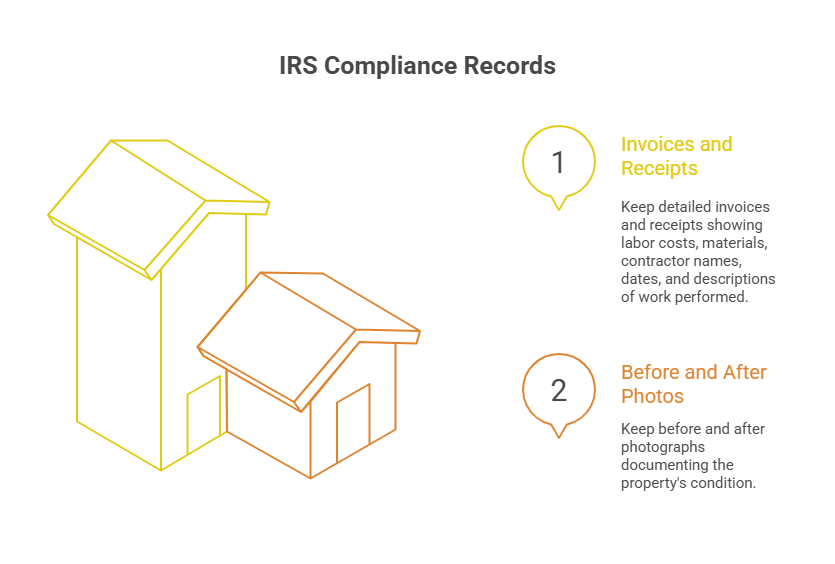
Meticulous record-keeping is essential for defending your expense classification during audits. Maintain detailed invoices and receipts showing labor costs, materials, contractor names, dates, and descriptions of work performed. Keep before and after photographs documenting the property's condition.
Create a property improvement log tracking all expenses by category, date, amount, and classification rationale. Save contracts and proposals showing the original scope of work. If scope expanded during the project, document why and when. Track depreciation schedules for all capital improvements, noting placed-in-service dates and recovery periods. Organize records by property and tax year, retaining everything for at least seven years. Consider using property management software that categorizes expenses automatically. The IRS can audit returns up to three years back (six years for substantial underreporting), so comprehensive records are your best defense against reclassification and penalties.
Capital improvements depreciate separately from the original property, with their own placed-in-service date. Residential rental property improvements use 27.5-year straight-line depreciation with mid-month convention. This means you divide the improvement cost by 27.5 years and deduct that amount annually.
For a $30,000 roof replacement, you deduct approximately $1,091 annually for 27.5 years. Commercial property improvements use 39-year depreciation. Certain qualified improvement property (QIP) for nonresidential buildings may qualify for accelerated 15-year depreciation. The placed-in-service date is when the improvement is ready and available for use, not necessarily when construction begins. Track each improvement separately because selling property before full depreciation triggers depreciation recapture, taxing previously deducted amounts at ordinary income rates up to 25%. Strategic planning around depreciation methods and tax-saving strategies can significantly impact your long-term tax liability.
Repairs restore property to its original condition without adding value, extending useful life, or adapting it to new uses. These expenses are immediately deductible. Capital improvements add value, prolong useful life, or adapt property to new uses. Examples include replacing an entire roof (improvement) vs. patching a few shingles (repair). Capital improvements must be capitalized and depreciated over 27.5 years for residential rental property or 39 years for commercial property.
The BAR test helps determine if an expense must be capitalized. It stands for Betterment (materially increases capacity, productivity, or quality), Adaptation (converts property to a new or different use), and Restoration (returns property to operating condition after it deteriorated to a state of disrepair, or replaces a major component). If any BAR criteria is met, the expense must be capitalized as an improvement rather than deducted as a repair.
Yes, through the small taxpayer safe harbor. If your average annual gross receipts are $10 million or less and the building's unadjusted basis is $1 million or less, you can deduct improvements if total annual amounts for repairs, maintenance, and improvements don't exceed the lesser of $10,000 or 2% of the property's basis. This election must be claimed annually on your tax return.
The de minimis safe harbor allows immediate deduction of items costing $2,500 or less per invoice (or $5,000 with an applicable financial statement). This applies to tangible property acquisitions and improvements that would otherwise need capitalization. You must have written accounting procedures in place and make an annual election. This safe harbor simplifies bookkeeping for small repairs and equipment purchases.
Residential rental property improvements depreciate over 27.5 years using the straight-line method. Commercial property improvements depreciate over 39 years. Certain qualified improvement property (QIP) for nonresidential buildings may qualify for 15-year depreciation. The depreciation period starts when the improvement is placed in service, and you use mid-month convention for real property improvements.
A planned repair can become a capital improvement if the scope expands significantly. For example, fixing a leaky section of roof (repair) may reveal extensive damage requiring full roof replacement (improvement). When this happens, you must capitalize the entire cost, even if you originally budgeted it as a deductible repair. Document the scope change to support your tax treatment.
Painting by itself is generally a deductible repair that maintains property condition. However, painting becomes part of a capital improvement if it directly benefits or is incurred as part of a larger improvement project. For example, painting after installing new siding or as part of a major remodel must be capitalized with the improvement project rather than deducted separately.
Madras Accountancy provides bookkeeping and tax preparation services for property owners and landlords. Since 2015, we've helped clients properly classify repairs versus capital improvements, apply IRS safe harbors, track depreciation schedules, and maximize deductions while maintaining compliance. Our team understands the BAR test and tangible property regulations to ensure your expenses receive correct tax treatment.
Correctly classifying repairs versus capital improvements directly impacts your immediate cash flow and long-term tax liability. Repairs provide immediate deductions, while improvements must be depreciated over 27.5-39 years. Use the BAR test (Betterment, Adaptation, Restoration) to determine classification, and take advantage of safe harbors for immediate deductions when eligible. Maintain detailed documentation including invoices, photos, and project logs to defend your position during IRS audits.
About Madras Accountancy: We've provided bookkeeping and tax services to property owners since 2015. Our team helps landlords and real estate investors properly classify expenses, maximize deductions, and maintain IRS compliance. Contact us for expert guidance on property expense classification and tax planning.

Section 4960's 21% excise tax now reaches far more nonprofit employees. See who is a covered employee in 2026 and what changed.

The Section 45S paid family leave credit is permanent for 2026 with new options. See who qualifies, the amounts, and how to claim it.

Opportunity zones become permanent in 2027 under the One Big Beautiful Bill. See the new deferral, rural bonus, and the 2026 handoff.