


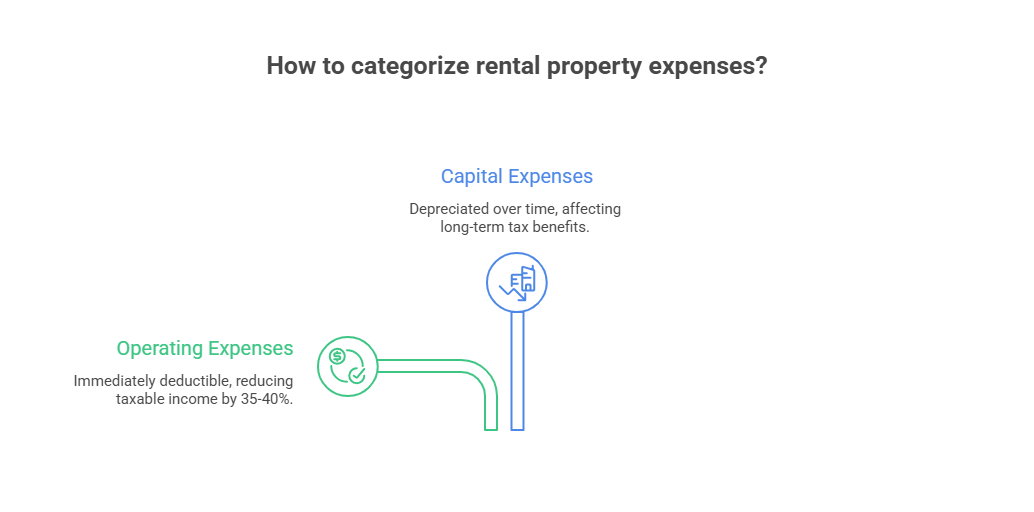
Landlord expense categorization is classifying rental property costs into IRS-approved categories, operating expenses (immediately deductible) versus capital expenses (depreciated over time). Correct categorization affects your tax bill directly. The IRS allows landlords to deduct ordinary and necessary expenses, reducing taxable rental income by 35-40% on average.
You bought your first rental last year. Tax season arrives with $18,000 in receipts, new roof, management fees, repairs. Your software asks if each expense is "deductible" or "capital." You guess wrong on the $8,000 roof. Two years later, the IRS audits you, disallows the deduction, and adds $2,400 in back taxes plus penalties.
Thousands of landlords face this annually. The difference between a repair (deductible now) and improvement (depreciated over 27.5 years) costs thousands. This guide breaks down how to categorize every rental expense in 2025.
Incorrect categorization triggers three problems. First, you overpay taxes, claiming a $5,000 repair as capital means deducting $182 annually instead of $5,000 now. Second, improper deductions create audit risk. The IRS targets rental income because many landlords misclassify capital expenses. Third, poor tracking complicates cash-on-cash return calculations.
Landlords who track correctly save $8,000-$15,000 annually on a five-property portfolio. The key: understanding which costs reduce income immediately versus which add to property basis for depreciation.
Operating expenses maintain your property's current condition and are fully deductible in the tax year incurred. Capital expenses improve the property, extend its life, or adapt it for new uses, these get depreciated over 27.5 years for residential properties.
Operating Example: Tenant's faucet breaks. You replace it with a similar model for $150. This maintains existing condition, deduct the full $150 this year.
Capital Example: You gut the bathroom, replacing vanity, toilet, tub, flooring, and lighting with upgrades. Cost: $12,000. This improves beyond original condition, depreciate over 27.5 years, deducting roughly $436 annually.
The IRS uses three tests: Does it materially increase value? Substantially prolong useful life? Adapt to new use? If yes to any, it's capital.
Key mistake: combining multiple repairs into one project. Repainting, fixing doors, and replacing carpet might seem routine. But if done right after purchase as "rent-ready" work, the IRS reclassifies it as capital. Keep projects separate and document their purpose.
Property Management & Professional Fees: Management companies charge 8-10% of rent plus leasing fees, fully deductible. Legal fees for evictions, accounting for tax prep, and appraisals qualify. Acquisition legal fees get capitalized.
Property Taxes & Insurance: Real estate taxes are 100% deductible in the year paid. Property tax rates vary significantly by state. Landlord insurance premiums (typically $800-$2,500 annually) are deductible.
Repairs & Maintenance: Restore operating condition without material improvement. Examples: fixing leaks, patching drywall, replacing broken appliances with similar models. Keep "like-for-like" receipts.
Utilities & Services: Water, sewer, electric, trash provided to tenants are deductible. Pest control, lawn care, snow removal maintain property condition.
Travel, Advertising & Software: Track mileage at $0.67 per mile in 2025. Zillow listings, tenant screening, and background checks are deductible. Property management software qualifies.
Capital expenses reduce taxable income through depreciation. Understanding these helps maximize Section 179 and bonus depreciation opportunities.
Major Improvements: New roofs, HVAC replacements, additions add to property basis. A $15,000 roof generates $545 annual depreciation for 27.5 years.
Renovations & Acquisitions: Kitchen remodels, bathroom upgrades, flooring throughout, purchase price, and closing costs get capitalized.
Cost segregation studies can reclassify components into shorter depreciation periods, accelerating deductions significantly.
The IRS requires "adequate records", receipts, invoices, canceled checks, and business purpose documentation.
System Essentials: Open dedicated bank accounts. Photograph every receipt immediately and store in cloud software. Use MileIQ or TripLog for automatic mileage tracking. Track income and expenses separately for each property.
Documentation Standards: Every deduction needs date, vendor, amount, property address, and purchase description. For repairs, add before/after photos. For professional services, keep engagement letters.
Understanding key 2025 tax law changes helps adapt your tracking to new requirements and identify emerging deduction opportunities.
Security Deposits: Not rental income when received, only report if kept for unpaid rent or damages. Many landlords incorrectly inflate income by reporting deposits.
Personal Use Allocation: If you use the rental personally for 14+ days annually or 10% of rental days, allocate expenses between rental and personal use. Only the rental portion is deductible.
Misclassifying Improvements as Repairs: Replacing damaged shingles = repair. Replacing entire roof = improvement. Landlords often try immediate deductions on major projects, but the IRS catches this through property value comparisons.
Forgetting Depreciation: You must depreciate rental properties even if you don't claim the deduction. Skip it for three years then sell, and the IRS calculates capital gain as if you had claimed it, you lose the benefit but still face depreciation recapture taxes.
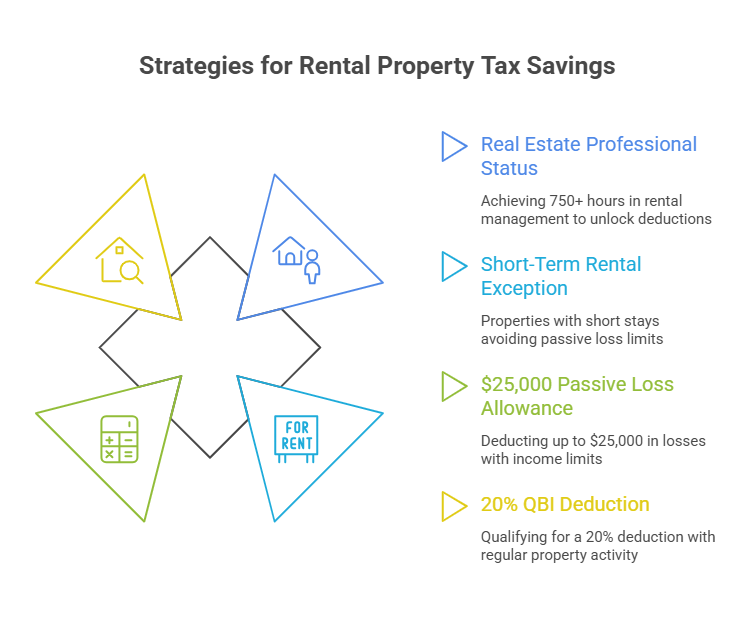
Real Estate Professional Status: Spend 750+ hours annually managing rentals as your primary business to unlock unlimited passive loss deductions against ordinary income, potentially saving $15,000-$30,000 annually.
Short-Term Rental Exception: Properties with average stays under seven days (or under 30 with substantial services) aren't subject to passive loss limits. Airbnb owners can deduct unlimited losses without real estate professional status.
$25,000 Passive Loss Allowance: Actively managing landlords can deduct up to $25,000 in rental losses against ordinary income if MAGI is below $100,000 (phases out at $150,000).
20% QBI Deduction: Rental properties operated as a business may qualify for the Section 199A deduction. This requires regular activity, advertising, tenant management, upkeep. Many miss this $4,000-$8,000 annual deduction.
DIY tracking works for 1-2 simple properties. Beyond that, professional help pays for itself through tax savings.
Hire a CPA when: You own 3+ properties, annual rental income exceeds $75,000, you're considering real estate professional status, you complete major renovations, or you've received an IRS audit notice.
Consider outsourced bookkeeping when: You spend 10+ hours monthly on rental bookkeeping, own properties in multiple states, or need professional financial statements for refinancing.
Madras Accountancy has processed accounting for 500+ rental properties since 2015, helping landlords reduce tax liabilities by an average of $11,000 annually through proper expense categorization and strategic planning.
Can I deduct mortgage interest and property taxes on rental properties?
Yes. Mortgage interest on loans for rental properties is fully deductible on Schedule E with no income limitations. Property taxes paid are 100% deductible as operating expenses in the year paid.
What rental expenses can I deduct if the property is vacant?
You can deduct expenses for vacant properties if you're actively marketing them for rent, insurance, property taxes, utilities, maintenance, and advertising. If you stop marketing, expenses become non-deductible until you resume rental activity.
How do I categorize repairs made immediately after purchasing a rental property?
Repairs to get a property rent-ready typically must be capitalized and depreciated, not immediately deducted. The IRS views these as acquisition costs. Routine maintenance clearly separate from renovation can remain deductible.
Are HOA special assessments for improvements deductible?
Special assessments for capital improvements (new roof, elevator) must be capitalized and depreciated over 27.5 years. Regular assessments for maintenance remain immediately deductible as operating expenses.
Can I deduct expenses for rental property in a different state?
Yes, all ordinary and necessary rental expenses are deductible regardless of location. However, you must file state returns in each state where you own rental property and report rental income.
How does the home office deduction work for rental property management?
If you use part of your home exclusively for rental management, you can deduct allocated home expenses (mortgage interest, property taxes, utilities) to that space. This requires documentation of exclusive business use.
What happens if I misclassify an expense and the IRS catches it?
The IRS will reclassify, adjust taxable income, and charge back taxes plus interest. Penalties can add 20-40% if the error appears intentional. For unintentional errors, file Form 1040-X to correct before an audit.
Should I use cash or accrual accounting for rental properties?
Most individual landlords use cash-basis accounting, reporting income when received and expenses when paid. This simplifies recordkeeping and aligns with Schedule E requirements.
Proper expense categorization transforms break-even rentals into wealth-building machines. Landlords saving $8,000-$15,000 annually don't own better properties, they simply track correctly and distinguish operating costs from capital improvements.
Start this week: open a dedicated bank account, download property accounting software, create a receipt photographing system, and schedule quarterly expense reviews. These four steps prevent 90% of landlord tax mistakes.
Contact Madras Accountancy to review your rental property expense tracking and identify immediate tax-saving opportunities with proper categorization systems.

Section 4960's 21% excise tax now reaches far more nonprofit employees. See who is a covered employee in 2026 and what changed.

The Section 45S paid family leave credit is permanent for 2026 with new options. See who qualifies, the amounts, and how to claim it.

Opportunity zones become permanent in 2027 under the One Big Beautiful Bill. See the new deferral, rural bonus, and the 2026 handoff.