


Ask ten small business owners how they handle their books and you’ll hear two broad camps. One swears by “my bookkeeper down the road – she’s brilliant.” The other has gone fully remote with an online firm or offshore team. Both groups think the other is slightly mad.
The truth, as usual, is somewhere in the messy middle. Local and remote models solve different problems. The trick is figuring out which problems you actually have.
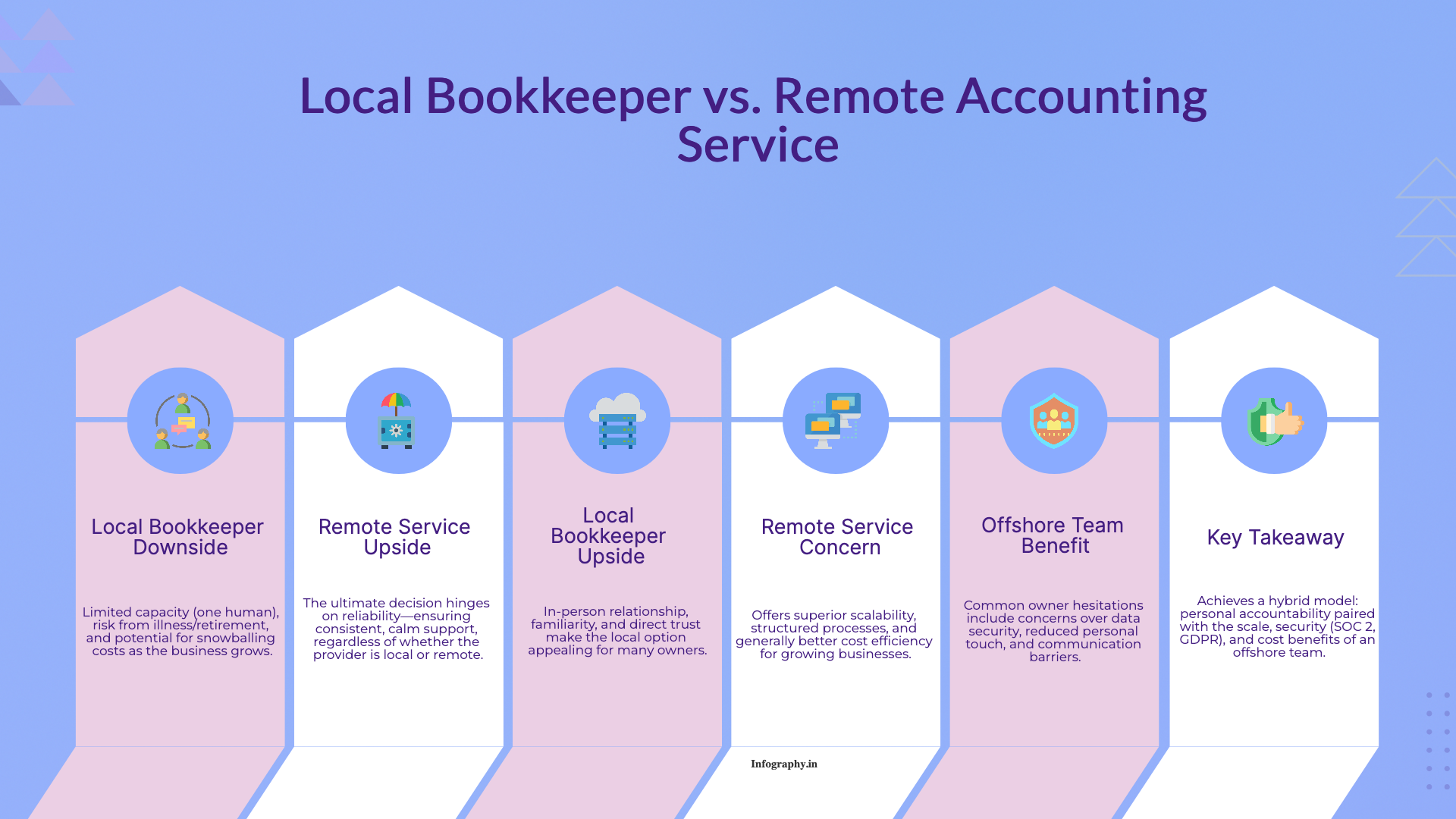
Let’s start with the traditional route. A local bookkeeper or CPA often comes via a referral: your lawyer, your neighbour, someone from your networking group. You meet in person, sign an engagement letter, and slowly hand over pieces of the back office.
There are real upsides:
For owners who are wary of faceless call centres, that in-person relationship is worth a lot.
The flip side? Capacity. Your local bookkeeper is, at the end of the day, one human. If they’re ill during your busiest month, or they decide to retire, you scramble. And as your business grows, the total cost of a fully loaded in-house bookkeeper (or small team) can snowball – salaries, benefits, software, training, the lot.
Madras Accountancy’s own offshore vs in-house calculators make that math uncomfortably clear: once you add everything up, the “cheap” in-house option isn’t always that cheap.
On the other side you’ve got remote accounting services: Bench, Pilot, Bookkeeper360, 1-800Accountant, and offshore partners like Madras Accountancy and Unison Globus.
In general, they offer:
For businesses that have outgrown the “nice person who does our books” model, that extra structure can be a relief.
Madras Accountancy is firmly at the “offshore team” end of the remote spectrum. Rather than simply giving you an app and a helpdesk, they build dedicated teams behind CPA firms and corporations – handling bookkeeping, payroll, sales tax, tax prep, audit support, and even fractional CFO work.
For owners working with a CPA firm, Madras may be invisible: you deal with your local advisor, while Madras provides the capacity, security (SOC 2, GDPR, ISO 27001, VDI), and documentation under the hood.
That model lets you get something like the personal touch of a local relationship with the scale and cost efficiency of offshore delivery. It’s not quite the best of both worlds – nothing ever is – but it’s closer than many people expect.
When owners hesitate about remote services, they usually cite three worries:
These are valid questions. Good remote firms address them head-on with security audits, clear escalation paths, and named contacts. Offshore-focused providers like Madras go further with formal certifications and due-diligence checklists to make the risk discussion concrete, not hand-wavy.
Instead of asking “which is better?” ask “which fits where we are right now?”
In the end, good accounting is less about geography and more about reliability. The question isn’t “local or remote?” so much as “who will still be calmly answering my emails when the quarter goes sideways?”
Section 4960's 21% excise tax now reaches far more nonprofit employees. See who is a covered employee in 2026 and what changed.

The Section 45S paid family leave credit is permanent for 2026 with new options. See who qualifies, the amounts, and how to claim it.
Opportunity zones become permanent in 2027 under the One Big Beautiful Bill. See the new deferral, rural bonus, and the 2026 handoff.



