



If you bought a home with less than 20% down, you are almost certainly paying for a policy that protects your lender if you stop paying. For five straight years, that cost gave you nothing back at tax time.
That changed this year.
Short version: starting with tax year 2026, a homeowner who itemizes can once again write off qualified MI as part of their home mortgage interest. You will claim it on the return you file in spring 2027. If you have been paying since January, you are already building it up.
Here is what it means for your income, your paperwork, and the choices you make before December 31.
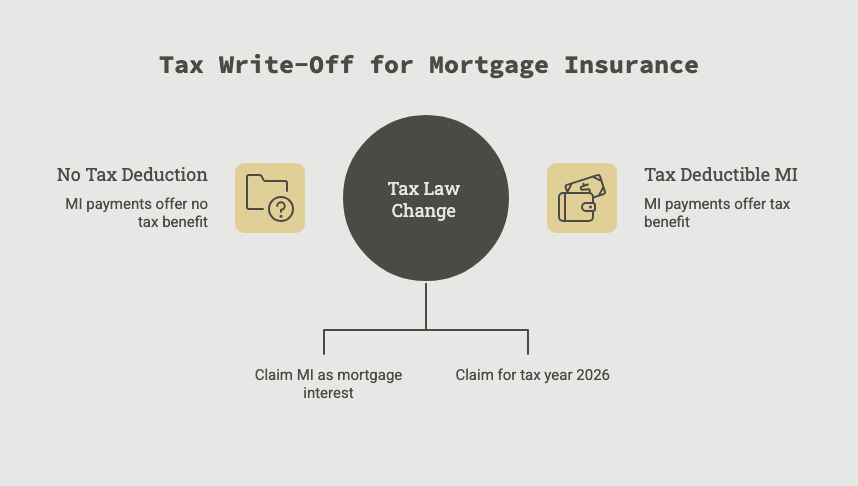
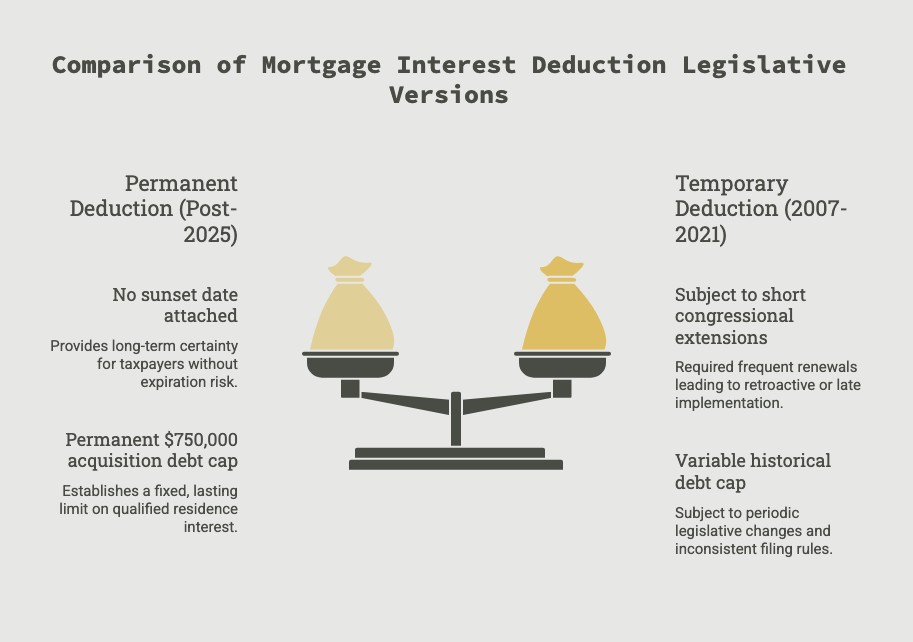
The rule first appeared in 2007 and then lived on short congressional extensions. Sometimes Congress renewed it late, sometimes retroactively. It ran out after tax year 2021 and stayed gone for the four filing years that followed.
The One Big Beautiful Bill Act (Public Law 119-21), signed July 4, 2025, brought it back under Section 70108 and treated it as qualified residence interest again for tax years beginning after December 31, 2025. This time there is no sunset date attached, which is the real news. The same law made the $750,000 cap on home acquisition debt permanent.
The old version was not a niche perk. According to U.S. Mortgage Insurers, an average of 3.4 million homeowners claimed it each year between 2007 and 2021, adding up to $64.7 billion. The typical claim was $1,454, and it reached $2,346 in that final year.
One thing worth saying plainly: nothing here is retroactive. Your 2022 through 2025 returns get no benefit from this change.
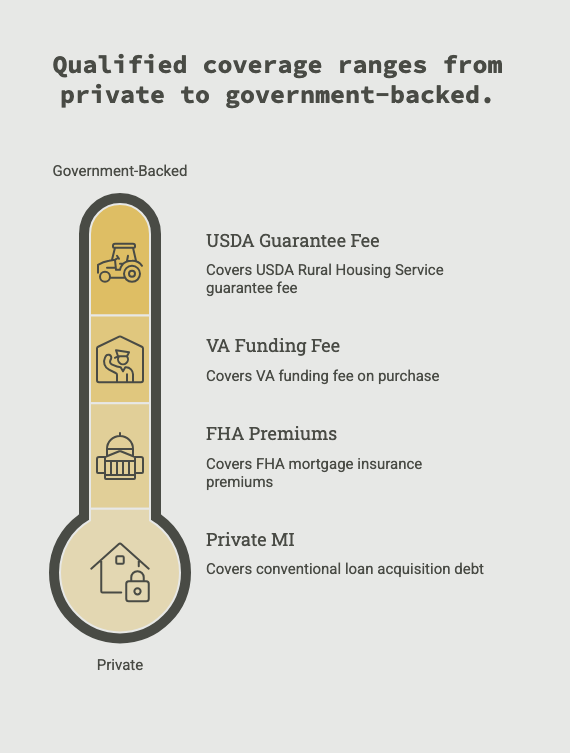
Plenty of people assume this is only about PMI on a conventional loan. It covers four things:
The contract has to have been issued after 2006, and the coverage has to relate to acquisition debt on your main home or one second home. The Department of Veterans Affairs confirmed in February 2026 that veterans and service members can now deduct funding fees on a purchase.
Rental and investment property is a separate story and always has been. Those costs never expired, because they get treated as an ordinary operating expense on Schedule E rather than an itemized deduction. If that is your situation, our guide to rental property tax deductions is the better starting point.
This is where the majority of people find their answer, so read this part slowly.
The deduction starts shrinking once adjusted gross income passes $100,000, or $50,000 if you are married filing separately. You lose 10% of the otherwise allowable amount for every $1,000, or part of $1,000, above that line. It disappears completely once AGI goes past $109,000 ($54,500 filing separately).
Say a married couple has AGI of $104,000 and paid $1,500 in premiums during the year. They are $4,000 over, so they lose 40%. They deduct $900.
Two details that catch people out. First, Thomson Reuters notes that these thresholds are not indexed for inflation, so they will sit exactly where they are while wages drift upward. Second, the whole phase-out range is only $9,000 wide, so a taxpayer sitting near the top of it can swing the result with one decision. A larger 401(k) or HSA contribution before year end is often all it takes to move back into range.
None of the above matters if you take the standard deduction.
For tax year 2026 the IRS set the standard deduction at $32,200 for married couples filing jointly, $16,100 for single filers and those filing separately, and $24,150 for heads of household. Your itemized total has to clear that number before any of this pays off.
The good news is that clearing it got easier. The state and local tax cap sits at $40,400 for 2026, up from the flat $10,000 that applied through 2024. Stack that with home mortgage interest on up to $750,000 of acquisition debt ($375,000 filing separately, or $1 million for debt taken on before December 16, 2017), property taxes and charitable giving, and Schedule A starts making sense for households it never used to. Our walkthrough of Schedule A covers how those pieces fit together.
Your servicer reports the amount in Box 5 of Form 1098, the Mortgage Interest Statement. The IRS instructions for Form 1098 confirm that lenders report $600 or more of MI for 2026, filed with the IRS in early 2027. Paid less than $600? You can still claim it if you have the records.
The figure lands on Line 8d of Schedule A, inside the "Interest You Paid" block, right next to your interest from Box 1. On the 2025 form that line reads "reserved for future use," and the IRS has not released the 2026 version yet. Expect the line to be live when the new form arrives.
How you paid changes the math:
Paid monthly. Deduct the premiums you actually paid during the year. Simple.
Paid upfront. A lump sum FHA charge or prepaid conventional coverage has to be spread out. Treasury Regulation 1.163-11 requires you to allocate it evenly over the shorter of the loan term or 84 months. An $8,400 upfront FHA payment works out to $100 a month, so $1,200 for a full calendar year, and less if you closed in September. If you refinance or sell before the 84 months run out, whatever is left is simply gone.
VA and USDA fees. These sit outside that spreading rule entirely. You claim the full amount in the year paid, whether you wrote a check at closing or rolled the fee into the loan balance. Financing it does not push the timing out.
Hold on to your closing disclosure either way. Upfront amounts often never appear in Box 5, and that document is your proof.
IRS Publication 936 still says the deduction expired. The current edition prepares 2025 returns, so it accurately describes a year when there was nothing to claim. Anyone who Googles this in a hurry reads that line and gives up. The 2026 edition will read differently.
Nobody should keep paying for coverage just to claim it. Under the Homeowners Protection Act you can request cancellation at 80% loan-to-value, and your servicer has to end it automatically at 78%. Killing an $1,800 annual bill beats a write-off worth a few hundred dollars in tax.
A financed fee still counts as paid. Rolling a VA funding fee into the balance does not disqualify anything. It is treated as paid at settlement.
Four moves, and none of them take long:
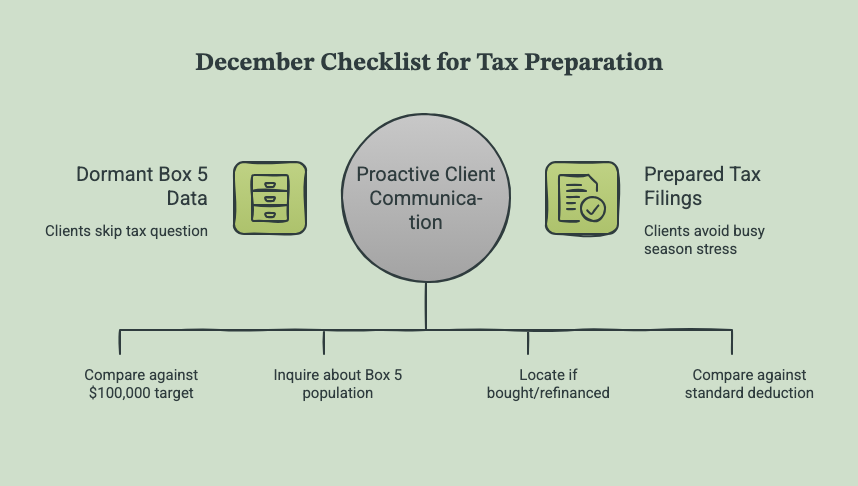
For CPA firms, this one is worth flagging in client organizers now rather than in February. Every client who bought with a small down payment between 2022 and 2025 has been trained to skip this question, and Box 5 data has been dormant in prep software for four filing seasons. Madras Accountancy supports US firms with exactly this kind of busy season prep work, from 1040 preparation through review.
Homeownership costs have climbed hard over the last few years. This is one line item quietly moving the other way.
1. Is mortgage insurance tax deductible in 2026? Yes. If you itemize and your income sits under the limit, you are able to deduct qualified premiums as residence interest under the One Big Beautiful Bill Act, starting with tax year 2026.
2. Can I claim it on my 2025 return? No. The break was unavailable for 2022 through 2025 and the reinstatement is not retroactive. Amending an earlier return will not recover it.
3. What is the income limit? The benefit shrinks by 10% for each $1,000 of AGI above $100,000 ($50,000 if married filing separately) and reaches zero above $109,000 ($54,500). These figures are fixed in the tax code and are not adjusted each year.
4. Do I have to itemize? Yes. It goes on Schedule A, so it only helps if your itemized total exceeds your standard deduction, which is $16,100 for single filers and $32,200 for joint filers in 2026.
5. Where does it go on my tax return? Line 8d of Schedule A, under "Interest You Paid." Your starting figure comes from Box 5 of Form 1098.
6. Is the VA funding fee deductible? Yes, starting with tax year 2026, and you claim the full amount in the year you paid it rather than spreading it. USDA guarantee fees work the same way.
7. What if I paid the whole amount upfront on an FHA loan? You allocate it over the shorter of your loan term or 84 months and claim one slice per year. If you refinance early, the unused portion is forfeited.
8. Is this permanent, or will it expire again? Current law carries no expiration date, which is a first for this provision. A future Congress could always revisit it, but you no longer have to wait on an annual extender to know where you stand.
This article is general information, not tax advice. Your own numbers and filing status decide the outcome, so check with a qualified tax professional before you file.

The 2026 1099 reporting threshold changed: 1099-NEC and 1099-MISC now start at $2,000, and 1099-K is back to $20,000. Here is what you must file.

A plain guide to how a 2026 sales tax holiday works, which items are exempt, and the rules on price caps, refunds, and rain checks.

Form 7004 buys a 6-month extension of time to file business returns like 1065, 1120-S and 1120. Deadlines, e-file steps and the payment trap.