


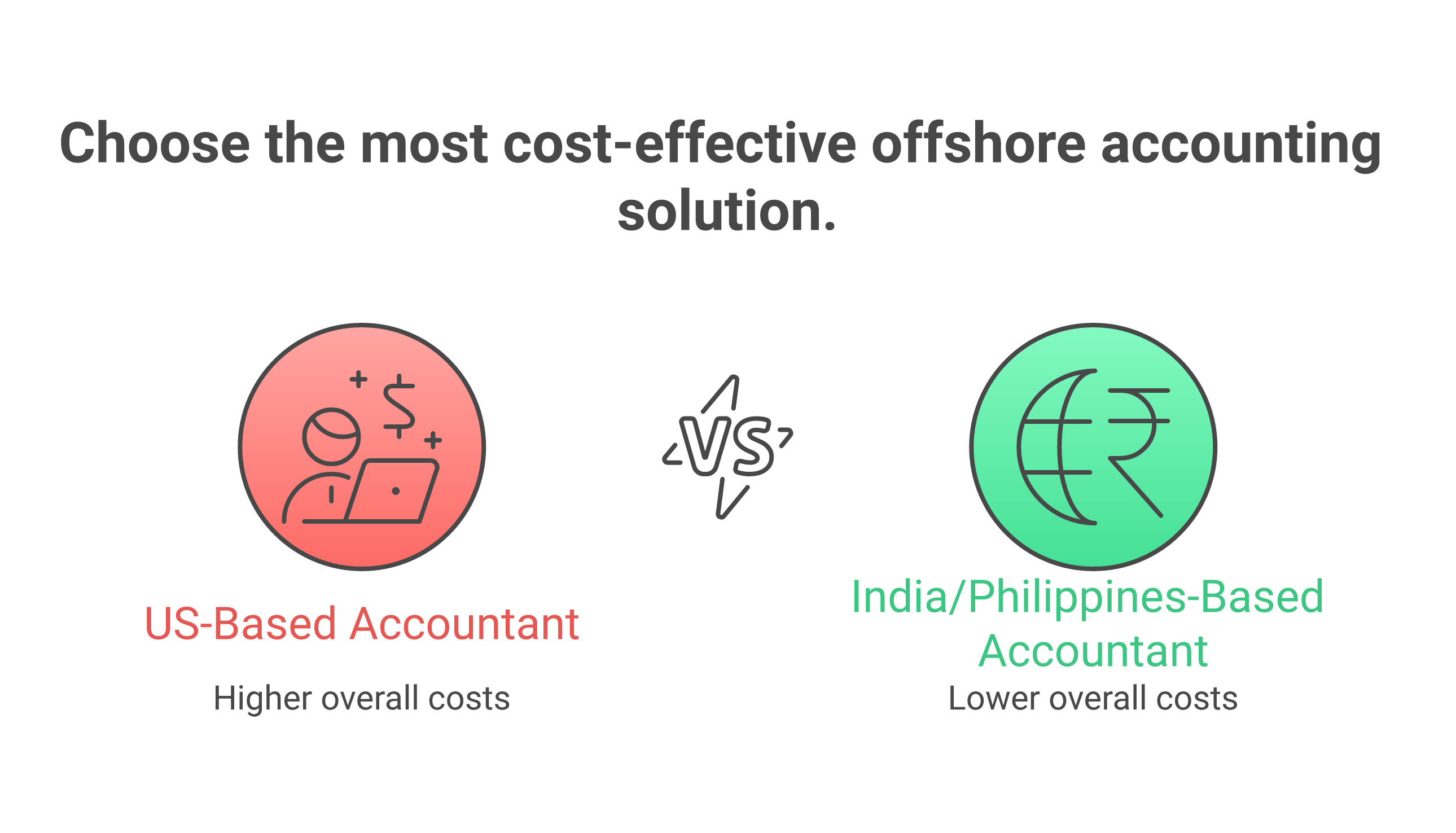
Every CPA firm owner who has looked at offshore accounting has seen the salary comparisons. An accountant in India makes a fraction of what a US-based accountant earns. The Philippines falls somewhere in between. The savings look dramatic on paper.
But salary is not cost. Not even close.
The real cost of an accountant, whether in Dallas, Manila, or Chennai, includes benefits, management overhead, technology, training, quality review time, turnover replacement costs, and a dozen other line items that never show up in the salary comparison charts. When you factor all of these in, the savings are still significant, but the ratios change. And the differences between India and the Philippines, which look negligible at the salary level, become meaningful at the total cost level.
We have been running offshore accounting teams from India for years. We know exactly what it costs to deliver a fully-loaded, production-ready accountant to a US CPA firm. Here is that number, and here is how it compares.
Let us start with the baseline. What does a staff accountant actually cost a CPA firm in the United States in 2026?
Base salary: $55,000 to $75,000 for a staff accountant with 2 to 5 years of experience. Senior accountants with 5 to 10 years run $75,000 to $100,000. These numbers vary by market. A staff accountant in New York City commands $65,000 to $85,000. The same role in a mid-size Midwest city might be $50,000 to $65,000.
Benefits and taxes: Add 25% to 35% on top of base salary. This includes employer-side payroll taxes (FICA, FUTA, state unemployment), health insurance ($6,000 to $15,000 per employee per year for the employer's share), 401(k) match (typically 3% to 6%), PTO accrual, and other standard benefits. For a $65,000 salary, benefits and taxes add $16,000 to $22,000.
Office space and equipment: $5,000 to $12,000 per year per employee, depending on your market and whether you maintain a traditional office. Even remote employees need laptop provisions, home office stipends, and software licenses.
Software licenses: $3,000 to $6,000 per year. Tax software, accounting software, practice management tools, document management systems, communication platforms. These costs exist regardless of where the accountant sits, but they are part of the total cost.
Management and supervision: This is the cost most firms forget. Your managers and partners spend time reviewing work, answering questions, providing training, and conducting performance evaluations. At a typical firm, a manager spends 2 to 4 hours per week per staff accountant on these activities. At a manager's effective hourly rate of $75 to $125, that is $7,800 to $26,000 per year in management cost per staff member.
Recruiting and turnover: The accounting profession has a turnover problem. Average turnover at CPA firms runs 15% to 25% annually. Replacing a staff accountant costs 50% to 100% of their annual salary when you factor in recruiting fees, interview time, onboarding, and the productivity ramp. At 20% turnover and a $65,000 salary, you are spending an additional $6,500 to $13,000 per year per position on turnover-related costs, amortized across your team.
Training and CPE: $1,500 to $3,000 per year for continuing professional education, internal training programs, and professional development.
Total fully-loaded cost of a US staff accountant: $94,000 to $145,000 per year.
For a senior accountant, that number climbs to $120,000 to $185,000.
These numbers are why CPA firms are looking offshore. The accountant shortage in the US has pushed salaries up 15% to 25% over the past three years, and firms still cannot fill positions. The talent pool is shrinking while demand grows.
Now the India side. And we are going to be specific, because vague ranges help no one.
Base salary in India: A staff accountant with 2 to 5 years of US accounting experience earns INR 5,00,000 to INR 9,00,000 per year ($6,000 to $10,800 at current exchange rates). A senior accountant with 5 to 10 years earns INR 9,00,000 to INR 16,00,000 ($10,800 to $19,200). These are Chennai and Hyderabad rates. Mumbai and Bangalore run 15% to 25% higher.
Note that we said "US accounting experience." An Indian accountant trained in Indian GAAP is not immediately productive on US engagements. The ones commanding higher salaries within India have worked on US clients, understand GAAP and US tax code, and can work in UltraTax, QuickBooks, or Xero without hand-holding. That experience premium is real and justified.
Benefits and statutory costs in India: Indian employers pay for Provident Fund (12% of base salary), Employee State Insurance (3.25% for employers in applicable brackets), gratuity, professional tax, and typically provide health insurance. Total statutory and benefit costs add 20% to 30% to base salary. For a $8,000 salary, that is $1,600 to $2,400.
Infrastructure: Office space, workstations, internet (redundant connections are standard for BPO operations), power backup (generators and UPS systems, necessary in India), and physical security. $2,000 to $3,500 per employee per year.
Technology: Software licenses, VPN infrastructure, endpoint security tools, monitoring systems. $1,500 to $3,000 per year.
Management overhead: This is where the comparison gets interesting. Managing an offshore team requires more management infrastructure than an in-house team. You need team leads, quality reviewers, and engagement managers. At Madras, our management overhead per staff accountant runs $2,000 to $4,000 per year. This covers the team lead who supervises daily work, the senior reviewer who checks output quality, and the engagement manager who interfaces with the client firm.
Quality control: In our experience, effective offshore accounting requires a structured review layer that you would not need (or at least not as formally) with in-house staff. This adds $1,500 to $2,500 per year per accountant.
Turnover costs: Turnover in the Indian accounting outsourcing sector runs 15% to 30% annually at most providers. We run lower than industry average because of our location in Chennai and our retention practices, but this cost is real. Recruiting and training a replacement costs 2 to 3 months of salary. Amortized, that adds $1,000 to $2,500 per year per position.
Provider margin: If you are working through an outsourcing provider (as opposed to setting up your own captive center), the provider needs to make money. Margins in the Indian accounting outsourcing space run 20% to 35%. This is built into the price you pay.
Total fully-loaded cost of an India-based staff accountant (through a provider): $18,000 to $32,000 per year.
For a senior accountant: $28,000 to $45,000 per year.
That is roughly 20% to 25% of the equivalent US cost. The savings are real, even after accounting for every hidden cost.
Our detailed cost analysis of how much it costs to outsource accounting services breaks these numbers down further by service type.
The Philippines is India's primary competitor for offshore accounting talent. Here is how the costs compare.
Base salary: Filipino accountants with US accounting experience earn PHP 500,000 to PHP 900,000 per year ($9,000 to $16,000). That is 30% to 50% higher than equivalent Indian salaries. The Philippines' accounting talent pool skews toward general bookkeeping and accounts payable/receivable rather than tax preparation, which pushes up salaries for tax-experienced staff.
Benefits and statutory costs: Philippine employers pay for SSS (Social Security System), PhilHealth, Pag-IBIG, and 13th-month pay (mandatory). Total statutory costs add 15% to 25% to base salary. $1,350 to $4,000 per year.
Infrastructure: Office costs in Manila and Cebu (the primary outsourcing hubs) are comparable to Indian metros. $2,500 to $4,000 per year per employee.
Technology: Similar to India. $1,500 to $3,000 per year.
Management overhead: $2,500 to $4,500 per year. Slightly higher than India because the Philippines has a thinner bench of experienced supervisors for US accounting work.
Quality control: $1,500 to $3,000 per year.
Turnover: The Philippine outsourcing market has higher turnover than India, running 20% to 35% annually. The BPO sector is large and competitive, and staff frequently move between providers for small salary increases. Replacement costs add $1,500 to $3,500 per year per position.
Provider margin: Similar to India, 20% to 35%.
Total fully-loaded cost of a Philippines-based staff accountant (through a provider): $24,000 to $42,000 per year.
For a senior accountant: $35,000 to $55,000 per year.
Here is the full picture in one table:
India is cheaper than the Philippines. But the cost advantage alone does not explain why India dominates the accounting outsourcing market. Several structural factors tilt the comparison.
Deeper talent pool for accounting. India produces approximately 300,000 commerce graduates and 15,000 to 20,000 Chartered Accountants (CA) per year. The CA qualification is rigorous, with pass rates below 10% for the final exam. This creates a deep bench of highly trained accounting professionals. The Philippines produces excellent general accountants, but the pool of US GAAP-trained, US tax-experienced professionals is significantly smaller.
Tax preparation expertise. India has been doing US tax preparation outsourcing for over two decades. The knowledge base is institutional, not individual. When a preparer at an Indian firm leaves, the replacement typically has some US tax exposure already. In the Philippines, US tax preparation is a newer and less established service line.
Time zone advantage. India is 9.5 to 12.5 hours ahead of US time zones (depending on the specific zones). That means work submitted at the end of a US business day is processed overnight and ready for review the next morning. The Philippines is 12 to 15 hours ahead, which works similarly but with a slightly less favorable overlap window for real-time communication during US business hours.
Our article on the time zone advantage of offshore teams explores how this overnight processing cycle creates real productivity gains.
English proficiency. Both countries have strong English proficiency. The Philippines is often cited as having more neutral accents, which matters for client-facing roles. For accounting production work (which is primarily written, not spoken), the difference is negligible. Both countries produce professionals who communicate clearly in written English.
Retention and stability. Indian accounting outsourcing firms in tier-2 cities like Chennai, Hyderabad, and Pune tend to have lower turnover than Manila-based operations. The cost of living is lower, career alternatives are fewer, and employees tend to stay longer. At Madras, our average team member tenure exceeds three years, which is well above the industry average in both countries.
There is one cost that is identical regardless of where you offshore, and it is the cost most firms underestimate.
Your in-house staff will spend time reviewing offshore work. Period. This is true whether the work comes from India, the Philippines, or a provider down the street. Offshore work requires review because your firm is responsible for the output, and because no outside team, however good, will match your institutional knowledge in the early months.
We typically tell firms to budget 15 to 30 minutes of review per hour of offshore production work during the first 90 days, declining to 5 to 15 minutes per hour after the team is fully ramped. At an internal reviewer's effective rate of $50 to $100 per hour, this adds $8 to $50 per hour of offshore production to your real cost.
This review cost is the same regardless of which country you choose. What varies is how quickly it declines. A provider with strong quality control, experienced staff, and good documentation will see review times drop faster than one cutting corners on any of those fronts.
For strategies on reducing review time, our quality control guide for outsourced accounting covers the frameworks that drive accuracy higher and review burden lower over time.
We believe India offers the best value for most US CPA firms. But there are scenarios where the Philippines is the better choice.
Client-facing roles. If you need your offshore team to interact directly with your end clients (handling inbound calls, conducting client interviews for bookkeeping information), Filipino professionals are often more comfortable in conversational American English. Their cultural exposure to American media and business norms makes phone and video interactions feel natural.
Accounts receivable and collections. Similar to client-facing roles, AR collections require phone skills and cultural comfort. Philippine teams tend to perform better in these roles.
Narrow time zone overlap needs. If your firm is on the West Coast and you need maximum overlap with your offshore team's business day, the Philippines' time zone gives you a slightly better overlap window than India.
At the cost levels we are discussing, some firms wonder whether they should set up their own office in India or the Philippines rather than going through a provider.
The short answer: only if you need 25+ FTEs.
Setting up a captive center involves entity registration, office leasing, HR and payroll infrastructure, local legal compliance, and a local management team. The fixed costs are significant. You need at least 25 dedicated staff to amortize those costs down to where a captive center is cheaper than a provider.
For firms needing 1 to 20 FTEs, a provider is more cost-effective and dramatically simpler. You get the labor savings without the operational complexity of running a foreign subsidiary.
Our comparison of offshore, nearshore, and onshore outsourcing models covers this build-vs-buy decision in more detail.
The cost data points to India as the best value for US CPA firms outsourcing accounting and tax preparation work. The talent pool is deeper, the costs are lower, and the industry maturity means fewer growing pains.
But cost should not be your only factor. The right provider matters more than the right country. A mediocre provider in India will deliver worse results than a great provider in the Philippines. Focus on finding a partner with strong quality controls, low turnover, transparent pricing, and references from firms similar to yours.
At Madras Accountancy, we have built our operation in Chennai specifically to serve US CPA firms. Our fully-loaded costs fall in the $1,800 to $3,200 per month range for staff accountants, with senior accountants at $2,800 to $4,200. Those numbers include everything: salary, benefits, infrastructure, technology, management, quality control, and our margin.
If you want a detailed proposal based on your specific needs, reach out at madrasaccountancy.com. We will provide transparent pricing, not ranges, tailored to your firm's size and service requirements.
Is the quality of work from India comparable to the Philippines? For accounting production work (bookkeeping, tax preparation, reconciliations), the quality from experienced providers in both countries is comparable. India has an edge in US tax preparation due to the longer history of providing this service. The Philippines has an edge in client-facing and communication-heavy roles. Quality depends far more on the specific provider than the country.
How do exchange rate fluctuations affect pricing? Most Indian and Philippine providers quote in US dollars, absorbing exchange rate risk on their side. If the local currency weakens, your provider's margins improve. If it strengthens, their margins compress. For multi-year contracts, some providers include exchange rate adjustment clauses. At Madras, we price in USD and do not pass exchange rate fluctuations to clients during the contract term.
Can I hire an offshore accountant directly instead of going through a provider? Technically yes, through platforms like Upwork or direct hiring. The base cost will be lower because you are not paying the provider margin. But you absorb all the management, quality control, infrastructure, and compliance costs yourself. For firms hiring 1 to 5 offshore staff, the management burden typically makes direct hiring more expensive on a total-cost basis than using a provider.
What is the minimum engagement size that makes offshore cost-effective? Generally, one to two FTEs or approximately $2,000 to $5,000 per month in outsourced services. Below that threshold, the fixed costs of onboarding and managing the relationship outweigh the labor savings. For very small engagements, per-return or per-project pricing models work better than FTE commitments.
How long does it take for an offshore accountant to reach full productivity? Typically 60 to 90 days for routine work (bookkeeping, simple tax returns) and 90 to 120 days for complex work (business tax returns, controller-level tasks). This timeline assumes consistent work flow and regular feedback from your team. Gaps in work or feedback extend the ramp period proportionally.

Section 4960's 21% excise tax now reaches far more nonprofit employees. See who is a covered employee in 2026 and what changed.

The Section 45S paid family leave credit is permanent for 2026 with new options. See who qualifies, the amounts, and how to claim it.

Opportunity zones become permanent in 2027 under the One Big Beautiful Bill. See the new deferral, rural bonus, and the 2026 handoff.