

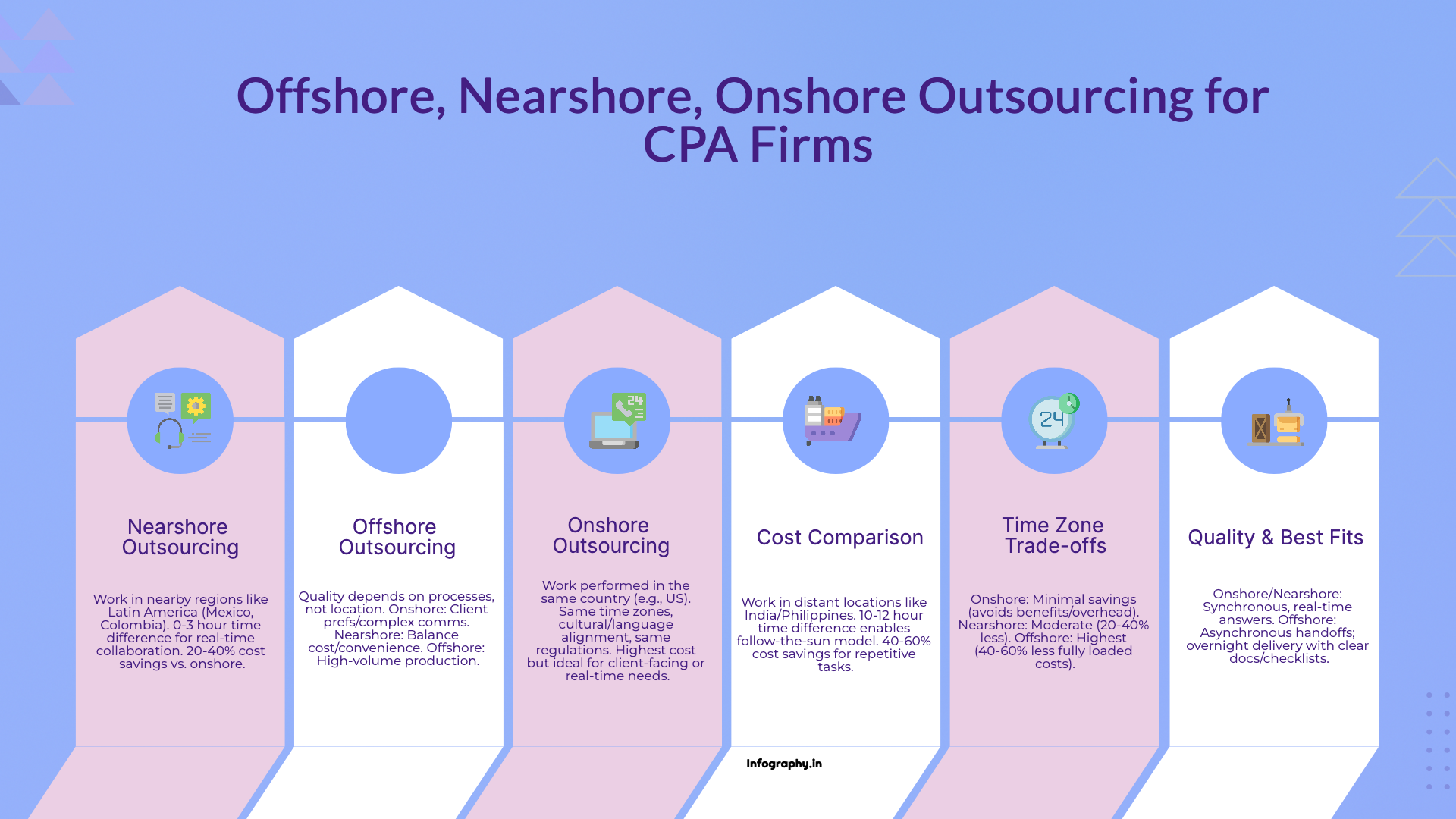

Not all outsourcing happens halfway around the world, and not all offshore locations operate the same way. The terminology used in outsourcing conversations can be confusing because firms use offshore, nearshore, and onshore models interchangeably without clarifying what they mean. Each model has different cost structures, time zone implications, and operational characteristics. None is universally superior. The right choice depends on what your firm values most: cost savings, real-time collaboration, client preferences, or operational complexity.
Onshore outsourcing means work is performed within the same country as your firm, typically by domestic contractors, remote staff, or outsourcing providers with US-based teams. The work happens in the same time zones, under the same regulatory framework, and with staff who share cultural and language norms with your clients.
Nearshore outsourcing refers to work performed in a nearby region with overlapping or adjacent time zones. For US firms, this typically means Latin America, particularly countries like Mexico, Colombia, or Costa Rica. The time zone difference is minimal, usually zero to three hours, which allows for real-time collaboration during standard business hours.
Offshore outsourcing involves work performed in more distant locations, commonly India or the Philippines for US firms. The time zone difference is significant, typically ten to twelve hours, which means the offshore team works while the US team sleeps. This distance creates both challenges and opportunities depending on how the workflow is structured.
Cost is the primary reason most firms explore outsourcing, and the cost differences between models can be substantial. Onshore outsourcing is the most expensive option because labor costs in the United States are high. Contractors and remote staff based in the US command rates that are closer to full-time employee salaries. The cost savings come from avoiding benefits, payroll taxes, and office overhead, but those savings are modest compared to offshore alternatives.
Nearshore outsourcing offers moderate savings, typically 20 to 40 percent less than onshore rates, depending on the specific country and role. The savings reflect lower cost of living in Latin American countries, but nearshore rates are higher than offshore rates because demand for bilingual professionals with US time zone availability is strong. Firms pay a premium for the convenience of real-time collaboration.
Offshore outsourcing delivers the largest cost savings, often 40 to 60 percent less than hiring in-house staff when comparing fully loaded costs that include salary, benefits, training, and overhead. These savings reflect the lower cost of living in countries like India and the Philippines, combined with large talent pools of accounting professionals. The savings are most pronounced for roles that involve repetitive tasks like data entry, reconciliation, and workpaper preparation.
Cost estimates vary widely based on role complexity, provider quality, and contract structure. A junior bookkeeping role will cost less than a senior tax preparation role. A high-quality provider with strong training and quality control will cost more than a low-cost provider with minimal oversight. Firms should compare total cost of ownership, including management time and rework, not just hourly rates.
Time zones affect how quickly your team can get answers to questions, how workflows are structured, and whether work can progress around the clock. Onshore and nearshore models allow for real-time collaboration. If your senior accountant has a question at 2 PM, the contractor or nearshore team can answer immediately. Same-day back-and-forth is easy, which is valuable for fast-moving projects or situations where requirements change frequently.
Offshore models require asynchronous communication. When your team finishes work at 5 PM Eastern, the offshore team is just starting their day. Questions raised by the offshore team overnight get answered the next morning, and responses to your questions arrive while you sleep. This delay can feel frustrating if workflows are not structured to account for it.
However, the time zone difference can be an advantage if you structure workflows as handoffs. The US team prepares the work package at the end of their day and hands it off to the offshore team. The offshore team works overnight and delivers the completed draft by the next morning. This follow-the-sun model can reduce turnaround time for certain workflows, turning a 24-hour cycle into an overnight delivery.
The key to making offshore time zones work is reducing the need for real-time interaction. Clear documentation, comprehensive checklists, and well-defined escalation procedures minimize the number of questions that require immediate answers. When the offshore team has everything they need to complete the work independently, the time zone difference becomes a feature rather than a bug.
Quality concerns are common when firms first consider outsourcing, especially offshore outsourcing. The fear is that work performed far away will be lower quality, less reliable, or harder to control. This fear is understandable but misplaced. Quality is not determined by geography. It is determined by process, training, and oversight.
Firms with poor processes and weak review standards will get poor results regardless of where the work is performed. An onshore contractor working without clear documentation and quality checks will produce inconsistent work. An offshore team working with detailed checklists, standardized templates, and rigorous review will produce consistent, high-quality work.
The control mechanism is the same in every model. Define the workflow clearly. Document the standards. The outsourced team, whether onshore, nearshore, or offshore, drafts the work. The US-based team reviews it, addresses exceptions, and signs off. Responsibility stays with the firm. The outsourced team is an extension of your capacity, not a replacement for judgment and oversight.
Onshore outsourcing fits when clients demand fully domestic delivery or when the work requires heavy real-time collaboration. Some clients have strong preferences against offshore work due to data security concerns or philosophical objections. For those clients, onshore contractors provide capacity without triggering client concerns. Onshore also works well for roles that require frequent client calls, live collaboration, and nuanced communication where cultural alignment and language fluency matter most.
Nearshore outsourcing fits when you want cost savings but need time zone overlap for coordination. If your workflows involve frequent communication, rapid iteration, or client-facing work that requires bilingual professionals, nearshore offers a middle ground. The cost is higher than offshore, but the operational simplicity and real-time availability can justify the premium. Nearshore is particularly appealing for firms that want to test outsourcing without committing to the asynchronous communication required by offshore models.
Offshore outsourcing fits when you prioritize cost savings and scalability for high-volume, preparation-heavy work. If the workflow is clearly defined, the tasks are repetitive, and the review process is strong, offshore delivers the best cost-to-quality ratio. The time zone difference becomes an advantage if you structure workflows as overnight handoffs. Offshore is the most common model for reconciliations, close support, tax workpaper assembly, and other production tasks that do not require real-time client interaction.
Start by identifying your primary constraint. If cost is the main driver and you have workflows that can operate asynchronously, offshore is likely the best fit. If client preferences or compliance requirements restrict where work can be performed, onshore is necessary. If you want a balance between cost and convenience, nearshore offers a compromise.
Pick one workflow to pilot. Reconciliations, close support, or tax workpaper preparation are common starting points because they have clear inputs and outputs. Define review standards in writing before the pilot starts. Quality expectations should be explicit, measurable, and consistent regardless of which model you choose.
Measure rework rates for at least four weeks. Rework is the clearest indicator of whether the model is working. If review notes per file decrease over the pilot period, the team is learning and quality is improving. If rework rates stay flat or increase, the process needs refinement before you scale.
Do not assume the first model you try is the only option. Some firms use hybrid models, keeping client-facing and judgment-intensive work onshore or nearshore while sending high-volume production work offshore. The models are not mutually exclusive. The goal is to match the right work to the right model based on cost, complexity, and coordination needs.

Section 4960's 21% excise tax now reaches far more nonprofit employees. See who is a covered employee in 2026 and what changed.

The Section 45S paid family leave credit is permanent for 2026 with new options. See who qualifies, the amounts, and how to claim it.

Opportunity zones become permanent in 2027 under the One Big Beautiful Bill. See the new deferral, rural bonus, and the 2026 handoff.