



Your client got a letter. Maybe it is a CP2000 (automated mismatch notice). Maybe it is Letter 2202 (actual examination notice). Either way, the clock is ticking and your team is already stretched thin.
Here is what most CPA firms do not realize: the vast majority of IRS audit response work is not legal representation. It is not testimony. It is not making judgment calls about tax positions. It is pulling bank statements, organizing receipts, creating reconciliation schedules, preparing PBC (prepared by client) lists, and compiling documentation into a format the IRS examiner can follow.
That work, the 70 percent that is data compilation, is exactly what an offshore team is built to do. The CPA handles representation, strategy, and communication with the IRS. The offshore team handles the production work that would otherwise bury your staff for weeks.
We have supported CPA firms through dozens of audit engagements at Madras Accountancy. Not as the representative (that is always the licensed CPA), but as the production team behind the representative. Our offshore audit support guide covers the broader audit support model. This article is specifically about IRS examinations.
Organize and index client records. The IRS requests specific documents: bank statements for specific periods, receipts for specific expense categories, contracts, invoices, payroll records. Your offshore team pulls these from the client's records, organizes them chronologically, indexes them by category, and prepares a master document binder (digital or physical) that the CPA can hand to the examiner. This alone saves 10 to 20 hours of CPA time on a typical audit.
Prepare reconciliation schedules. The examiner wants to see that reported income matches bank deposits. That reported expenses match invoices and bank withdrawals. That payroll reported on 941s matches W-2s and the general ledger. Your offshore team builds these reconciliation schedules working from the client's accounting records and bank statements. Discrepancies are flagged for CPA review.
Analyze the specific issues under examination. If the IRS is examining home office deductions, your offshore team calculates the square footage percentage, pulls the mortgage interest, property tax, insurance, and utility records, and prepares the computation worksheet. If the IRS questions vehicle expenses, the team compiles mileage logs, fuel receipts, and maintenance records. If the IRS challenges COGS, the team rebuilds the inventory calculation from purchase records and sales data.
Draft response letters for CPA review. The offshore team can draft the initial response to the IRS information document request (IDR), including the narrative explaining the client's position on each examined item. The CPA reviews, edits, and signs. The production work of drafting saves hours.
Prepare amended returns if needed. If the audit results in agreed adjustments, the offshore team prepares the amended return (1040-X or corrected business return) for CPA review and filing.
Build timeline and transaction summaries. For complex audits involving multiple years or multiple entities, the offshore team creates chronological transaction summaries that help the CPA tell the story clearly. These summaries organize deposits, payments, and transfers in a way that demonstrates the client's position with supporting documentation referenced at every step.
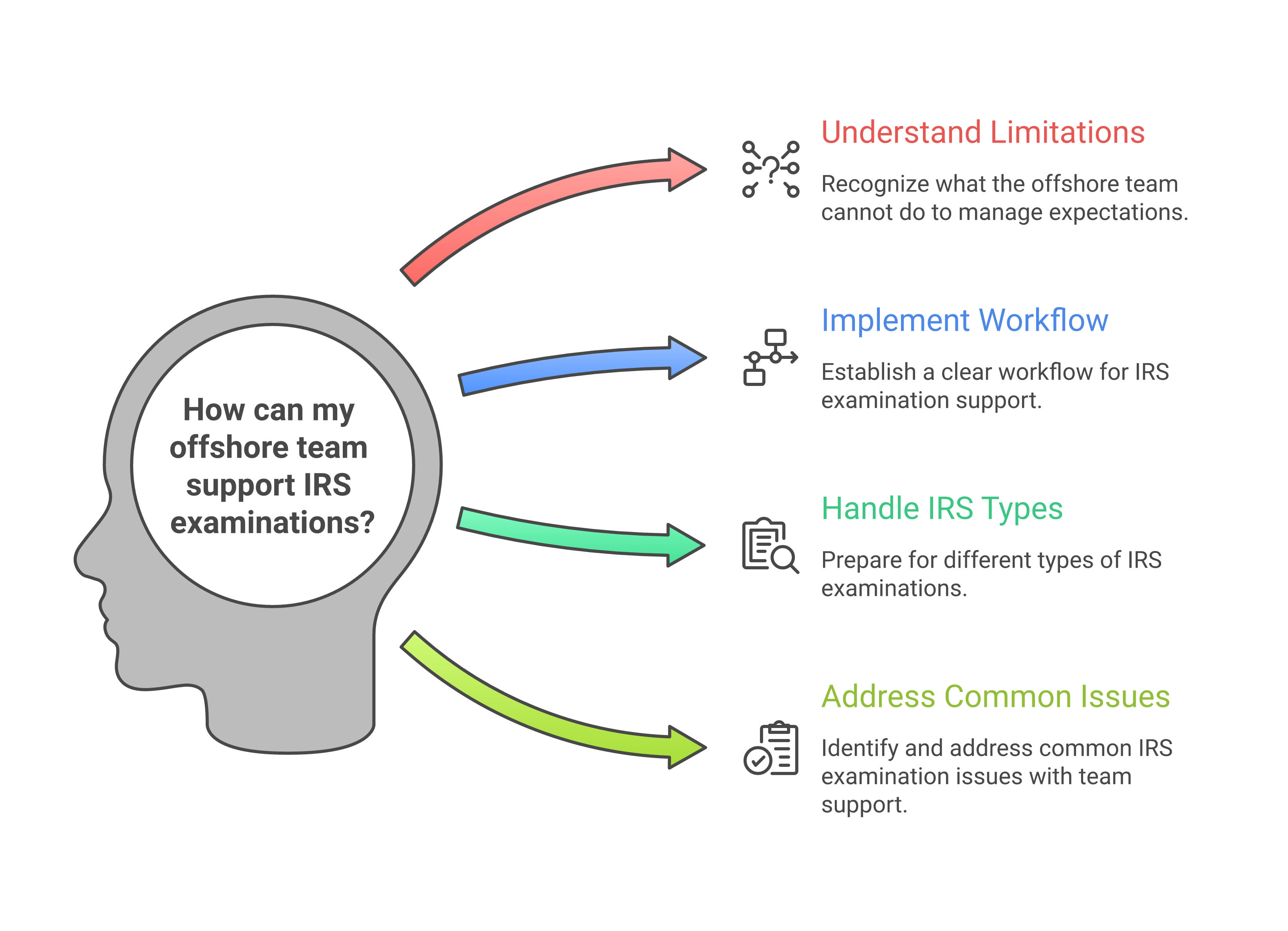
Represent the client before the IRS. Only a CPA, enrolled agent (EA), or attorney can represent a taxpayer before the IRS under Circular 230. Your offshore team member in Chennai cannot attend an audit meeting, speak with the examiner, or sign any correspondence. This is a hard line that cannot be crossed. Our article on staying compliant when outsourcing covers the regulatory boundaries.
Make judgment calls about tax positions. Should the client concede on the home office deduction and fight on the vehicle expenses? Should the client request Appeals if the examiner proposes a large adjustment? These are strategic decisions that require the CPA's professional judgment, knowledge of the client's full situation, and assessment of the audit risk.
Communicate with the IRS directly. No phone calls, no emails, no correspondence with the IRS examiner. All IRS communication goes through the licensed representative.
Advise the client on audit strategy. The CPA explains the process to the client, manages expectations, and advises on next steps. The offshore team supports the CPA's work but does not interact with the client on audit matters.
Understanding where these boundaries sit is critical. In our experience, the firms that use offshore audit support most effectively are the ones that draw the line clearly from day one. The offshore team knows exactly what is in their scope (production, organization, preparation) and what stays with the CPA (representation, strategy, communication). When those boundaries are clear, the workflow runs smoothly.
A CPA firm client receives an IRS audit notice. Here is how the engagement flows when an offshore team is supporting.
Day 1: CPA reviews the notice, identifies the issues under examination, and creates a task list for the offshore team. Example: "Pull bank statements for 2024 from Chase and Wells Fargo. Reconcile total deposits to reported Schedule C gross receipts. Flag any deposits that are not income (transfers, loans, personal deposits)."
Days 2 to 5: Offshore team executes the task list. They work from the client's records (QBO backup, bank statements, receipts). Every schedule is prepared with source document references so the examiner can verify. The team flags anything unusual or questionable for CPA attention.
Days 6 to 7: CPA reviews the offshore team's work. Checks the reconciliation for accuracy. Reviews flagged items. Makes strategic decisions about what to include in the response and what positions to take.
Day 8 to 10: CPA prepares (or reviews the offshore team's draft of) the response letter. Assembles the final documentation package. Sends to the IRS before the response deadline.
Total CPA time: 8 to 15 hours. Total offshore team time: 15 to 30 hours. Without the offshore team, the CPA would spend 25 to 40 hours, most of it on document compilation that does not require a CPA license.
Not all audits are the same, and the offshore team's role varies based on the type of examination.
CP2000 notices (automated underreporter) are the most common and simplest to handle. The IRS identified a mismatch between what the taxpayer reported and what was reported by third parties (W-2s, 1099s, K-1s). The offshore team pulls the relevant source documents, prepares a reconciliation showing where the IRS's proposed adjustment is correct or incorrect, and drafts the response. In our experience, 60 to 70 percent of CP2000 notices involve a misunderstanding that can be resolved with proper documentation rather than an actual underpayment.
Correspondence audits are conducted entirely through mail. The IRS requests documentation for specific items (charitable deductions, business expenses, education credits). The offshore team compiles the supporting documents, organizes them by category, and prepares summary schedules. The CPA writes the cover letter and sends the package. These audits are almost entirely production work, which means the offshore team handles 80 to 90 percent of the effort.
Office audits require the taxpayer (or their representative) to appear at an IRS office with documentation. The preparation is the same as a correspondence audit, but more intensive because the examiner will be reviewing documents in real time and asking follow-up questions. The offshore team prepares the document binder and summary schedules in advance. The CPA reviews everything thoroughly because there will be no opportunity to supplement during the meeting. We typically see 20 to 30 hours of offshore preparation time for a well-documented office audit response.
Field audits are the most comprehensive. The IRS examiner comes to the taxpayer's place of business and reviews records on site. These audits can cover multiple issues and multiple years. The offshore team's role expands significantly: preparing multi-year reconciliation schedules, building detailed expense analyses, organizing source documents by category and year, and creating summary workpapers that the CPA can reference during the examination. Field audits can require 40 to 80 hours of offshore team preparation depending on complexity.
We have seen certain issues come up repeatedly across audit engagements. Here is how the offshore team supports the CPA on each.
Unreported income from bank deposit analysis. The IRS adds up all bank deposits and compares the total to reported income. Any unexplained deposits are treated as unreported income. The offshore team's job is to trace every deposit to its source: sales revenue, loan proceeds, transfers between accounts, personal deposits (gifts, insurance reimbursements), and tax refunds. We prepare a deposit analysis that categorizes every deposit and provides the source documentation. This is the most time-intensive part of most audits and exactly where the offshore team saves the most CPA hours.
Schedule C expense substantiation. The IRS challenges the deductibility of specific expense categories. The offshore team compiles receipts, invoices, and bank/credit card statements that support each expense. They build an expense summary by category with amounts tied to specific source documents. For categories like meals and travel, they confirm that the required documentation elements (business purpose, attendees, location) are present.
Home office deduction verification. The offshore team calculates the square footage percentage, gathers the supporting costs (mortgage/rent, utilities, insurance, repairs), and prepares the computation using either the simplified method or the actual expense method. They also pull comparable rental data if needed to support the fair market value of the home office space.
Vehicle expense documentation. If the client claims actual expenses, the team compiles fuel, maintenance, insurance, and depreciation records. If the client uses the standard mileage rate, the team reviews the mileage log for completeness and reasonableness. We flag any gaps in the mileage log that the IRS would challenge.
Audit response engagements are high-value for CPA firms. Clients pay $3,000 to $10,000 for a typical correspondence audit response and $10,000 to $25,000 for an office or field audit.
If you bill the client $8,000 for an office audit response and your CPA spends 15 hours at a $300 effective rate ($4,500 internal cost) plus 25 offshore hours at $20 per hour ($500 internal cost), your total cost is $5,000 and your margin is 37.5 percent. Without the offshore team, the same engagement requires 40 CPA hours ($12,000 at effective rate), which exceeds the $8,000 fee and produces a loss.
The offshore team is what makes audit response engagements profitable at competitive fee levels. And because the offshore team handles the production work, the CPA can manage more audit engagements simultaneously without burning out.
There is also a capacity consideration that firms often overlook. During tax season, audit notices keep arriving but CPAs have no bandwidth to work on them. Extensions get filed, deadlines get missed, and clients get anxious. An offshore team that handles audit preparation year-round means the CPA only needs to dedicate review time, not production time. In our experience, this allows a single CPA to manage 3 to 4 times as many audit engagements simultaneously compared to handling everything solo.
If your CPA firm handles IRS audits and wants to increase capacity without adding expensive onshore staff, reach out at madrasaccountancy.com. We can walk through how our team integrates into your audit response workflow. Our quality control process ensures every schedule meets the standard required for IRS submission.
Yes. The offshore team is performing production work (data gathering, schedule preparation) under the supervision of a licensed CPA. This is no different from a staff accountant at your firm preparing the same materials. The key requirement is that a licensed CPA reviews and takes responsibility for all work before it is submitted to the IRS, and that the CPA (not the offshore team) handles all IRS communication and representation.
Correct. Audit files contain SSNs, income data, and personal financial information. This data should only be accessed through secure infrastructure. At Madras, all audit support work happens on VDI with encrypted connections and no local data storage. The same data security standards we apply to tax preparation and bookkeeping apply to audit support.
Yes. State sales tax audits, state income tax examinations, and state payroll audits all involve the same type of production work: pulling records, building reconciliations, and preparing response schedules. The CPA provides the representation and strategy. The offshore team handles the heavy lifting. We have supported state audit responses in over 30 states and the workflow is essentially the same as federal, with the addition of state-specific documentation requirements.
If your firm already has an outsourcing relationship with us, we can assign audit support resources within 1 to 2 business days. If you are a new client, initial setup takes about a week (access configuration, process alignment). Either way, the 30-day IRS response window provides enough time to get the offshore team productive before the deadline.
This is more common than anyone admits. We handle audit responses for clients whose books were never properly reconciled, whose records are incomplete, or whose prior accountant is no longer available. The offshore team starts with whatever records exist (bank statements, tax returns, 1099s) and reconstructs the financial picture. This reconstruction work is time-intensive but is exactly the kind of high-volume data work our team handles well. The CPA then reviews the reconstruction and builds the audit response strategy from there.
We support the data compilation for audits involving foreign accounts and international income, including FBAR schedules, Form 8938 (FATCA), and foreign tax credit computations. The CPA handles all strategic decisions regarding disclosure and penalty mitigation. Our team gathers the foreign bank statements, prepares the required schedules, and organizes the documentation that supports the client's filing position.
Section 4960's 21% excise tax now reaches far more nonprofit employees. See who is a covered employee in 2026 and what changed.

The Section 45S paid family leave credit is permanent for 2026 with new options. See who qualifies, the amounts, and how to claim it.

Opportunity zones become permanent in 2027 under the One Big Beautiful Bill. See the new deferral, rural bonus, and the 2026 handoff.