



A $5M staffing agency might have 200 temporary employees on assignment at any given time, each with different bill rates, pay rates, overtime rules, and workers comp classifications. That is 200 payroll calculations every week, plus the corresponding client invoicing, gross margin tracking, and workers comp accrual adjustments. The accounting volume for a $5M staffing company rivals what a $50M business in another industry generates.
This volume is why staffing agency bookkeeping breaks when you hand it to a generalist. The generalist bookkeeper knows how to process payroll for 15 employees. They do not know how to process payroll for 200 temporary workers across 30 client sites with 8 different workers comp codes and variable overtime rules that change by state.
We support CPA firms that serve staffing agencies at Madras Accountancy. Our team handles the high-volume transaction processing that staffing accounting demands while the CPA focuses on advisory work: gross margin optimization, workers comp audit preparation, and pricing strategy. Our outsourced accounting services scale to match the transaction volume these agencies generate.
In our experience, the moment staffing agencies hit 75 to 100 temps on assignment, the accounting demands begin overwhelming whatever internal process they have in place. The bookkeeper starts falling behind on reconciliations. Client invoices go out late. Workers comp accruals are not tracked properly. Gross margin reports, if they exist at all, are inaccurate because the burden calculations are based on estimates rather than actual rates. Each of these issues compounds over time, and by the time the CPA firm is brought in to investigate, the cleanup work can be substantial.
Staffing agency profitability is measured by gross margin per placement. The formula looks simple: bill rate minus pay rate minus burden (payroll taxes, workers comp, benefits) equals gross profit per hour. A temp billed at $28 per hour and paid $18 per hour with $3.50 in burden produces $6.50 per hour in gross profit, or a 23.2 percent gross margin.
But tracking this across 200 placements with different rates, different burden percentages, and different overtime patterns is operationally intense. When overtime kicks in, the pay rate goes to 1.5x but the bill rate may only increase by 1.25x (depending on the client contract), which compresses the margin on every overtime hour. Workers comp rates vary by classification code and by state, so a temp doing clerical work in Ohio has a different burden than one doing light industrial work in California.
Our offshore team at Madras tracks gross margin by placement, by client, and by job classification. The CPA firm gets monthly reports that show which clients and which job types are profitable, which are marginal, and which are losing money after burden. This analysis drives the advisory conversation about pricing adjustments and client retention. For the quality control standards we apply to this work, see our guide.
The margin analysis by client is particularly valuable because it often reveals that a small number of clients generate most of the profit while others are marginally profitable or even losing money. In our experience, staffing agency owners often resist raising rates with large clients for fear of losing the volume. But when the data shows that a client generating $500,000 in revenue is producing only $15,000 in gross profit after burden, the conversation shifts from "should we raise rates?" to "can we afford not to?" A CPA firm that can present this analysis with precise numbers has a powerful advisory tool that drives client action.
The overtime margin compression is another area where detailed tracking pays off. Some client contracts specify that overtime hours are billed at the straight-time bill rate plus a premium, while others simply bill overtime at the straight-time rate. In the second scenario, the margin on overtime hours can drop to single digits or even go negative because the pay rate increases by 50 percent but the bill rate does not change. Our team flags these situations in the monthly margin report so the CPA can advise the agency on renegotiating overtime billing terms.
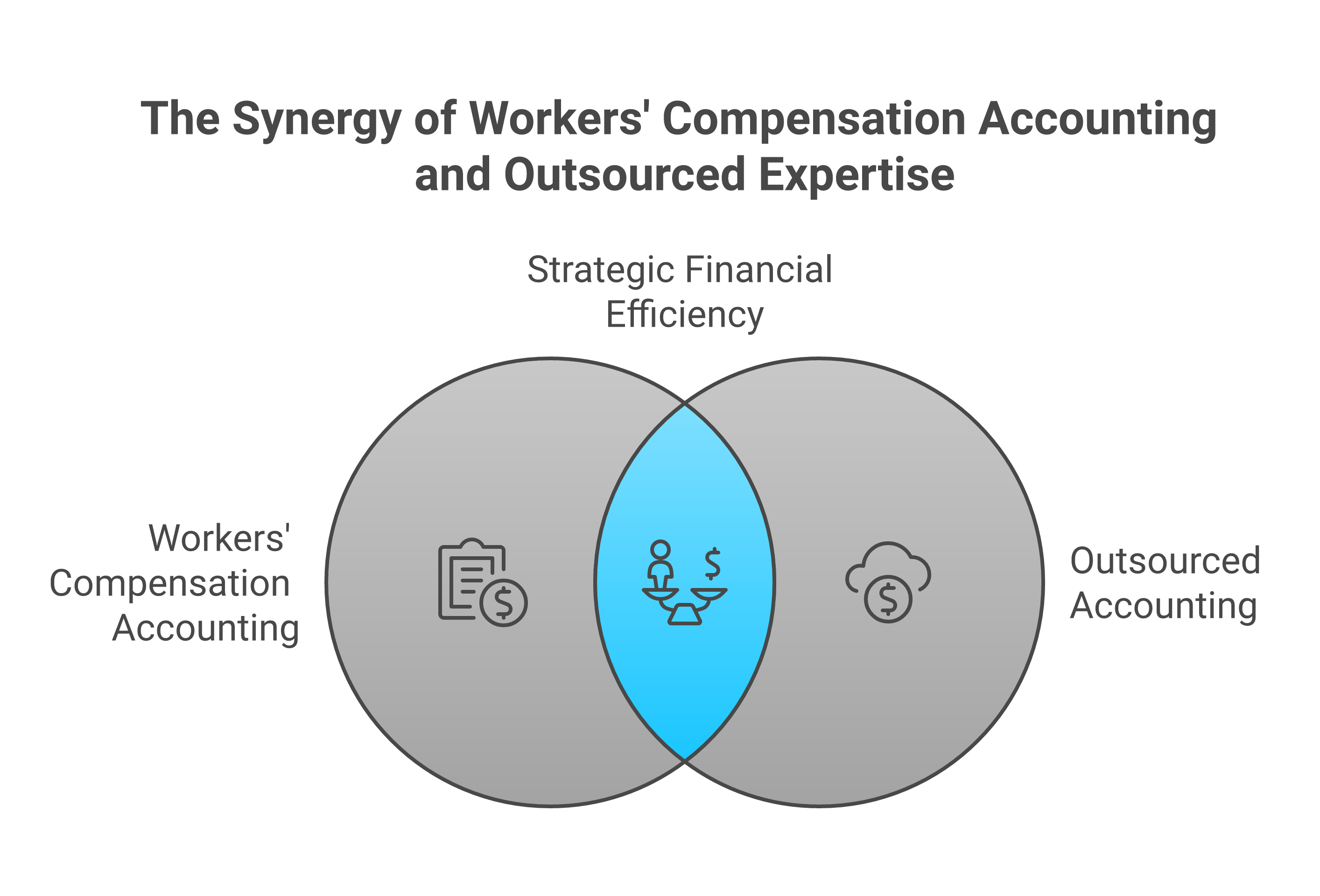
Workers comp is where staffing agency accounting gets genuinely tricky. Most staffing agencies pay workers comp premiums based on estimated payroll, then get audited annually by the insurance carrier. The audit compares actual payroll by classification code to the estimated payroll and produces an adjustment (usually a bill for additional premium).
The accounting challenge is maintaining accurate accruals throughout the year so the annual audit adjustment is not a surprise. Our team tracks actual payroll by workers comp classification code monthly, calculates the estimated premium based on actual payroll (using the rate per $100 of payroll for each code), compares the accrued premium to the actual premium billed, and adjusts the accrual to keep it in line with reality.
A staffing agency that does not track workers comp accruals accurately will either overstate income throughout the year (if the accrual is too low) or understate it (if the accrual is too high). Either way, the year-end adjustment is a surprise that can be significant. We have seen annual audit adjustments of $50,000 to $200,000 for mid-size agencies. Proper monthly accrual tracking prevents this shock.
The classification code accuracy is equally important. Workers comp rates vary dramatically by classification. Clerical work (code 8810) might carry a rate of $0.25 per $100 of payroll. Light industrial work (code 8742) might be $2.50 per $100. A temp who is coded as clerical but actually performing light industrial work is underinsured, and if they are injured, the carrier may deny the claim or assess a retroactive premium adjustment. Our team at Madras verifies classification codes against the actual job descriptions for each placement, flagging discrepancies for the agency to resolve.
The annual workers comp audit is a significant event for staffing agencies, and preparation matters. Our team maintains the detailed payroll records by classification code that the auditor needs, prepares the audit support schedule, and helps the agency respond to auditor inquiries. A well-prepared audit typically results in a smaller adjustment because the records support the agency's position on classification and payroll amounts. A poorly prepared audit invites the auditor to make assumptions that usually favor the insurance carrier.
Staffing agencies bill clients weekly or biweekly, but the billing cycle does not always align with the pay period or the accounting period. At month-end, there are almost always hours worked by temps that have been paid (or will be paid) but have not yet been invoiced to the client.
This unbilled work-in-progress needs to be accrued as a receivable at month-end. The calculation: hours worked but not yet billed, multiplied by the bill rate, equals the unbilled receivable. This can be a material number. A $5M agency with a one-week billing lag might have $100,000 in unbilled receivables at any given time.
Our team at Madras calculates unbilled receivables at each month-end by reconciling the payroll system's hours to the billing system's invoiced hours. The difference is the unbilled balance, which gets accrued and then reversed when the invoice goes out. Skipping this accrual understates both revenue and receivables, which distorts the agency's financial picture.
The unbilled receivable calculation is more nuanced than it first appears. Different clients may have different billing cycles (weekly versus biweekly), different rate structures, and different approval processes that can delay invoicing. Some clients require timesheet approval before the agency can invoice, which can add days or even weeks to the billing cycle. Our team tracks the billing cycle for each client and calculates the unbilled receivable accordingly, rather than applying a single estimate across the entire portfolio.
For agencies that are growing rapidly, the unbilled receivable balance grows proportionally, and this can create a cash flow challenge. The agency is paying its temps weekly, but the client invoices may not go out for another week and may not be collected for another 30 to 45 days after that. This creates a working capital gap that needs to be financed. A fractional CFO or the CPA firm can use the unbilled receivable data to model the working capital requirement and ensure the agency has adequate financing in place.
Staffing agencies that operate on a cash basis often produce financial statements that are misleading. Revenue swings week to week based on when clients pay, not when the work was performed. Expenses may not align with the revenue they generated. The financial picture is choppy and difficult to analyze.
Moving to accrual basis accounting, or at least producing accrual-basis management reports, gives the CPA firm and the agency a much clearer picture of financial performance. Revenue is recognized when the work is performed (regardless of when the invoice goes out or when the client pays). Payroll and burden costs are matched to the revenue period. Workers comp accruals are updated monthly. The result is financial statements that reflect the actual economic activity of each period.
Our team at Madras maintains accrual-basis books for staffing agency clients, including the revenue accruals, payroll accruals, workers comp accruals, and unbilled receivable calculations that accrual accounting requires. For agencies that file taxes on a cash basis (which is common for smaller agencies), we produce both cash-basis tax reports and accrual-basis management reports from the same underlying data.
A staffing agency with fewer than 50 temps on assignment can typically manage with a competent in-house bookkeeper and a solid payroll platform (Staffbase, TempWorks, Avionte). The volume is manageable.
At 50 to 200 temps, the volume starts exceeding what a single bookkeeper can handle alongside their other responsibilities. Weekly payroll processing, client invoicing, gross margin tracking, workers comp accruals, and month-end close all compete for the same person's time. This is where outsourcing the production work makes sense.
Above 200 temps, outsourcing is not optional unless you want to hire a 2 to 3 person in-house accounting team. The transaction volume (1,000 or more payroll transactions per month) demands dedicated processing capacity.
At Madras, we handle the high-volume work (payroll data processing, client invoice preparation, gross margin reporting, workers comp accrual tracking, and month-end close) while the CPA firm focuses on the advisory layer. If your CPA firm serves staffing agencies and needs production capacity, reach out at madrasaccountancy.com.
Yes. These platforms are cloud-based and our team accesses them through secure VDI infrastructure. The staffing software handles payroll processing and invoicing. Our team reconciles the output to the general ledger, tracks gross margins, and prepares financial reports.
Each temp is taxed based on the state where they work, not where the agency is headquartered. Our team tracks state assignments, ensures correct withholding rates are applied, and prepares quarterly payroll tax filings for each state. For agencies with temps in 10 or more states, this multi-state compliance is a significant workload that our team handles as part of the standard engagement.
For an agency with 100 to 200 temps on assignment, expect $2,000 to $4,000 per month for full bookkeeping including weekly payroll reconciliation, client invoicing support, gross margin reporting, workers comp accruals, and monthly financial statements. The cost scales with temp count and transaction volume. For larger agencies with 200 or more temps, the cost typically runs $4,000 to $7,000 per month.
We work alongside the existing bookkeeper during a 30 to 60 day transition period. During this time, our team learns the agency's specific processes, client billing requirements, workers comp classifications, and reporting preferences. We run parallel processes during the first month-end close to ensure the output matches. By the end of the transition, our team is handling the full scope independently. The CPA firm reviews the first several month-end packages to verify accuracy before moving to their standard review cadence.
Yes. Catching up on delinquent bookkeeping is a common first step when we onboard a staffing agency client. The backlog work involves reconciling bank accounts, rebuilding payroll records from the staffing software, calculating retroactive workers comp accruals, and producing the financial statements that are overdue. In our experience, the catch-up typically takes 4 to 8 weeks depending on how far behind the agency is. Once we are current, we transition to the ongoing monthly process.

Section 4960's 21% excise tax now reaches far more nonprofit employees. See who is a covered employee in 2026 and what changed.

The Section 45S paid family leave credit is permanent for 2026 with new options. See who qualifies, the amounts, and how to claim it.

Opportunity zones become permanent in 2027 under the One Big Beautiful Bill. See the new deferral, rural bonus, and the 2026 handoff.