


Assurance work is fundamentally a capacity game. The calendar fills with engagement deadlines. The provided-by-client list grows longer as clients struggle to gather documentation. Audit teams spend excessive time organizing files, chasing missing schedules, and formatting workpapers when they should be evaluating risk, testing controls, and performing substantive procedures. The technical work that requires professional judgment gets compressed into shorter windows because the administrative and preparation work consumes too much time.
Outsourced audit support addresses this capacity problem by shifting the preparation and organization tasks to a team that specializes in execution while the onshore audit team focuses on judgment, review, and client communication. This is not about compromising audit quality or delegating responsibilities that require licensure. It is about creating leverage so that CPAs and audit managers can spend their time on the work that actually requires their expertise.
Outsourced audit support works best for preparation and organization tasks that follow repeatable patterns and documented procedures. These are tasks that require attention to detail and accounting knowledge but do not require senior-level judgment about materiality, risk assessment, or audit conclusions.
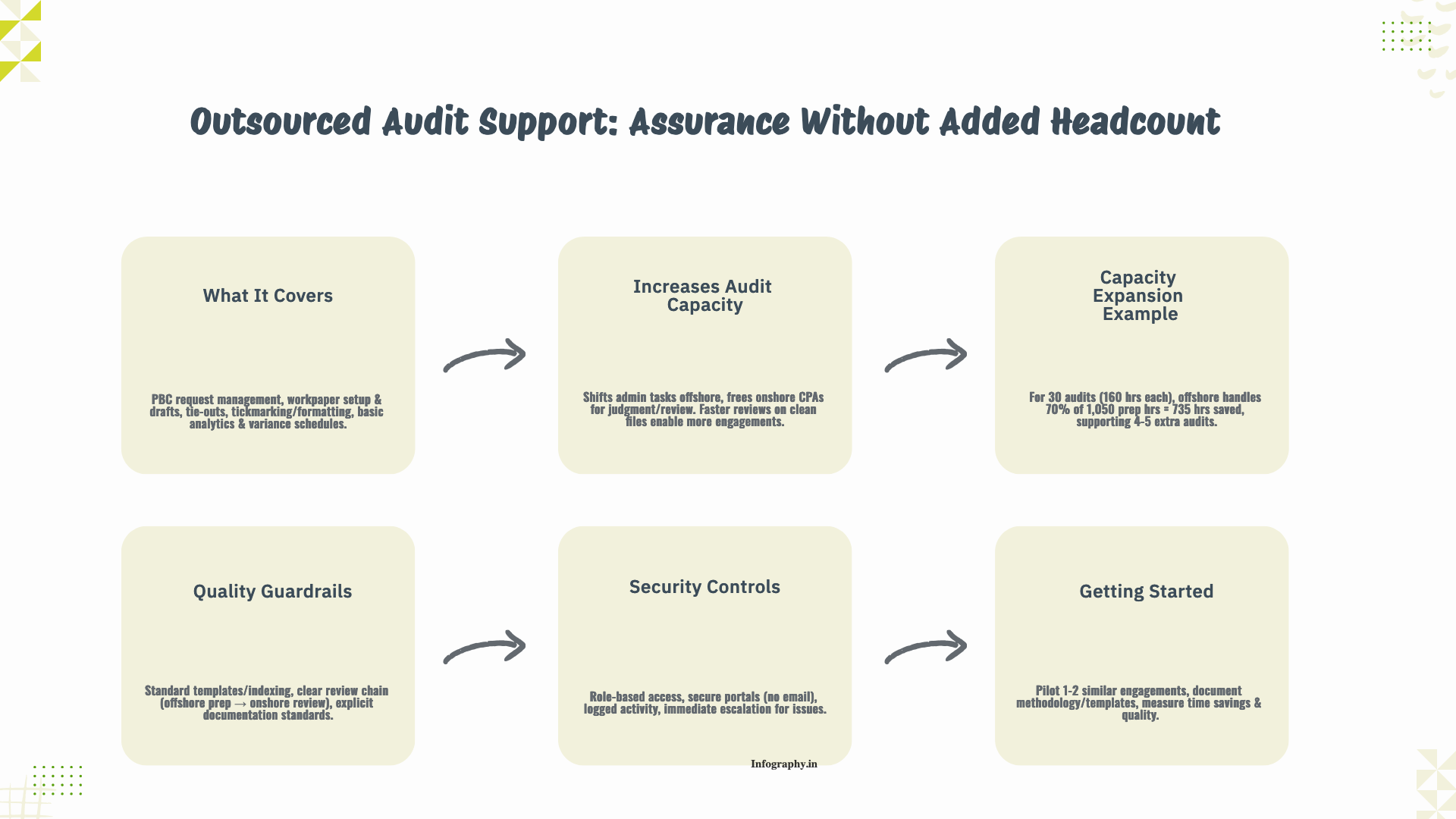
PBC request list management, tracking, and document organization are prime candidates for offshore support. The offshore team sends requests to clients, tracks what has been received, follows up on missing items, and organizes received documents in the file structure. This administrative work is time-consuming but does not require auditor judgment. When done well, it ensures that fieldwork can begin with complete documentation rather than starting with gaps that cause delays.
Workpaper setup and first-draft workpapers shift preparation work offshore. The team sets up the engagement file according to the firm's template, prepares lead schedules, drafts analytical review schedules, and completes routine tests that follow documented procedures. The onshore team reviews these drafts, investigates exceptions, and finalizes conclusions. The leverage comes from one senior auditor being able to review work prepared by two or three offshore team members, multiplying effective capacity.
Tie-outs between trial balance, lead schedules, and financial statements are tedious but essential. The offshore team performs the mathematical reconciliations, documents the tie-out process, and flags any discrepancies for investigation. This ensures that the numbers flow correctly through the audit file and that errors are caught early rather than discovered during partner review.
Tickmarking and formatting under firm standards makes workpapers review-ready. The offshore team applies the firm's tickmark legend, formats schedules consistently, and ensures that workpapers meet documentation standards before they go to review. This reduces the time reviewers spend fixing formatting issues and allows them to focus on substantive review.
Basic analytics and variance schedules provide the foundation for analytical procedures. The offshore team calculates ratios, prepares trend analyses, and identifies variances that exceed thresholds. The onshore auditor evaluates whether the variances are explainable and whether additional testing is needed. The calculation work happens offshore. The professional judgment happens onshore.
Audit teams lose time in two predictable places: gathering and formatting. Gathering includes chasing client documentation, organizing files, and ensuring that all required schedules are complete and properly labeled. Formatting includes setting up workpapers, applying firm standards, performing tie-outs, and making everything review-ready. If those steps are handled well by a dedicated team, seniors and managers can spend more time on risk assessment, test design, evaluation of results, and review.
The time savings compound because review is faster when workpapers are clean, complete, and properly formatted. A reviewer can move through a well-prepared file in half the time it takes to review a messy file with missing documentation and formatting errors. The offshore team's work quality directly affects the efficiency of the entire engagement.
Consider a firm that completes thirty audits per year. Each engagement averages one hundred sixty hours of total effort, including planning, fieldwork, review, and finalization. Of that total, assume thirty-five hours per engagement is spent on document organization, file setup, tie-outs, and first-draft workpaper preparation. These are tasks that can often be supported effectively by an offshore team that follows documented procedures.
Across thirty engagements, that represents one thousand fifty hours of preparation work annually. If offshore support can handle seventy percent of this work with adequate quality, the firm frees up approximately seven hundred thirty-five hours of onshore capacity. This freed capacity can be used to complete additional engagements, reduce overtime during busy season, or allow seniors and managers to focus more time on complex accounting issues and client advisory work.
If an average audit requires one hundred sixty hours of total effort, seven hundred thirty-five freed hours can support approximately four to five additional audits, depending on engagement complexity. This capacity expansion happens without adding full-time staff, without increasing office overhead, and without the recruitment and training burden that new hires require.
Audit support fails when quality standards are unclear, review is inconsistent, or the offshore team does not understand what constitutes complete and adequate documentation. Quality in audit work is not negotiable, and offshore support only works if it strengthens rather than weakens the audit process.
Standard templates and indexing systems are essential. Use one template set for all engagements. Use one indexing and cross-referencing system. Do not improvise file structures on a per-engagement basis. Consistency makes training faster, reduces errors, and allows reviewers to navigate files efficiently. When every engagement follows the same structure, the offshore team builds expertise quickly and the onshore team can review faster.
A clear review chain defines who is responsible for what level of review. Offshore staff prepare drafts and perform initial quality checks. Onshore senior auditors review the work for completeness, accuracy, and compliance with auditing standards. Managers handle complex accounting issues, evaluate conclusions, and address unusual circumstances. Partners perform final review and sign the audit report. This layered review approach ensures that work is checked multiple times and that professional judgment is applied by licensed, experienced auditors.
Documentation standards must be explicit and enforced. Define what supporting documentation must be attached to each workpaper, how it must be labeled, and what level of detail is required in workpaper narratives. If support is missing or inadequately documented, the workpaper is not considered complete and should be returned for correction before review proceeds. This discipline ensures that the audit file is defensible and that reviewers have everything they need to evaluate the work.
Audit files contain highly sensitive client information, including financial data, internal control documentation, and identified deficiencies. Security is not optional. Firms must implement controls that protect this information regardless of where work is performed.
Use controlled access with role-based permissions. Each offshore team member should have access only to the specific engagements they are assigned to, not to the entire audit portfolio. Access should be logged so the firm can track who accessed which files and when. This audit trail is essential for both security and quality control purposes.
Use secure portals rather than email for file transmission. Email is not encrypted, is difficult to audit, and is prone to user error like sending files to wrong recipients. A secure portal with version control, access logging, and encryption protects client data and provides visibility into file activity.
Implement procedures for handling identified issues. If the offshore team discovers a potential control deficiency, unusual transaction, or accounting error during their work, they must have a clear escalation path to flag it immediately to the onshore team. Time-sensitive issues cannot wait for the next scheduled review meeting.
Start with one engagement type that follows a consistent pattern. If your firm performs multiple audits of similar entities, such as nonprofits or employee benefit plans, begin with those. The similarity allows the offshore team to build expertise in a specific domain rather than trying to learn multiple different industries and reporting frameworks simultaneously.
Document your audit methodology and workpaper requirements before training begins. The offshore team cannot guess what your standards are. They need written procedures, example workpapers, and clear quality criteria. If your methodology only exists in the heads of experienced staff, documenting it for offshore support will also improve consistency across your entire audit practice.
Run a pilot with one or two engagements before expanding. Measure the time savings, rework rates, and reviewer satisfaction. If the pilot demonstrates that quality is maintained and capacity increases, expand gradually. If quality issues emerge, address them through better training or clearer documentation before scaling.
Outsourced audit support does not compromise audit quality when implemented with proper controls, clear standards, and rigorous review. It creates leverage that allows audit teams to handle more engagements without sacrificing the professional judgment and skepticism that effective auditing requires.

Section 4960's 21% excise tax now reaches far more nonprofit employees. See who is a covered employee in 2026 and what changed.

The Section 45S paid family leave credit is permanent for 2026 with new options. See who qualifies, the amounts, and how to claim it.

Opportunity zones become permanent in 2027 under the One Big Beautiful Bill. See the new deferral, rural bonus, and the 2026 handoff.



