


Outsourced bookkeeping services for small businesses give you a remote team that records transactions, reconciles every bank and card account, tracks what customers owe and what you owe vendors, and sends a profit and loss statement and balance sheet each month. You pay a monthly fee in place of a salary, and you keep ownership of the books, the software login and every decision.
This guide is written for owners of small US businesses, not accounting firms. It covers what the service includes, how a typical month runs, what drives the fee, how the cost compares with hiring a bookkeeper at Bureau of Labor Statistics wage levels, how to vet a provider's data security, and the signs that it is time to stop doing the books yourself. If you run a CPA practice and want to send client work out, our outsourced bookkeeping pricing guide for CPA firms covers that model separately.
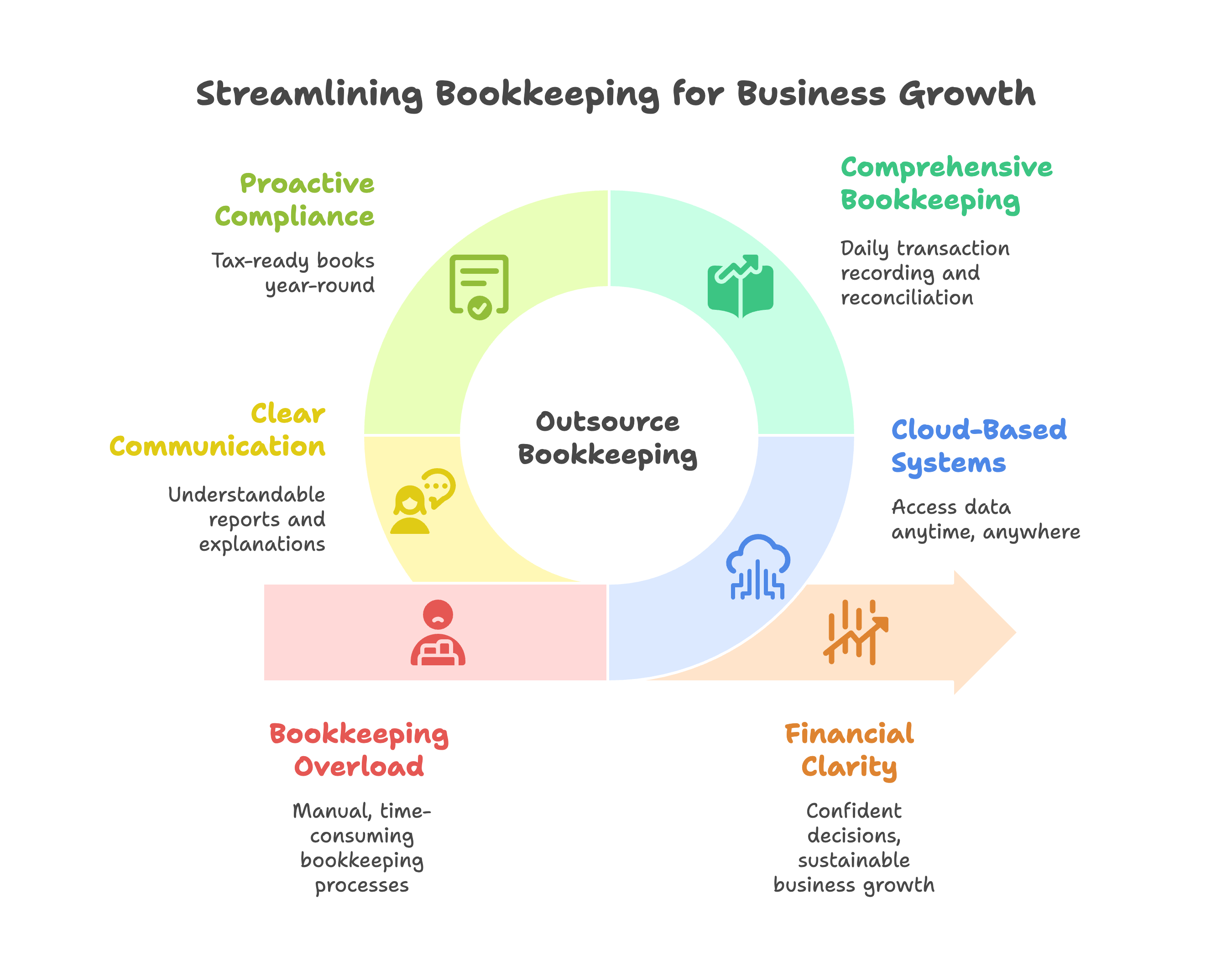
Most monthly engagements cover the same core tasks, with add-ons priced separately.
Core monthly work
Common add-ons
Once onboarding is done, the work settles into a repeating calendar. The dates below are a typical pattern, offered as guidance; your provider should commit to its own dates in writing.
| Timing | What the bookkeeper does | What you do |
|---|---|---|
| Ongoing, weekly | Imports bank feeds, codes routine transactions, enters bills | Upload receipts and forward vendor bills |
| Days 1 to 5 after month end | Reconciles bank, card and processor accounts; records payroll | Make sure all statements and payroll reports are available |
| Days 5 to 10 | Posts accruals or adjustments if you use accrual basis; reviews balance sheet accounts | Answer the open-questions list |
| Days 10 to 15 | Delivers profit and loss, balance sheet and any agreed reports | Review the reports, ideally in a short call |
| Quarterly | Prepares figures for estimated tax payments and sales tax returns | Approve payments with your tax preparer |
| Year end | Closes the year and sends a tax package to your CPA | Confirm owner draws, loans and asset purchases |
Firms that run a disciplined monthly close with AP, AR and reconciliation steps can often hit the shorter end of those windows. The quarterly row matters because federal estimated tax payments fall due four times a year, and you can only size them well when the books are current; see this guide to quarterly estimated tax payments and how to calculate them.
Onboarding. As a general guide, onboarding takes about four to eight weeks. That period usually involves granting read-only bank access, inviting the bookkeeper into QuickBooks Online or Xero as a separate user, agreeing the chart of accounts and report formats, and listing every account the business uses. If the books are far behind, the provider should quote cleanup as a separate fixed project before monthly work begins, so you can see what the backlog costs and when the books will be current.
Your monthly hand-off. Expect to send statements for accounts without a bank feed, receipts, payroll reports and loan statements, ideally from a shared checklist.
Keep ownership of the numbers. Set a fixed day each month to review profit, cash, receivables, payables and any expense that moved sharply.
Two federal changes from the One Big Beautiful Bill Act, which the IRS now also refers to as the Working Families Tax Cuts legislation, change what your bookkeeper tracks for 2026.
Form 1099-NEC threshold. The IRS instructions for Forms 1099-MISC and 1099-NEC state that "for tax years beginning after 2025, the minimum threshold amount for reporting certain payments" increased to $2,000, and that it "may be adjusted for inflation beginning in calendar year 2027." Your bookkeeper still needs a W-9 and running totals for every contractor, because the filing decision depends on the year's total. More detail is in our breakdown of the 2026 1099 reporting thresholds.
Form 1099-K threshold. The IRS guidance for gig economy workers confirms that payment platforms issue a 1099-K when payments for the year are "more than $20,000" and the number of transactions is "more than 200." Fewer small sellers will receive the form, but all income is still reportable. That makes reconciling platform payouts to recorded sales a bookkeeping job your tax preparer will rely on.
Record retention. The IRS page on how long to keep records sets the general rule at three years, with longer periods in specific cases: seven years if you claim a loss from worthless securities or a bad debt deduction, and "at least 4 years" for employment tax records. Ask any provider where your documents are stored and for how long.
Published rates vary widely, so this guide does not quote market prices. Your quote will mostly reflect these drivers.
| Cost driver | Why it moves the fee |
|---|---|
| Monthly transaction volume | More lines to code and reconcile each month |
| Number of bank, card, loan and processor accounts | Each account needs its own reconciliation |
| Cash or accrual basis | Accrual adds journal entries for revenue, prepaid costs and accrued expenses |
| Inventory or cost of goods sold | Requires inventory counts, COGS entries and margin reports |
| Payroll and contractors | Payroll journals, benefit accruals and 1099 tracking |
| Sales tax in several states | Tracking taxable sales by jurisdiction and filing calendars |
| Classes, locations or projects | Extra tagging on every transaction to produce segment reports |
| Bill pay and invoicing on your behalf | Moves the work from recording into processing |
| Backlog | Cleanup is usually a separate one-time fee |
| Turnaround and access | Faster close dates and a named point of contact take more staff time |
A low monthly quote that excludes reconciliation of processor accounts or charges per question can cost more over a year. Our guide to what it costs to outsource accounting services walks through how to compare scopes on equal terms.
The fairest benchmark for an outsourced fee is what you would pay an employee to do the same work.
The wage benchmark. The Bureau of Labor Statistics Occupational Outlook Handbook reports that "the median annual wage for bookkeeping, accounting, and auditing clerks was $50,670 in May 2025," or $24.36 per hour. The lowest 10 percent earned less than $36,000 and the highest 10 percent more than $74,550.
The benefits load. The BLS Employer Costs for Employee Compensation release for June 2026 shows that for private industry workers, wages and salaries "accounted for 70.0 percent of employer costs," with benefits making up the remaining 30.0 percent. Applying that average ratio is an approximation, since benefits vary by employer and job.
Illustrative example. A service business with about 300 transactions a month, two bank accounts, one credit card, Stripe payouts and a small payroll is weighing three options. The outsourced fee below is a hypothetical quote used for illustration only.
| Option | Annual cost | Monthly equivalent |
|---|---|---|
| Full-time bookkeeper at the BLS median wage, grossed up so wages are 70% of total cost | $72,386 | $6,032 |
| Part-time bookkeeper, 20 hours a week at $24.36, wages only before payroll taxes and benefits | $25,334 | $2,111 |
| Outsourced service at a hypothetical $1,500 a month | $18,000 | $1,500 |
The arithmetic: $50,670 divided by 0.70 equals $72,386, of which $21,716 is benefits. The part-time wage is $24.36 × 20 hours × 52 weeks, or $25,334. The hypothetical outsourced fee is $1,500 × 12, or $18,000, which is $54,386 below the full-time figure and $7,334 below the part-time wage alone.
The in-house figures exclude recruiting, software, training and cover for vacations or turnover. The outsourced figure excludes cleanup and your own review time. Run the same table with your real quotes. For a fuller model, see our analysis of the true cost of in-house vs outsourced accounting in 2026.
Ask each provider the same questions and get the answers in writing.
Your bookkeeper will see bank statements, payroll data, customer lists and tax IDs, so security deserves its own review.
The FTC's Safeguards Rule guidance applies to financial institutions under FTC jurisdiction and lists "tax preparation firms" among them, so a provider that also prepares returns is covered. Its requirements make a good checklist for any bookkeeping firm:
In practice, ask whether the provider uses separate named user logins for every staff member, read-only bank connections where possible, a secure portal in place of email attachments, and device controls for remote staff. Ask whether the firm holds an independent SOC 2 report and, if so, request a copy; our explainer on SOC 1 vs SOC 2 audits explains what each report covers. On your side, never share your own banking password and remove access promptly when the engagement ends.
Outsourcing tends to pay off when one or more of these signs appear:
The main risk is a rushed handoff. Start with reconciliations, transaction coding, monthly reports and the open-questions list. Once that runs smoothly for two or three months, add bill pay, invoicing, payroll review or sales tax support.
What do outsourced bookkeeping services for small businesses usually include? Transaction coding, reconciliation of bank, card and payment processor accounts, receivables and payables tracking, and a monthly profit and loss statement and balance sheet. Payroll, bill pay, sales tax work and cleanup projects are usually optional add-ons.
How much does outsourced bookkeeping cost compared with hiring? Fees depend on transaction volume, the number of accounts, accrual accounting, inventory, payroll and sales tax. For comparison, BLS puts the May 2025 median wage for bookkeeping clerks at $50,670, and benefits add roughly 30 percent of total compensation on average across private industry.
Will I lose control of my books? No. Keep the software subscription in your own name, give the bookkeeper a separate login and review the reports monthly.
Is outsourced bookkeeping safe? It can be, if the provider uses multi-factor authentication, encryption, separate user logins and a secure portal. Ask for its written security policies first.
How long does it take to get started? As a rough guide, onboarding takes about four to eight weeks, depending on how many accounts you have and how organized your records are. A backlog adds a separate cleanup project first.
Do I still need a CPA if I outsource bookkeeping? Usually yes for tax returns and planning. The bookkeeper keeps the records accurate during the year, and the CPA uses them to file and advise.
Madras Accountancy provides monthly bookkeeping for US small businesses, along with payroll support, tax preparation and CFO advisory when you need them. To talk through your accounts, transaction volume and reporting needs, contact our team.
The section 4960 excise tax is 21% of nonprofit pay over $1M. From 2026 it covers all employees. See the medical carve-outs, Form 4720 and a worked example.

The paid family and medical leave tax credit is permanent from 2026. See the 12.5% to 25% rates, the premium option, the 6-month rule and how Form 8994 works.

Opportunity zones become permanent in 2027 under the One Big Beautiful Bill. See the new deferral, rural bonus, and the 2026 handoff.