




Standard bookkeeping tracks revenue and expenses. Manufacturing accounting tracks the cost of transforming raw materials into finished goods through a production process, and it does so at multiple levels: by product, by work order, by production line, and by cost component (materials, labor, overhead). It is a fundamentally different discipline.
A manufacturer who uses a generalist bookkeeper typically discovers the problem at one of three moments. During a bank loan application when the lender asks for gross margin by product line and nobody can produce it. During an acquisition conversation when the buyer's due diligence team asks for standard cost variances and gets blank stares. Or during tax season when the CPA realizes that inventory valuation has been wrong for years and the tax returns need amendment.
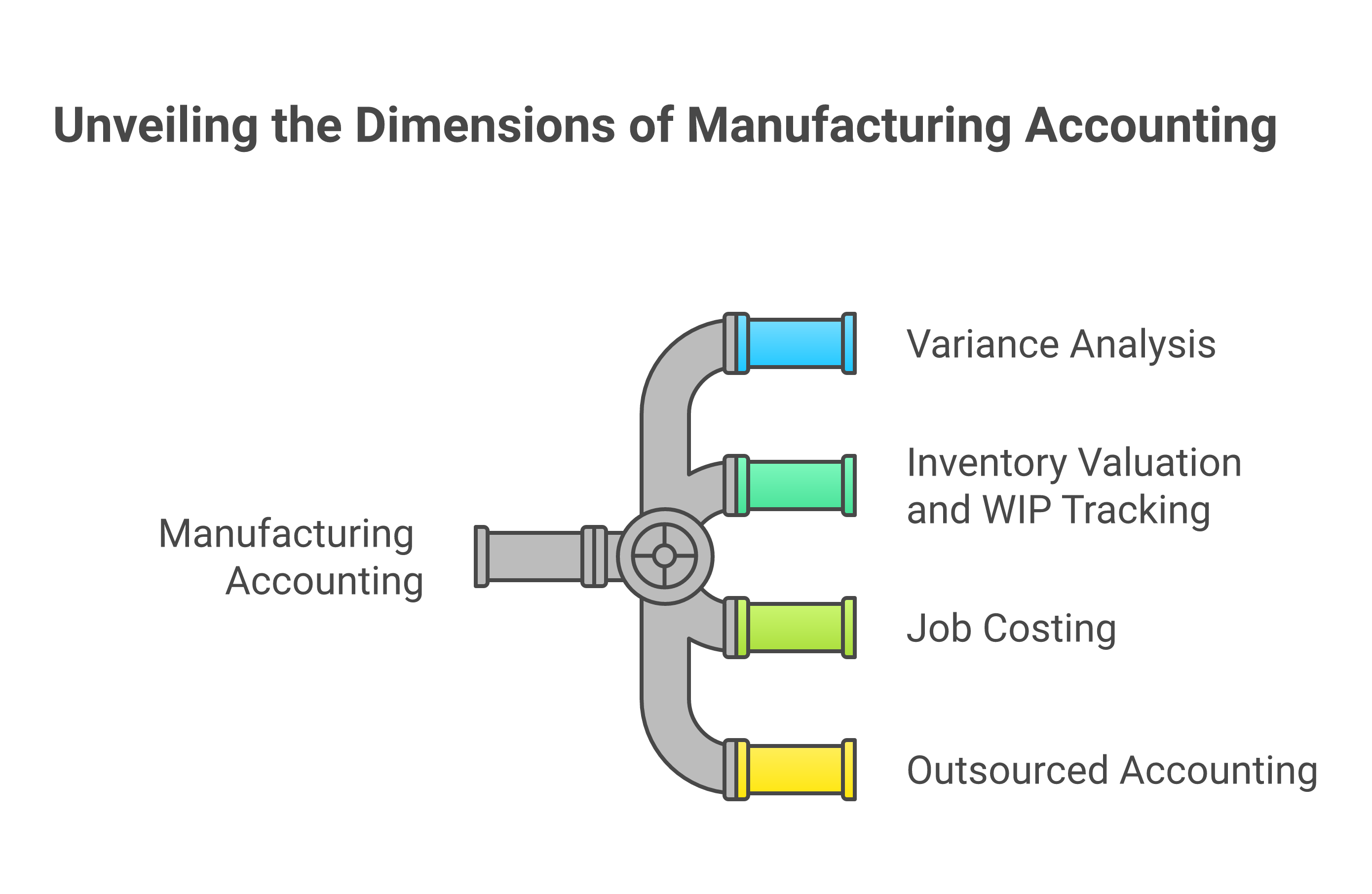
We support CPA firms that serve manufacturers at Madras Accountancy. Our team handles the production-heavy accounting work (cost roll-ups, variance analysis, inventory reconciliation, WIP tracking) while the CPA provides the advisory layer. Our outsourced accounting guide covers the general model. This article covers manufacturing specifically.
In our experience, the gap between what manufacturers need from their accounting and what they actually get is wider than in almost any other industry. A service business can function reasonably well with basic bookkeeping because the financial model is straightforward: revenue minus expenses equals profit. A manufacturer cannot, because the relationship between inputs and outputs is complex, inventory sits on the balance sheet as an asset until it ships, and the cost of goods sold calculation depends on getting the product costing right. When the costing is wrong, every financial statement that depends on it is also wrong.
Manufacturing companies that make the same products repeatedly need a standard cost system. Standard costing assigns a predetermined cost to each product based on expected material quantities, expected labor hours, and allocated overhead. Actual costs are then compared to standard costs, and the differences (variances) are analyzed to identify inefficiencies.
A standard cost for a widget might break down as: materials (2.3 lbs of steel at $1.80/lb = $4.14), direct labor (0.4 hours at $22/hr = $8.80), and manufacturing overhead (allocated at $15 per direct labor hour = $6.00). Total standard cost: $18.94.
Setting up and maintaining standard costs requires building a bill of materials (BOM) for every product, establishing labor routing standards, calculating overhead allocation rates, and updating standards annually (or more frequently if material costs are volatile).
The BOM is the cornerstone of the entire system. Every component that goes into the finished product must be listed with its quantity and current cost. For manufacturers with complex products (assemblies that contain sub-assemblies), the BOM can be multi-level, and the cost rolls up through each level. A change in the cost of a single component ripples through every product that uses it. Maintaining accurate BOMs requires coordination between the accounting team and the engineering or production team, because engineering changes (substituting a component, changing a material specification) must be reflected in the BOM to keep the costing accurate.
Our offshore team at Madras maintains the standard cost database, updates BOMs when engineering changes occur, recalculates overhead rates quarterly, and produces the variance reports that tell the CPA and the manufacturer where costs are deviating from plan. This is detailed, recurring work that follows established processes once set up. Exactly the kind of work outsourcing handles efficiently.
The overhead allocation methodology deserves specific attention because it is one of the most common sources of error in manufacturing accounting. Overhead costs (facility rent, utilities, equipment depreciation, supervisory labor, quality control) need to be allocated to products using a base that reflects how those costs are consumed. Direct labor hours, machine hours, and units produced are all common allocation bases, but choosing the wrong one distorts product costs. A manufacturer with a highly automated production line should allocate overhead based on machine hours, not direct labor hours, because the machines consume most of the overhead resources. A labor-intensive manufacturer should use direct labor hours. Our team works with the CPA to establish the appropriate allocation methodology and recalculates the overhead rate quarterly to keep it current.
The whole point of standard costing is variance analysis. When actual costs differ from standard costs, the variance tells you something specific about what went wrong (or right).
Material price variance tells you whether you paid more or less than expected for raw materials. If steel prices jumped 8 percent and your standard was based on last year's price, you will see an unfavorable material price variance across every product that uses steel. This is a purchasing issue, not a production issue.
Material usage variance tells you whether production used more or less material than the standard allows. If the standard calls for 2.3 lbs of steel per widget but production actually used 2.6 lbs, you have waste or scrap that needs investigation. This is a production efficiency issue.
In our experience, the material usage variance is one of the most actionable metrics in manufacturing accounting. Unfavorable usage variances point to specific production problems: tooling that needs replacement, operators who need training, or raw materials that are out of specification and require more waste. When the variance is calculated monthly by product and by production line, the production manager can identify and address the root cause quickly. Without the variance analysis, the waste simply increases the cost of goods sold and nobody knows why margins are declining.
Labor rate variance tells you whether you paid more or less per hour than budgeted. If you used overtime labor at 1.5x the standard rate, the unfavorable variance shows up here.
Labor efficiency variance tells you whether production took more or less time than the standard allows. If the standard is 0.4 hours per widget and production averaged 0.5 hours, something in the production process is slower than expected.
Overhead variance captures the difference between allocated overhead and actual overhead, broken into volume variance (did you produce fewer units than expected, leaving overhead under-absorbed?) and spending variance (did actual overhead costs exceed the budget?).
The volume variance is particularly important for manufacturers with high fixed costs. If the overhead rate was calculated assuming 10,000 production hours per month and the plant only ran 7,500 hours, the overhead is under-absorbed by 25 percent. That under-absorption means the actual cost per unit is higher than the standard cost, and the manufacturer's margins are lower than expected. Understanding whether the volume shortfall is a temporary blip or a structural change helps the CPA advise the manufacturer on capacity planning and pricing.
Our team at Madras calculates all of these variances monthly, presents them in a format the CPA can deliver to the manufacturer, and flags material variances for investigation. The CPA then works with the manufacturer to understand root causes and recommend corrective action.
Manufacturing inventory has three components: raw materials, work in process (WIP), and finished goods. Each needs to be valued correctly on the balance sheet, and the flow between them needs to be tracked accurately.
When raw materials enter production, they move from raw materials inventory to WIP. As labor and overhead are applied during production, WIP value increases. When production is complete, the finished goods move from WIP to finished goods inventory. When goods ship to a customer, they move from finished goods to COGS.
Getting this flow wrong has direct tax and financial statement consequences. Understating WIP means overstating COGS, which understates income. Overstating finished goods means understating COGS, which overstates income. The IRS specifically scrutinizes inventory changes in manufacturing businesses during examinations.
The WIP tracking is the most challenging component because it requires knowing the stage of completion for every work order at month-end. A work order that is 60 percent complete should have 60 percent of the standard material, labor, and overhead applied to it. Our team uses the production status reports from the manufacturer's ERP or production system to calculate the WIP value at each month-end. For manufacturers that do not have robust production tracking systems, we work with the production manager to estimate completion percentages for open work orders.
Inventory obsolescence is another area that requires ongoing attention. Raw materials that have not been used in 12 months, finished goods that have not shipped in 6 months, and components for discontinued products all need to be evaluated for obsolescence. The accounting treatment requires either writing down the inventory to net realizable value or reserving for the expected loss. Our team generates aging reports for each inventory category and flags items that may require an obsolescence reserve. The CPA reviews the analysis and works with the manufacturer to determine the appropriate reserve level.
Our team maintains perpetual inventory records, reconciles physical counts to the accounting system (monthly or quarterly depending on the manufacturer's cycle count schedule), and ensures that the inventory flow (raw materials to WIP to finished goods to COGS) is properly recorded. For CPA firms looking to improve their quality control on manufacturing clients, our review process includes inventory reconciliation as a standard step.
Not all manufacturers make the same products repeatedly. Custom manufacturers, job shops, and contract manufacturers produce different products for different customers based on specific orders. These companies need job costing rather than (or in addition to) standard costing.
Job costing tracks the actual materials, labor, and overhead consumed on each job or work order. The job cost report shows the total cost to produce the order, which is compared to the quoted price to calculate the actual margin. Over time, the job cost data reveals patterns: certain types of jobs are consistently profitable, others are consistently marginal, and some are losing money because the estimating process underestimates the complexity.
Our team at Madras maintains job cost records by tracking material issues to specific jobs, allocating labor hours based on time tracking data, and applying overhead using the predetermined rate. The CPA firm receives monthly reports showing job profitability by customer, by product type, and by production facility. This analysis supports the advisory conversation about pricing, quoting accuracy, and customer profitability.
Under $5M in revenue, a manufacturer can often manage with an in-house bookkeeper who has been trained on the basics of cost accounting and inventory tracking. The product count is small, the BOM structures are simple, and the variance analysis is manageable.
Between $5M and $20M, the complexity outgrows what a single bookkeeper can handle. Multiple product lines, growing inventory counts, and the need for detailed margin analysis by product create a workload that requires dedicated accounting support. This is the sweet spot for outsourcing.
Above $20M, most manufacturers have an in-house controller or accounting manager. But even at this size, the production-level accounting (cost roll-ups, variance calculations, inventory reconciliation) can be outsourced to free the controller for analysis, reporting, and strategic work.
If your CPA firm serves manufacturers and needs production-level accounting support, reach out at madrasaccountancy.com. Our team in Chennai includes accountants with cost accounting training who can maintain standard cost systems, produce variance reports, and keep inventory valuations accurate. Our first 90 days onboarding covers how we get up to speed on industry-specific clients.
For mid-market manufacturers on NetSuite, Sage 100/300, or Epicor, yes. Our team accesses these systems remotely and handles the accounting transactions within them. For large ERP implementations (SAP, Oracle), we typically work with data exports rather than directly in the system, preparing the analysis and reports offline.
We do not perform the physical count (that happens at the manufacturer's facility). We reconcile the count results to the perpetual inventory records, investigate discrepancies, prepare adjustment entries, and calculate the financial impact of any shrinkage or variances. For manufacturers doing cycle counts, we process count results weekly or monthly.
For a manufacturer with $5M to $15M in revenue, expect $3,000 to $6,000 per month for full cost accounting support including standard cost maintenance, monthly variance analysis, inventory reconciliation, and financial statement preparation. The cost depends on the number of products, the frequency of BOM changes, and the complexity of the overhead allocation model.
Our team communicates with the production manager or plant controller on a weekly basis to collect production status data, engineering change notices, and physical count results. This communication typically happens via email and shared spreadsheets. For manufacturers with ERP systems, much of the production data flows through the system and our team accesses it directly. The key is establishing a reliable data flow during the onboarding phase so the cost accounting stays current with actual production activity.
Yes. Many of the manufacturers we work with through their CPA firms are transitioning from basic bookkeeping to proper cost accounting. The setup process involves building the initial BOMs, establishing labor routing standards, calculating the initial overhead allocation rate, and configuring the accounting system to track costs by product. This setup typically takes 60 to 90 days, after which the recurring monthly process takes over. The CPA firm provides the advisory guidance on methodology, and our team implements the system and maintains it going forward.

Section 4960's 21% excise tax now reaches far more nonprofit employees. See who is a covered employee in 2026 and what changed.

The Section 45S paid family leave credit is permanent for 2026 with new options. See who qualifies, the amounts, and how to claim it.

Opportunity zones become permanent in 2027 under the One Big Beautiful Bill. See the new deferral, rural bonus, and the 2026 handoff.



