


Sales tax compliance is not intellectually challenging because the underlying math is complex. The calculations are straightforward. What makes sales tax difficult is the operational burden. Rules change by state and sometimes by local jurisdiction. Filing frequencies vary. Some states require monthly filings, others quarterly, and the schedule can change based on your client's sales volume. Penalty notices arrive quickly when deadlines are missed, and the financial consequences are immediate. For CPA firms managing clients across multiple states, sales tax becomes a time sink and a liability risk that consumes disproportionate staff attention relative to the revenue it generates.
Outsourcing can help manage this burden, but only if the workflow is structured properly. Throwing sales tax work over the wall to an offshore team without clear processes, documentation, and quality controls does not solve the problem. It just moves the chaos to a different team. The key is building a workflow that maintains control while shifting the repetitive preparation work offshore.
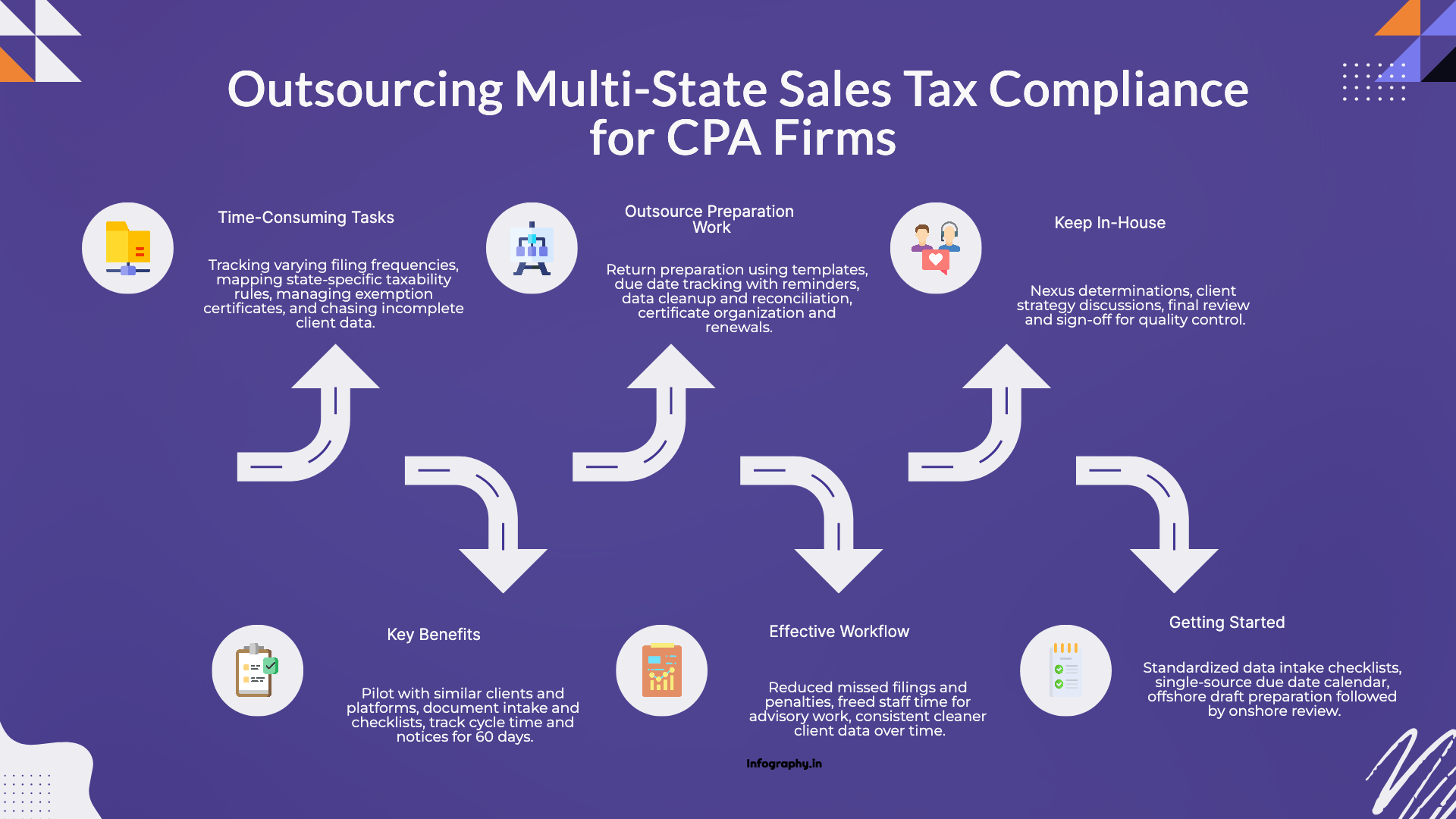
Tracking filing frequencies and due dates across states is tedious and error-prone. Each state has different rules. Some require monthly filings. Others require quarterly or annual filings. The frequency can change if your client's sales volume crosses certain thresholds. Keeping track of which returns are due when, for which clients, in which states, requires constant attention and detailed tracking systems that break down when staff turnover disrupts institutional knowledge.
Mapping products and services correctly requires understanding state-specific taxability rules. Is software as a service taxable in this state? Are shipping charges included in the tax base? Are certain food items exempt while others are taxable? These determinations require research, and the answers change over time as states update their rules. Getting the mapping wrong results in under-collected or over-collected tax, both of which create problems during audits.
Handling exemptions and resale certificates adds another layer of complexity. Clients provide certificates from customers claiming exemption, but those certificates expire, and tracking renewal dates is another administrative task. If a certificate is expired and the exemption is challenged during an audit, your client faces back taxes and penalties. Managing certificate expiration tracking for dozens of clients with hundreds of exempt customers is a full-time job that no one wants.
Chasing missing data from clients is perhaps the most frustrating aspect. Clients are busy running their businesses. Sales tax filing is not their priority. Data arrives late, incomplete, or in formats that do not match what you need. You spend time following up, clarifying, and piecing together information that should have been provided upfront. This back-and-forth consumes hours every month and delays filings, increasing the risk of late penalties.
Not all sales tax work is equally suitable for outsourcing. Preparation and tracking tasks can move offshore. Technical judgment and client-facing strategy must stay onshore.
Outsource return preparation using the firm's standard templates. The offshore team takes the data provided, applies the correct rates, calculates the tax, and prepares the return in the format your firm uses. They follow the checklist, document their work, and flag any missing information or unusual items. This preparation work is time-consuming but does not require CPA-level judgment.
Outsource due date tracking and status updates. The offshore team maintains the filing calendar, monitors upcoming deadlines, and sends reminders when data is needed from clients. They track which returns have been filed, which are in progress, and which are waiting for client input. This tracking creates visibility and reduces the risk of missed deadlines.
Outsource data cleanup and reconciliation between point-of-sale systems, ecommerce platforms, and the general ledger. Different systems report sales differently, and reconciling these sources to arrive at a single, accurate sales figure is tedious and prone to error. The offshore team handles the reconciliation, documents discrepancies, and produces a clean data set for return preparation.
Outsource certificate organization and renewal tracking. The offshore team maintains the certificate database, tracks expiration dates, and sends renewal requests to clients and their customers. They organize the certificates in a way that makes them easy to retrieve during audits.
Keep nexus determinations and edge cases in-house. Deciding whether a client has nexus in a new state based on their business activities requires judgment and an understanding of the client's operations. These decisions have significant consequences and should be made by licensed CPAs who can assess the risk and advise the client appropriately.
Keep client-facing strategy calls in-house. Clients want to discuss sales tax planning, exposure, and risk management with someone who understands their business and can provide strategic advice. These conversations require context, relationship, and judgment that cannot be outsourced.
Keep final review and sign-off in-house. The onshore team reviews the prepared returns, investigates any unusual items flagged by the offshore team, and approves the filing. This review step is where quality control happens and where accountability resides.
A successful sales tax outsourcing workflow starts with standardized intake. Define exactly what data is needed each month from the client. Sales by state, exempt sales supported by valid certificates, marketplace facilitator activity, and general ledger tie-outs are typical requirements. Provide the client with a template or checklist that specifies the format and level of detail required. Consistency in intake reduces the time spent clarifying and chasing missing information.
Build a comprehensive due date calendar that serves as the single source of truth. One tracker, one owner, no guessing. The calendar should list every filing obligation for every client, in every state, with the due date, the frequency, and the status. The offshore team maintains this calendar and updates it as filings are completed or deadlines change. The onshore team monitors the calendar to ensure nothing falls through the cracks.
Implement a draft-offshore-review-onshore process. The offshore team prepares the returns based on the data provided, attaches supporting documentation, and flags any exceptions or unusual items. The onshore team reviews the prepared returns, investigates the flagged items, and approves the filing. This division of labor allows the onshore team to focus on judgment and quality control rather than data entry and calculation.
Results vary based on the quality of implementation, but firms with stable workflows commonly see several benefits.
Fewer missed filings and fewer late fees are the most immediate and measurable outcomes. When due dates are tracked systematically and reminders are sent proactively, deadlines are less likely to be missed. The financial savings from avoiding penalties can be significant, especially for firms managing dozens of clients with multi-state obligations.
Less staff time spent on deadline chasing and data follow-up frees capacity for higher-value work. When the offshore team handles the tracking and reminders, the onshore team is not constantly following up with clients or scrambling to meet last-minute deadlines. This time can be redirected toward advisory work, nexus planning, or audit support.
Cleaner client data over time is an underappreciated benefit. When intake becomes consistent and standardized, clients learn what is expected and start providing better data. The monthly back-and-forth decreases, and the quality of information improves. This clean data not only makes sales tax filing easier, but also improves the accuracy of financial reporting and reduces the risk of audit issues.
Start with one client group and one filing platform. Do not try to outsource sales tax for every client across every state and every software platform simultaneously. Pick a group of clients who use the same ecommerce or POS system, operate in similar states, and have similar complexity levels. This focus allows the offshore team to build expertise in a specific workflow before expanding to other scenarios.
Document the intake packet and review checklist before any work is handed off. The intake packet specifies exactly what data the client needs to provide and in what format. The review checklist specifies what the onshore reviewer should verify before approving a filing. These documents are the foundation of quality control and consistent output.
Track cycle time and notice volume for at least 60 days to establish a baseline and measure improvement. Cycle time is the number of days from data receipt to filing. Notice volume is the number of penalty or inquiry notices received from taxing authorities. If cycle time decreases and notice volume stays flat or declines, the outsourcing model is working. If cycle time increases or notice volume rises, the workflow needs adjustment before scaling further.
Sales tax outsourcing works when it reduces surprise. Surprise is what causes penalties. When deadlines are tracked, data is provided consistently, and returns are prepared systematically, surprise decreases. That predictability is what makes multi-state sales tax compliance manageable rather than a constant source of stress and liability risk.
Related read: due date.
Section 4960's 21% excise tax now reaches far more nonprofit employees. See who is a covered employee in 2026 and what changed.

The Section 45S paid family leave credit is permanent for 2026 with new options. See who qualifies, the amounts, and how to claim it.

Opportunity zones become permanent in 2027 under the One Big Beautiful Bill. See the new deferral, rural bonus, and the 2026 handoff.