

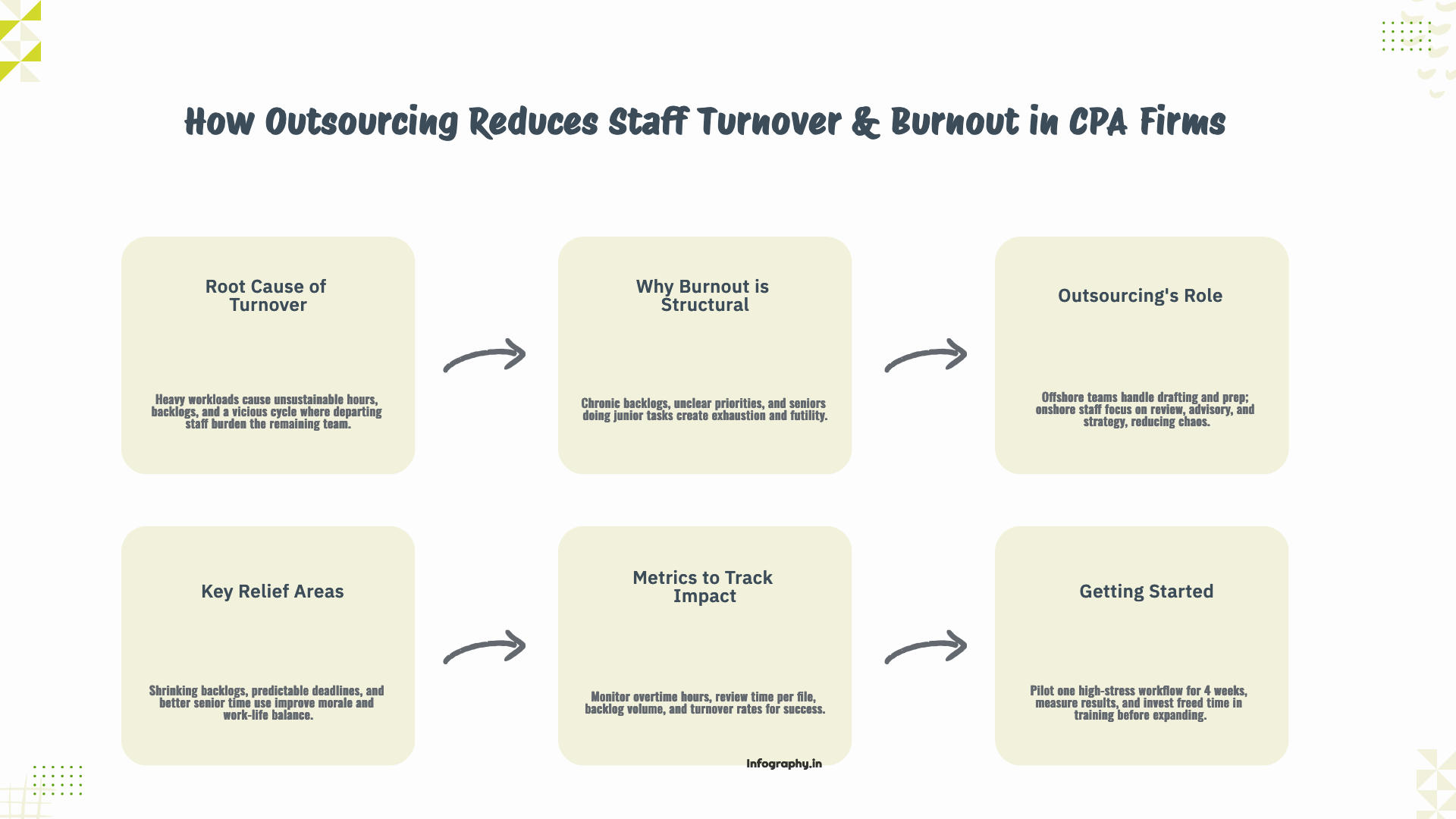

Turnover is not a problem that can be solved entirely by better recruiting, more competitive salaries, or improved interview processes. Those things help, but they do not address the root cause. The root cause is workload. When talented staff leave CPA firms, the exit interview usually reveals the same story. The hours were unsustainable. The backlog never cleared. Every deadline felt like a crisis. They were tired of spending weekends catching up on work that should have been finished during the week.
When staff leave, the firm loses trained capacity and institutional knowledge. The remaining team absorbs the departed employee's workload, which increases their stress and makes them more likely to leave. The cycle feeds itself. High turnover creates more work for those who stay, which causes more turnover. The firm ends up in a constant state of recruiting, onboarding, and training, never building the stable, experienced team needed to deliver consistent quality.
Burnout in CPA firms is often framed as a personal resilience issue. If staff could just manage their time better, work more efficiently, or handle stress more effectively, they would be fine. This framing is wrong. Burnout is a structural issue caused by chronic understaffing, unclear priorities, and work models that put senior staff in roles they should have graduated from years ago.
A chronic backlog that never clears creates a sense of futility. Staff finish one set of reconciliations or close packages, and immediately another set lands on their desk. There is no moment of completion, no sense of progress. The work is never done, and the volume keeps growing. This endless grind is demoralizing and exhausting.
Unclear priorities and last-minute deadlines compound the problem. When everything is urgent and nothing is planned, staff spend their days reacting rather than executing. They cannot finish a task without interruption because a partner needs something immediately, a client is upset, or a deadline moved up without warning. The constant context-switching burns cognitive energy and makes it impossible to achieve flow or build momentum.
Senior staff doing junior work is one of the clearest signs that production capacity is too thin. When managers are reconciling bank accounts, preparing trial balances, or assembling tax workpapers, something is fundamentally wrong with the staffing model. These tasks should be handled by junior staff or support teams, freeing seniors to review, coach, and solve complex problems. When seniors spend their time on tasks that do not require their expertise, they become frustrated, bored, and resentful. This is not a path to retention.
Outsourcing does not fix bad management, toxic culture, or unreasonable client expectations. But it can remove the production bottleneck that makes good culture difficult to maintain. When an offshore team handles the drafting, preparation, and cleanup work, the onshore team shifts to review, client advisory, and strategic work. This reallocation of effort changes the nature of the job in ways that reduce burnout.
The offshore team drafts the reconciliations, prepares the close schedules, assembles the tax workpapers, and organizes the documentation. The onshore team reviews the work, investigates exceptions, communicates with clients, and makes judgment calls. The onshore staff are no longer drowning in data entry and document assembly. They are doing the work they were hired to do, the work that requires their training and expertise.
This shift reduces the feeling of constant emergency that characterizes many CPA firm cultures. When production work is handled consistently and predictably by a dedicated team, the onshore staff can plan their days, finish tasks without constant interruption, and leave the office at a reasonable hour. The work still gets done, but the process is less chaotic and stressful.
Backlog reduction is the most visible and immediate benefit. When reconciliations, close work, and tax prep are consistently drafted by the offshore team, the backlog that has been accumulating for months or years finally starts to shrink. Staff stop spending weekends and evenings catching up. They can take time off without worrying that the backlog will explode in their absence. The firm moves from a reactive, crisis-driven mode to a more stable, predictable rhythm.
More predictable deadlines create breathing room. When the close process runs on a consistent schedule, staff know what to expect each month. They can plan their work, allocate their time, and manage their personal commitments without constant surprises. Predictability is not the same as easy, but it is far less exhausting than a culture where deadlines are arbitrary and subject to last-minute changes.
Better use of senior time improves both morale and quality. When managers stop doing cleanup and data entry, they have time to review work thoroughly, provide detailed feedback to junior staff, and invest in training. This attention improves the skills of the junior team, which reduces rework and improves output quality. The managers feel like they are developing people and building something, rather than just surviving. That sense of purpose is a powerful retention factor.
Weekly overtime hours are the most straightforward indicator. If outsourcing is reducing burnout, overtime should decline. Track average hours worked per week for each role and watch for trends. If overtime remains constant or increases after implementing outsourcing, something is wrong with the workflow or the scope.
Review hours per file reveal whether the work product quality is improving. If the offshore team is producing clean, well-documented deliverables, review should become faster and less burdensome. If review hours stay flat or increase, the offshore team may need additional training, or the workflow may need to be refined.
Backlog volume is a measure of whether the firm is keeping up with demand or falling behind. Track the number of open tasks, the age of the oldest open task, and the rate at which new work arrives versus the rate at which work is completed. If the backlog is shrinking, the firm is building capacity. If it is growing, more changes are needed.
Turnover rate and time-to-fill roles show whether retention is improving. If turnover declines after implementing outsourcing, that suggests the workload reduction is having the intended effect. If turnover remains high, other factors beyond workload may be driving departures, or the workload reduction may not be significant enough to change the employee experience.
Choose one workflow that drives overtime consistently. Close support, tax workpaper preparation, and reconciliation backlogs are common culprits. Pick the one that consumes the most senior or manager time and creates the most stress during peak periods.
Pilot outsourcing for at least four weeks to get through multiple cycles of the workflow. Track overtime hours, rework rates, and staff feedback. If the pilot demonstrates measurable relief, expand the scope. If it does not, diagnose the problem before scaling.
Use the time saved to train and improve quality, not to add more work. The temptation when capacity frees up is to take on more clients or expand service offerings. Resist that temptation initially. Invest the freed capacity in making the existing work better, training junior staff more thoroughly, and building documentation and processes that will make future growth sustainable. Only after the firm has stabilized should you consider adding more work.
Outsourcing does not fix a bad culture. It cannot make a toxic manager supportive, an unreasonable client reasonable, or a dysfunctional firm functional. But it can remove the workload pressure that makes it impossible for a good culture to thrive. When staff are not chronically overwhelmed, they have the capacity to collaborate, learn, and contribute in ways that make the firm stronger. That is how outsourcing reduces turnover. Not by magic, but by creating the space for good management and supportive culture to actually work.

Section 4960's 21% excise tax now reaches far more nonprofit employees. See who is a covered employee in 2026 and what changed.

The Section 45S paid family leave credit is permanent for 2026 with new options. See who qualifies, the amounts, and how to claim it.

Opportunity zones become permanent in 2027 under the One Big Beautiful Bill. See the new deferral, rural bonus, and the 2026 handoff.



