


Some decisions in business arrive quietly. You’re reconciling bank feeds in QuickBooks Online for the third Sunday in a row, the coffee’s gone cold, and a tiny thought pops up: “Maybe I shouldn’t be the one doing this.”
If you’re using QuickBooks already, the next thought is usually, “Should I just add QuickBooks Live?” It’s right there in the product. Tempting, neat, one click away.
But is that enough – or is it time to bring in a professional bookkeeper or offshore team that can handle more than just categorising transactions?
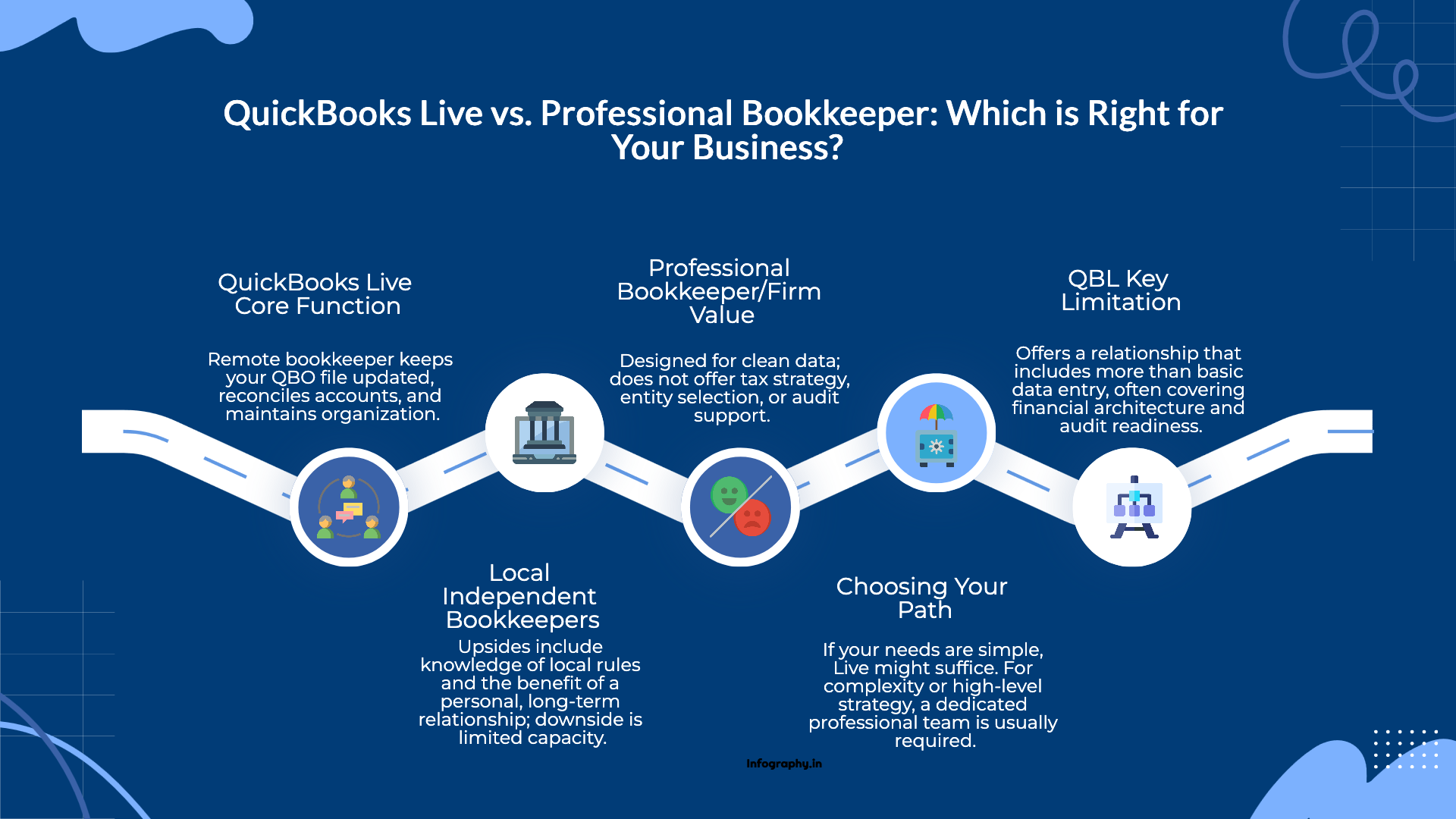
QuickBooks Live Bookkeeping is Intuit’s built-in service: a remote bookkeeper keeps your QuickBooks Online file up to date, reconciles accounts, and helps you stay organised.
It’s tightly integrated with QBO, which means setup is generally painless. Pricing is lower than hiring a full-service accounting firm, and it’s marketed squarely at small businesses who want clean books without a lot of hassle.
QuickBooks itself is quite clear in its guidance: bookkeeping is not the same as tax strategy, entity selection, or audit support. QuickBooks Live is designed to keep the data tidy – not to stand between you and the IRS or to architect multi-entity structures.
So if your business is simple – one entity, straightforward revenue, no fancy inventory tricks – Live can be enough for now. Once complexity creeps in, the cracks show.
Hiring a professional bookkeeper – whether a local independent, a virtual firm, or an offshore partner – usually means stepping out of the “product feature” mindset and into a relationship.
Here’s what that often includes beyond basic Live-style bookkeeping:
And, crucially, it’s usually easier to loop in your tax CPA when they know there’s a real close process behind the data.
On one end you have QuickBooks Live. On the other, you have firms like Madras Accountancy that treat bookkeeping as just one part of a full finance engine.
Madras works primarily with US and UK CPA firms and corporations. They don’t just post transactions; they build entire offshore teams that handle:
For a small business that works through a CPA, Madras is the invisible machine behind your advisor – the people making sure there’s a good answer when your lender or investor asks, “Can you send us your last three years of financials and tax returns?”
One thing that stands out in Madras content is the emphasis on process: due-diligence checklists, documented workflows, and security (SOC 2, GDPR, ISO 27001, VDI). That matters if you’ve ever had to explain to a banker or acquirer exactly how your numbers are produced.
It’s a step beyond the "we’ll take care of it" promise that productised services sometimes lean on.
Then there’s the classic option: a local bookkeeper or small CPA firm down the road.
The upsides are obvious. They know your local rules. They might pop into your office. They understand the strange quirks of your regional tax authority in a way no software ever will. Sometimes, they’ll even help with non-finance admin because that’s just how long-term relationships work.
The downside? Capacity. A single person can only do so much. If they get sick during your busiest month, or decide to retire, you’re scrambling.
There’s also a growing roster of online firms – Bench, Pilot, Bookkeeper360 and the like – that offer done-for-you bookkeeping with varying layers of tax and CFO help on top.
Compared to QuickBooks Live, they often:
They also typically cost more than Live. No surprise there.
If you’re paralysed by the options, try this slightly unscientific but very practical test:
Ultimately, bookkeeping isn’t just about clean ledgers; it’s about having numbers you trust enough to make uncomfortable decisions. Whether that comes from a Live subscription or a seasoned human team is the choice in front of you.
Section 4960's 21% excise tax now reaches far more nonprofit employees. See who is a covered employee in 2026 and what changed.

The Section 45S paid family leave credit is permanent for 2026 with new options. See who qualifies, the amounts, and how to claim it.
Opportunity zones become permanent in 2027 under the One Big Beautiful Bill. See the new deferral, rural bonus, and the 2026 handoff.