

If you want offshore support to succeed, invest time in setup. Skipping the upfront work does not save time. It just moves the cost into rework, confusion, and quality issues that take months to untangle. Firms that rush into outsourcing without proper preparation spend more time fixing problems than they would have spent doing the work themselves. Firms that do the setup work once, deliberately and thoroughly, build a foundation that scales efficiently.
This is not a theoretical framework. It is a practical checklist drawn from firms that have successfully implemented offshore partnerships. Use it as a pre-flight list before you hand off any client work. Each item addresses a specific failure point that causes outsourcing relationships to break down.
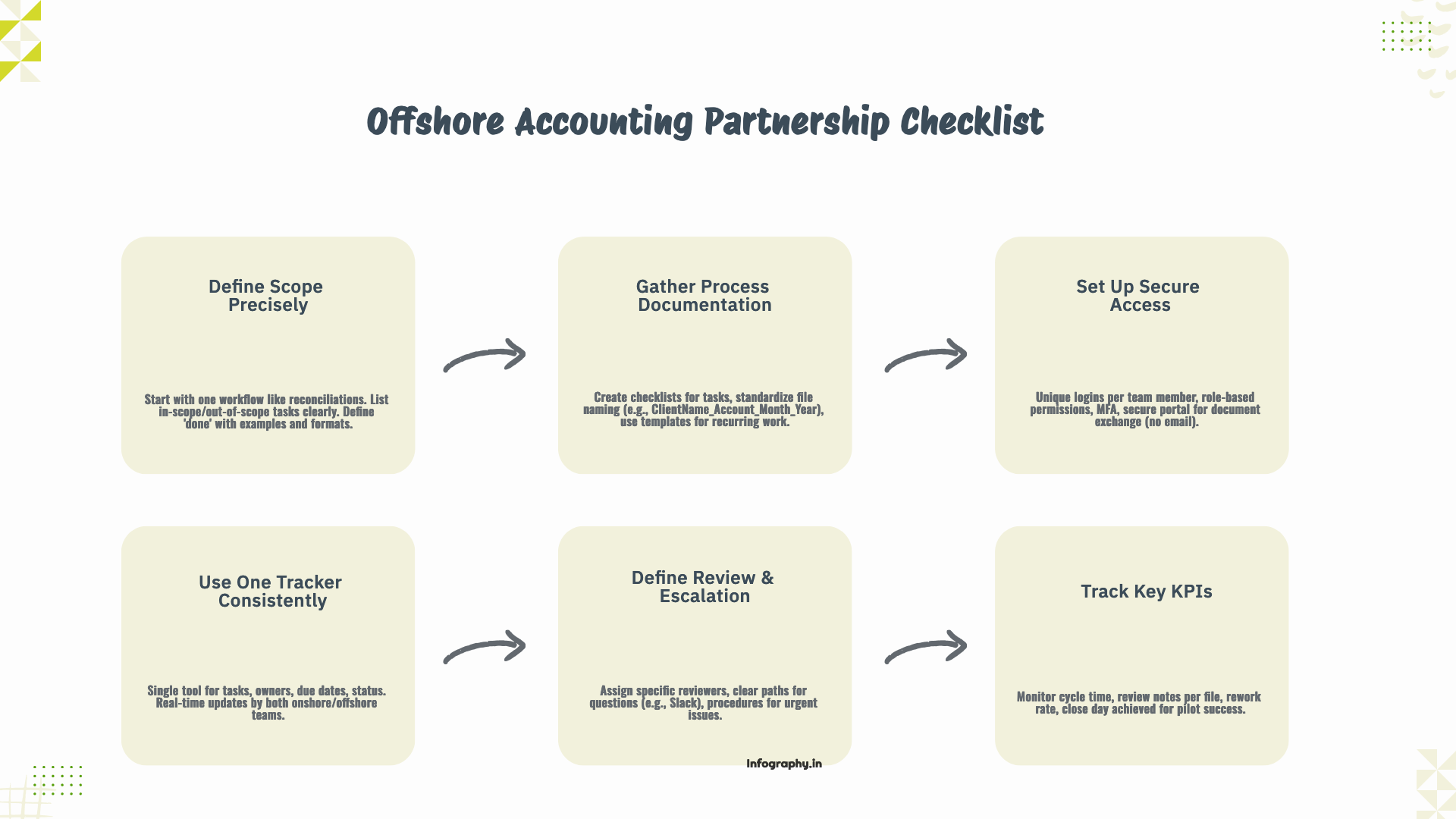
Choose one workflow to start with. Reconciliations, close support, or tax workpaper assembly are common starting points because they have clear inputs and outputs. Do not try to outsource multiple workflows simultaneously. Focus creates clarity, and clarity creates quality.
List specific tasks that are in scope and out of scope. In scope might include preparing bank reconciliations, documenting uncleared items, and flagging discrepancies. Out of scope might include investigating unusual transactions, communicating with clients about missing documentation, and making journal entries without approval. The more specific you are, the less confusion exists about what the offshore team should do versus what the onshore team should handle.
Define what done means. What does a completed deliverable look like? What format should it take? What supporting documentation should be attached? If you cannot describe what done looks like, the offshore team cannot deliver it consistently. Write down the definition and include examples of good deliverables.
Process documentation is not optional. It is the foundation of consistent output. Without it, every team member interprets the workflow differently, and quality varies based on who is doing the work.
Start with checklists. A month-end close checklist lists every task that needs to be completed, in order, with quality checks at each step. A tax workpaper checklist lists every schedule, form, and supporting document required for different return types. These checklists become the training material and the quality control tool.
Document naming conventions. If files are named inconsistently, the offshore team will waste time searching for documents and the onshore team will waste time explaining where things are. A simple naming convention like ClientName_AccountName_Month_Year eliminates this friction.
Create templates for recurring workpapers. If every bank reconciliation follows the same format, training is faster and review is easier. Templates also reduce the cognitive load on the offshore team because they do not need to design the layout. They just fill in the information.
Security is not something you retrofit after a problem occurs. It is a foundational requirement that must be in place before any client data is shared.
Assign unique logins for each offshore team member. Shared credentials make it impossible to track who accessed what and when. Individual logins create accountability and provide an audit trail if questions arise.
Implement role-based permissions and least privilege access. Each person should only have access to the files and systems they need for their assigned work. If someone is working on reconciliations for five clients, they should not have access to tax returns for fifty other clients. This limits exposure if a credential is compromised.
Enable multi-factor authentication wherever possible. Passwords alone are not sufficient protection for sensitive client data. MFA adds a second layer of security that dramatically reduces the risk of unauthorized access.
Use a secure portal for document exchange, not email. Email is not encrypted, is difficult to audit, and is prone to user error like sending files to the wrong recipient. A secure portal with activity logging provides visibility and control that email cannot match.
Multiple tracking systems create confusion, duplicated effort, and missed deadlines. Choose one system as the single source of truth for work status. Every task gets logged in the tracker, assigned to a specific person, and updated as it moves through the workflow.
The tracker should include clear fields for owner, due date, current stage, and any exceptions or blockers. Both the onshore and offshore teams should have access to the same tracker and update it in real time. When everyone is working from the same information, miscommunication decreases and accountability increases.
Clarity about who reviews what and how questions get answered prevents bottlenecks and quality lapses.
Assign specific reviewers to specific types of work. If bank reconciliations are being prepared offshore, designate one or two onshore senior accountants as the primary reviewers. Consistency in review improves quality because the reviewer becomes familiar with the offshore team's work and can spot patterns in errors.
Define where questions go. The offshore team will encounter situations where they are unsure how to proceed. There should be a clear path for raising questions, whether that is a dedicated Slack channel, a specific email address, or a field in the tracker. Questions should be answered within a defined timeframe, typically a few hours for routine questions and immediately for urgent blockers.
Establish how urgent issues are escalated. If the offshore team discovers a major discrepancy or a missing critical document, they need to know how to flag it immediately rather than waiting for the next daily sync meeting. An escalation procedure might involve tagging a manager in the tracker, sending a text message, or using a specific escalation code in the communication channel.
You cannot improve what you do not measure. Before the pilot starts, decide which metrics will indicate success or failure.
Cycle time from assignment to first draft tells you whether the offshore team is keeping pace with the workload. If cycle times are increasing over the pilot period, something is wrong with capacity, training, or task complexity.
Review notes per file measure quality. Fewer review notes suggest the offshore team is learning and producing cleaner work. More review notes suggest training gaps or unclear documentation.
Rework rate is the percentage of deliverables returned for corrections. High rework rates indicate fundamental problems with training, documentation, or communication that must be fixed before scaling.
Close day achieved measures whether the workflow is actually improving operational performance. If the goal was to close the books by day five instead of day ten, track whether that target is being met consistently.
Start the pilot with five to ten similar clients. Choose clients with similar complexity levels and business models so the offshore team is not trying to learn multiple different workflows simultaneously. Similarity creates consistency, and consistency creates learning.
Hold a short weekly exception review where the onshore and offshore teams discuss what went well, what went wrong, and what needs to change. This is not a status meeting. It is a process improvement meeting focused on identifying and fixing recurring issues.
Update the checklist when issues repeat. If the same review note appears on multiple files, that is a sign the checklist is incomplete or unclear. Update it to address the gap. Over the four-week pilot, the checklist should evolve into a comprehensive guide that reduces the need for constant supervision.
The temptation after a successful pilot is to immediately scale to all clients and add new workflows. Resist that temptation. Incremental expansion is slower but more sustainable.
Add clients gradually. Increase the volume by 20 to 30 percent at a time, not by doubling or tripling overnight. This allows the offshore team to absorb the additional work without quality collapsing.
Add one new task type at a time. If the pilot covered reconciliations, add close schedules next. After close schedules are stable, add financial statement preparation. Stacking new workflows before the previous one is stable creates chaos.
Keep review standards fixed. Do not loosen review rigor as volume increases. The review process is what maintains quality. If review becomes a rubber stamp because the team is too busy, quality will decline and the long-term value of outsourcing will erode.
Complete this checklist before the pilot starts, not during it. The pilot is for testing the workflow and measuring results, not for figuring out basic operational questions that should have been answered in advance.
If the pilot reduces rework and improves turnaround by week four, you have validated the model. Scale it thoughtfully, maintain quality standards, and continue to measure performance.
If the pilot does not deliver the expected improvements, pause before expanding. Diagnose what went wrong. Is the documentation unclear? Is the review process too slow? Is the task selection wrong? Fix the problem before adding more volume. Scaling a broken process just creates more problems.
Outsourcing works when it is treated as a real operating model that requires structure, discipline, and ongoing management. This checklist provides that structure. Follow it, and you build a foundation for sustainable offshore support that scales efficiently and delivers consistent quality.

Section 4960's 21% excise tax now reaches far more nonprofit employees. See who is a covered employee in 2026 and what changed.

The Section 45S paid family leave credit is permanent for 2026 with new options. See who qualifies, the amounts, and how to claim it.

Opportunity zones become permanent in 2027 under the One Big Beautiful Bill. See the new deferral, rural bonus, and the 2026 handoff.