

Workflow quality is where outsourcing relationships succeed or fail. Not in the contract terms. Not in the vendor's marketing materials. Not even in the initial training. Success depends on whether work moves through the firm smoothly, without getting stuck in email inboxes, lost in unclear handoffs, or delayed because someone cannot find a file. The goal is straightforward: tasks get assigned with complete inputs, work gets executed according to documented standards, review happens predictably, and deliverables reach clients on schedule. Achieving this requires deliberate design of tools, handoffs, communication rhythms, and documentation.
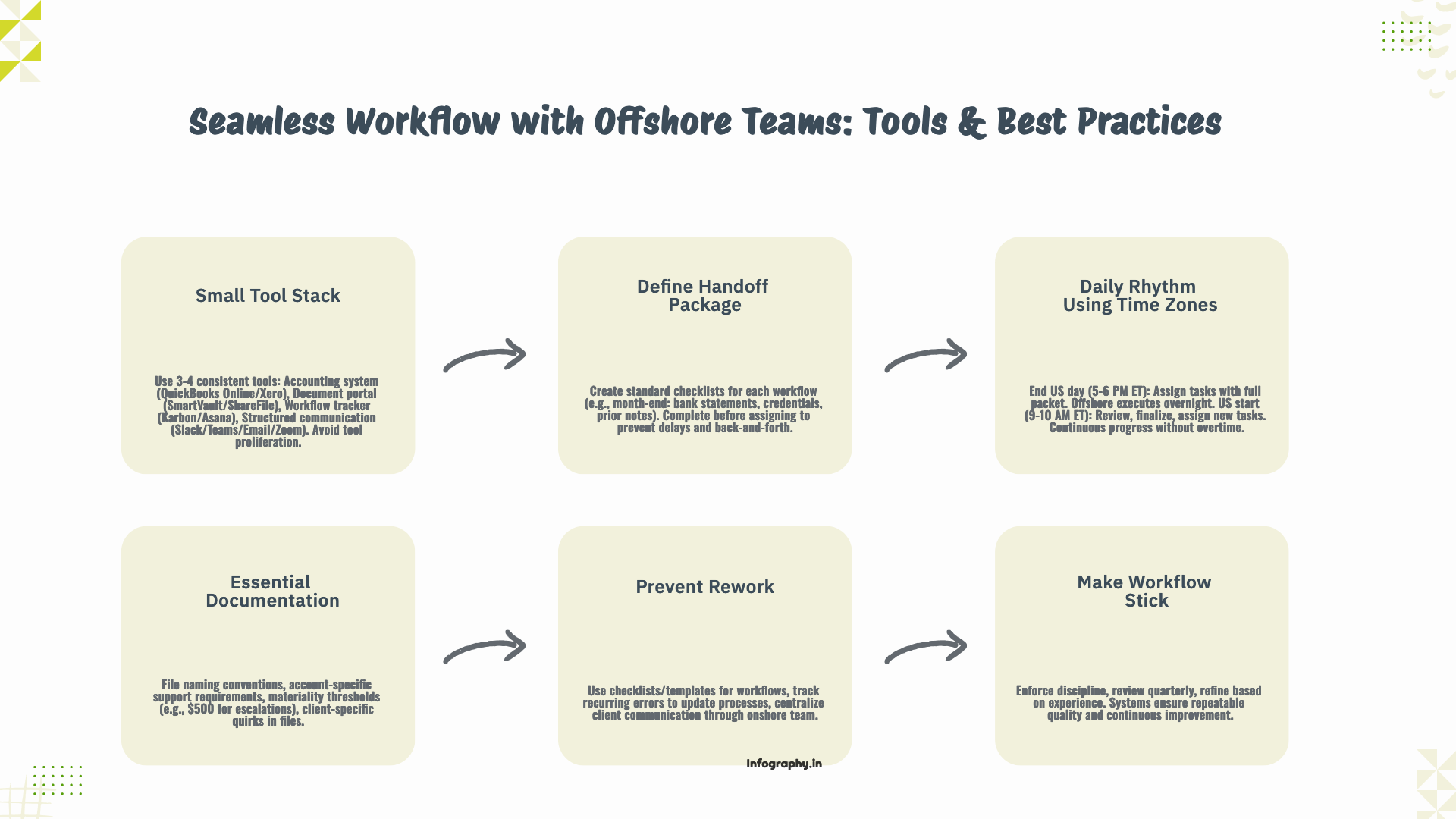
You do not need ten different tools to make outsourcing work. You need three or four tools that everyone uses consistently without exception. Tool proliferation creates confusion, duplicated effort, and information scattered across platforms where it cannot be found when needed. Simplicity and consistency matter more than feature richness.
An accounting system is the foundation. QuickBooks Online, Xero, or whatever platform your clients already use should be the primary workspace. Both onshore and offshore teams work in the same system, making real-time collaboration possible and eliminating the need to export and import data between platforms. If the offshore team is working in spreadsheets while your onshore team is working in QuickBooks, reconciliation becomes a nightmare.
A document portal provides secure file sharing with permissions and audit trails. This can be a dedicated portal like SmartVault or ShareFile, or a secure cloud storage system with proper access controls. The critical requirements are encryption, individual user logins, role-based permissions, and activity logging. Email is not a document portal. Stop using it for file transmission.
A workflow tracker provides visibility into what work is assigned, in progress, waiting for review, or complete. This can be a purpose-built tool like Karbon or Practice Ignition, a project management system like Asana, or even a well-structured spreadsheet if the team is small. What matters is that there is one system, everyone updates it in real time, and status is visible without sending inquiry emails.
Communication channels need structure. Slack or Microsoft Teams work well for quick questions that need answers within hours. Zoom or similar video conferencing handles weekly sync meetings. Email handles formal communications and client correspondence. Define which channel is used for what purpose, and train both teams to follow the protocol. Channel discipline prevents important messages from getting lost in chat streams or buried in email threads.
Most delays and quality issues trace back to incomplete handoffs. The offshore team starts work without the full packet of information, encounters blockers, sends questions, and waits twelve hours for answers while the US team sleeps. The task that should have been completed overnight takes three days because of missing inputs.
Create a standard handoff packet for each workflow type. For month-end bookkeeping close, the packet includes bank statements or confirmation of statement dates, access credentials to bank feeds and document storage, prior month close notes that list open items and follow-ups, and information about known changes like new accounts, new revenue streams, or unusual transactions.
The handoff packet should be a checklist that the assigning person completes before sending work offshore. If any item on the checklist is missing, the task does not get assigned until it is complete. This discipline prevents the offshore team from wasting time working with incomplete information and prevents the frustrating back-and-forth that erodes efficiency.
The time zone difference between the US and offshore locations like India can accelerate work or create delays depending on whether handoffs are structured. A simple daily cadence that takes advantage of the time zone looks like this.
At the end of the US workday, typically 5 or 6 PM Eastern, tasks are assigned with clear definitions of what done looks like. The assignment includes the complete handoff packet, links to relevant documents, and escalation procedures for issues that cannot wait.
During the offshore team's workday, which overlaps with US nighttime, they execute the assigned tasks. They prepare drafts, perform reconciliations, flag exceptions they cannot resolve independently, and attach supporting documentation. Work is submitted to the workflow tracker with notes about any issues encountered.
At the start of the US workday, typically 9 or 10 AM Eastern, reviewers clear exceptions, answer overnight questions, and finalize approved work. If additional tasks emerge from review, those get packaged for handoff at end of day. This rhythm creates continuous progress without requiring anyone to work outside normal business hours.
This is how firms achieve faster turnaround without burnout. Work happens around the clock, but people work standard hours in their own time zones. The leverage comes from structuring tasks so they can be executed independently during each time window.
Write down the information you find yourself repeating in emails, chat messages, and review notes. Each repeated explanation is a signal that documentation is missing or unclear.
File naming conventions eliminate confusion about which version is current and where specific documents live. A simple convention like ClientName_AccountName_Period_Version prevents the need for clarifying conversations about which file someone should be working on.
Support requirements for balance sheet accounts specify what documentation must be obtained and attached for each account type. Cash requires bank statements and reconciliation. Accounts receivable requires aging reports and bad debt analysis. Fixed assets require depreciation schedules. When these requirements are documented, the offshore team knows exactly what to provide and reviewers know exactly what to check for.
Materiality thresholds for follow-up questions prevent the offshore team from escalating every minor variance. If the threshold is set at five hundred dollars for unreconciled items, the team knows they can document and move on for amounts below the threshold and should escalate for amounts above. This empowers the team to use judgment within defined parameters.
Client-specific quirks and unusual situations should be documented in the client file. If a client has a recurring timing difference in their reconciliation, document it once so the offshore team does not flag it as an exception every month. This institutional knowledge prevents rework and builds efficiency over time.
Rework is expensive financially and demoralizing for everyone involved. The offshore team feels like they cannot get it right. The onshore reviewers feel like they are spending more time fixing work than they would have spent doing it themselves. Preventing rework requires systematic attention to quality at multiple stages.
Use checklists and templates for every workflow. The checklist ensures that all required steps are completed. The template ensures that the format is consistent and matches reviewer expectations. When work is submitted against a checklist and template, both the preparer and the reviewer have a shared understanding of what complete looks like.
Track recurring errors and update the checklist or training materials. If the same review note appears on multiple files, that is not a people problem. It is a process problem. The checklist is missing a step, the template is unclear, or the training did not cover that scenario. Fix the root cause rather than treating each occurrence as an individual error.
Keep client communication centralized through the onshore team. The offshore team should not guess what a client meant in an unclear email or make assumptions about client preferences. When questions arise, they should escalate to the onshore team who can clarify with the client directly. This prevents misunderstandings that lead to rework.
Workflows break down when discipline slips. Someone shortcuts the handoff packet because they are in a hurry. Another person skips the checklist because they think they remember the steps. A reviewer provides feedback verbally instead of documenting it. These shortcuts compound until the workflow is inconsistent and quality suffers.
Enforce the documented process even when it feels slower in the moment. The discipline pays off through reduced rework, faster training for new team members, and consistent output that clients can rely on.
Review the workflow quarterly and refine it based on what you have learned. Add items to the checklist that address recurring issues. Simplify steps that are unnecessarily complex. Update templates to reflect current best practices. The workflow should evolve based on experience, not remain static because no one took time to improve it.
A seamless workflow with an offshore team is not about finding the perfect vendor or the most talented staff. It is about building systems that make good work repeatable, quality visible, and continuous improvement automatic. Firms that invest in workflow design get the full value of outsourcing. Firms that try to operate without structure end up frustrated and convinced that outsourcing does not work.

Section 4960's 21% excise tax now reaches far more nonprofit employees. See who is a covered employee in 2026 and what changed.

The Section 45S paid family leave credit is permanent for 2026 with new options. See who qualifies, the amounts, and how to claim it.

Opportunity zones become permanent in 2027 under the One Big Beautiful Bill. See the new deferral, rural bonus, and the 2026 handoff.