

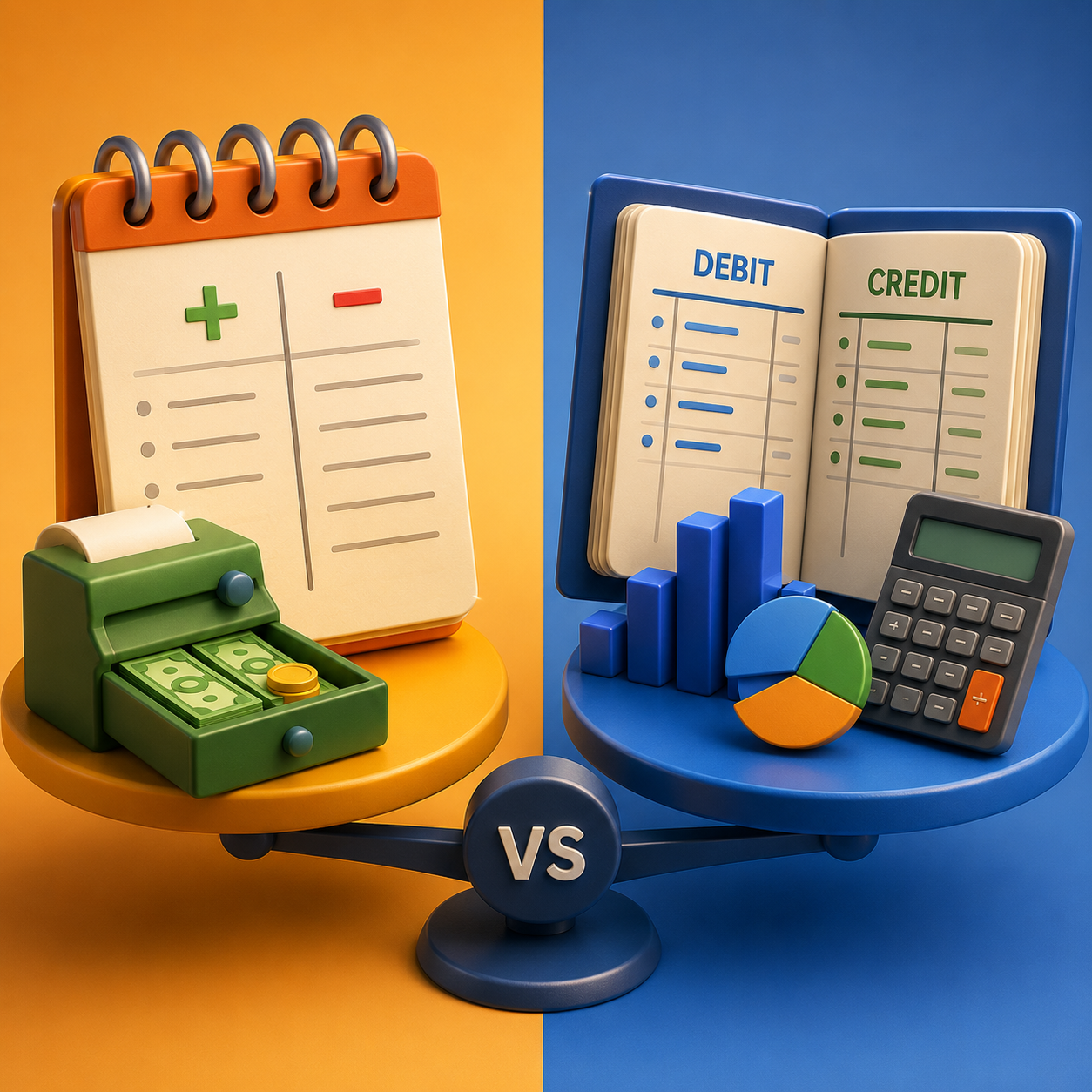

Every business has to record its money somehow, and there are two main ways to do it: single-entry and double-entry bookkeeping. The difference sounds technical, but it really comes down to one thing. How many times you record each transaction.
Single-entry bookkeeping notes each transaction once, like a running list of money in and money out. Double-entry bookkeeping records each transaction twice, once as a debit and once as a credit, so the books always stay in balance. One is simple and quick. The other takes more effort, but it gives you a full financial picture and catches errors the simple method never sees.
Here is the short answer if you are deciding between them. If you run a tiny operation with straightforward cash income and expenses, single-entry may be enough. The moment you take on a loan, carry inventory, bring in investors, or want real financial statements, double-entry is the system you need. The rest of this guide shows you why, in plain language.
Single-entry bookkeeping is the simplest accounting system there is. You record each financial transaction one time, in a single running log, usually split into income and expenses. If you have ever kept a checkbook register or a basic spreadsheet of what came in and what went out, you have already done single-entry accounting.
The main record in this method is a cash book. Money received gets added, money spent gets subtracted, and the running balance tells you roughly where you stand. It tracks the essentials: the date, a short description, the amount, and whether it was income or an expense. For a freelancer or a small side business with no inventory and no debt, that can be all you need. The IRS recognizes both single-entry and double-entry methods for small business recordkeeping, so either one is allowed. The question is which serves you better.
The trade-off is what single-entry leaves out. Because each business transaction is recorded only once, the method does not naturally track what you own and what you owe. There is no built-in check that your numbers are right, so a mistake can sit in the books unnoticed for months. If you want to understand when a simple setup stops being enough, our guide on bookkeeper vs CPA is a useful next read.
Double-entry bookkeeping records every transaction in two places at once. For each entry, one account is debited and another is credited, and the two amounts always match. That balancing act is the whole idea behind the double-entry system, and it has been the backbone of serious accounting for centuries.
The method rests on the accounting equation: Assets equal Liabilities plus Equity. Every business transaction has to keep that equation in balance, which is why it touches at least two accounts. Buy equipment with cash, and one account goes up while another goes down. Take out a loan, and your cash rises while a liability rises to match it. All of these entries live in your general ledger, the master record of every account your business uses.
Because the books have to balance, double-entry accounting builds in its own error check. When the debits and credits do not agree, you know something is wrong before it ever reaches your financial statements. For a sense of how this looks in a real monthly process, our client bookkeeping workflow walks through how entries get recorded and reconciled.
Debits and credits confuse almost everyone at first, so here is the plain version. Every account in double-entry bookkeeping can go up or down, and a debit or a credit simply tells you which direction the money moves for that account. The rule that never changes: for every transaction, total debits must equal total credits.
A quick example makes it click. Say your business buys a $500 laptop and pays cash. In double-entry, you record a $500 debit to your equipment account and a $500 credit to your cash account. Two accounts, one debit, one credit, equal amounts. In single-entry, you would just note "laptop, minus $500" and move on.
That second entry is what does the heavy lifting. It records not only that cash left, but what you got in return, so your books reflect the full story of each transaction instead of half of it. The mechanics get easier once software posts these for you, though knowing when to bring in bookkeeping help still matters as the volume grows.
The biggest practical difference shows up when it is time to produce financial statements. Single-entry can give you a basic read on income and expenses, which answers the question "did I make money this period." It struggles to produce anything more, because it never tracked your assets and liabilities in the first place.
Double-entry produces the full financial picture. From the general ledger you can pull a trial balance to confirm the books are in balance, then generate a proper balance sheet and income statement from there. That is the level of reporting lenders, investors, and auditors expect, and it is what keeps your books compliant with Generally Accepted Accounting Principles (GAAP). If you ever plan to raise money or face an audit, this matters, and our piece on audited financial statements explains what that process involves.
A real balance sheet is only possible under double-entry, since it depends on tracking what you own against what you owe. Our balance sheet template and example shows what that finished report actually looks like.
Match the method to your situation. Single-entry bookkeeping can work if you are a sole proprietor or freelancer with simple cash income, no inventory, no employees, and no loans. It is quick, cheap, and good enough when the financial picture is genuinely simple.
Double-entry becomes the right call the moment things get more involved. If you carry a business loan or any other liability, hold inventory, have investors or a bank watching your numbers, or want financial statements you can trust, you need the two-account method. Most small businesses cross that line sooner than they expect, often the first time they take on debt or hire someone. And because nearly every accounting software package is built on double-entry, you may already be using it without thinking about it.
For a growing business, the real question is less "which method" and more "who keeps it accurate." Our guides for e-commerce founders and on management reporting show how clean double-entry books feed the reports you actually use to run the company.
One thing worth saying plainly. Choosing double-entry is the easy part, because the software makes that choice for you. The actual work is keeping those entries accurate month after month: coding every transaction correctly, reconciling accounts, and making sure the debit and credit entries tell the truth before they turn into financial statements.
That is the work we take off people's plates at Madras Accountancy. Since 2015 we have run offshore accounting and bookkeeping support for U.S. CPA firms and the businesses they serve, handling the daily posting and monthly close so the numbers are clean when someone needs them. If your books have drifted, or you would rather spend your time running the business than balancing it, talk to our team and we will sort out the rest.
What is the main difference between single-entry and double-entry bookkeeping? Single-entry records each transaction once, as money in or money out, like a checkbook. Double-entry records each transaction twice, as a debit to one account and a credit to another, so the books always balance. The practical result is that double-entry tracks your full set of accounts and catches errors, while single-entry only gives you a simple view of income and expenses. Most growing businesses move to double-entry once a basic cash log stops telling the whole story.
Is single-entry bookkeeping allowed by the IRS? Yes. The IRS recognizes both single-entry and double-entry recordkeeping for small businesses, so you are free to use either as long as your records clearly show your income and expenses. Single entry is most common among sole proprietors with simple finances. The catch is that single-entry can make tax time harder if your situation is more complex, since it does not track assets and liabilities, and it offers no built-in way to confirm the numbers are right.
What is a debit and a credit in double-entry bookkeeping? A debit and a credit are the two sides of every double-entry transaction. A debit records value going into one account, and a credit records value coming out of another, though the exact effect depends on the account type. The unbreakable rule is that total debits must equal total credits for every entry. If you buy a $500 laptop with cash, you debit equipment $500 and credit cash $500. When the two sides do not match, you know there is an error to fix.
Do small businesses need double-entry bookkeeping? Many do, and more than expect to. If you are a freelancer with simple cash income and no debt, single-entry can be enough. But the moment you take on a business loan, carry inventory, hire staff, seek investors, or want reliable financial statements, double-entry becomes the practical choice. It is also the standard built into nearly all accounting software, so most small businesses end up using double-entry the day they start using a real bookkeeping tool, whether they planned to or not.
Can you produce a balance sheet with single-entry bookkeeping? Not a true one. A balance sheet shows what your business owns against what it owes at a point in time, and that requires tracking assets, liabilities, and equity in every transaction. Single-entry only follows cash in and out, so it never captures the data a balance sheet needs. Double-entry, built on the accounting equation, produces a real balance sheet along with the income statement. If you need formal financial statements for a lender or investor, you need double-entry books behind them.
Does accounting software use single-entry or double-entry? Almost all modern accounting software uses double entry behind the scenes, even when the screen looks simple. When you record an invoice or a payment, the software quietly posts both the debit and the credit for you, so you get the accuracy of double-entry without doing the entries by hand. A few very basic apps offer single-entry style tracking, but anything built for real business accounting, with financial statements and a general ledger, runs on the double-entry system.
What is the accounting equation in double-entry bookkeeping? The accounting equation is Assets equal Liabilities plus Equity. It is the rule that makes double-entry work, because every transaction has to keep both sides of that equation balanced. When you record a debit and a matching credit, you are really keeping the equation true. This is why double-entry can build a full balance sheet and why it spots errors: if the equation stops balancing, something was recorded wrong. Single-entry bookkeeping has no equivalent built-in check.
How does Madras Accountancy help with bookkeeping? We handle the day-to-day bookkeeping so you do not have to. Madras Accountancy is an offshore partner to U.S. CPA firms and the businesses they serve, and our team manages double-entry bookkeeping, transaction coding, reconciliations, and monthly close inside your accounting software. Since 2015 we have helped firms keep clean, GAAP-ready books while lowering overhead, so the accountant on record can focus on advice and review rather than data entry. You can reach our team through the contact link above.
Section 4960's 21% excise tax now reaches far more nonprofit employees. See who is a covered employee in 2026 and what changed.

The Section 45S paid family leave credit is permanent for 2026 with new options. See who qualifies, the amounts, and how to claim it.
Opportunity zones become permanent in 2027 under the One Big Beautiful Bill. See the new deferral, rural bonus, and the 2026 handoff.