


Most client concerns about outsourcing are not rooted in geography or ideology. They are rooted in surprise and the fear that quality or confidentiality will suffer. If a client discovers after the fact that their work involved offshore support, they feel deceived. If you explain the model upfront with clarity about controls and accountability, most clients focus on what actually matters to them: whether the work will be done correctly, on time, and securely.
The firms that handle this conversation successfully are transparent about their model, specific about controls, and confident about the value it delivers. The firms that struggle are vague, defensive, or apologetic, which signals to clients that something is wrong. How you communicate about outsourcing shapes whether clients see it as a strength or a liability.
Some firms disclose detailed information about offshore support proactively, explaining where the team is located, what work they handle, and how quality is maintained. Other firms keep the explanation simpler, describing a global team model without emphasizing geography unless clients ask directly. Either approach can work. What fails is being vague, defensive, or inconsistent, which makes clients suspicious that the firm is hiding something problematic.
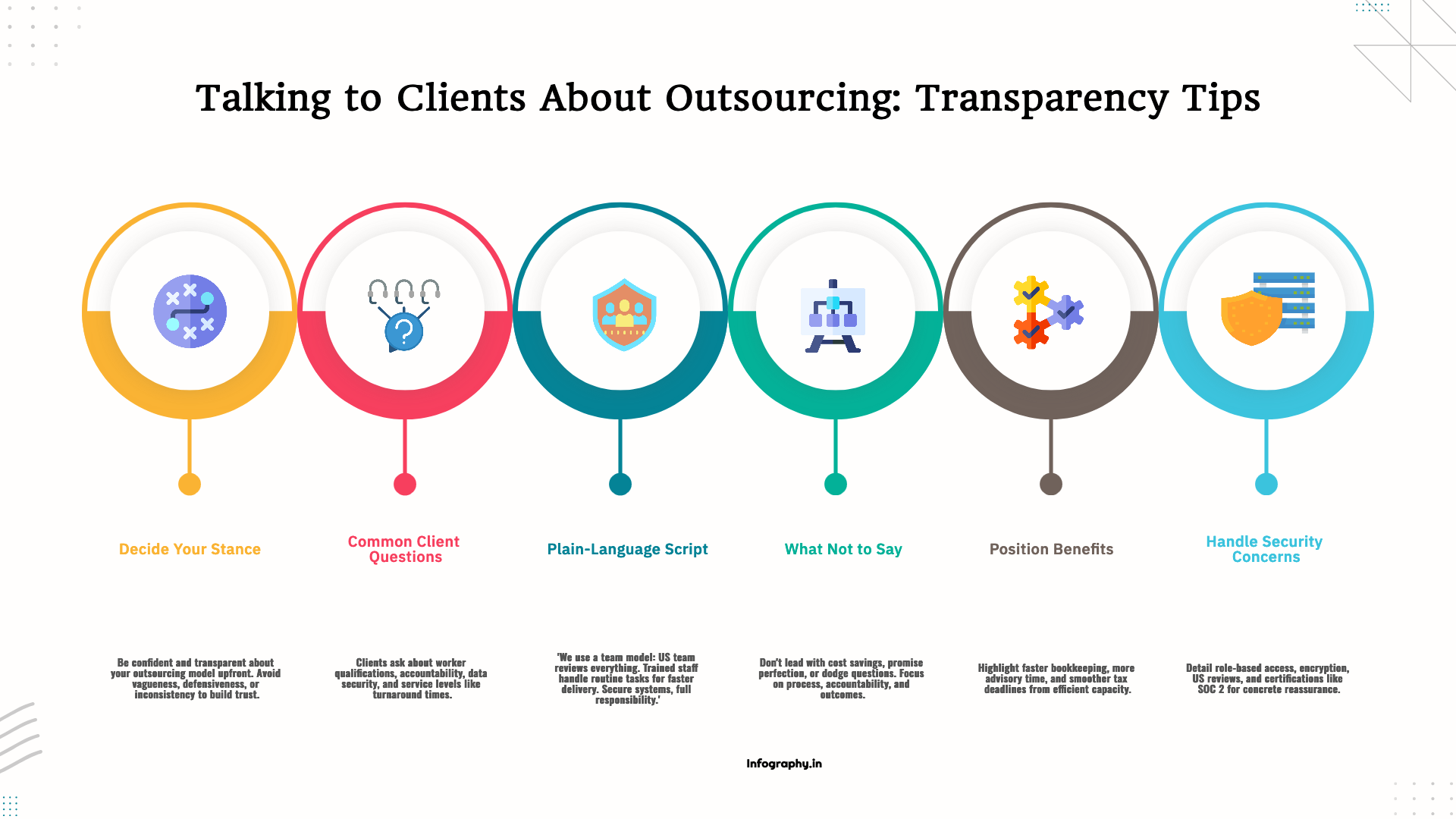
Your stance should reflect your confidence in the model and your willingness to answer client questions honestly. If you believe outsourcing strengthens your service delivery, own that position. If you are uncertain about whether it is working or worried about client reactions, fix those concerns before having client conversations. Clients detect hesitation and interpret it as risk.
Client questions about outsourcing follow predictable patterns. They want to know who is doing the work and whether those people are qualified. They want to know who is responsible if something goes wrong and whether they have recourse. They want to know how their data is protected from unauthorized access or breaches. They want to know whether turnaround times and service levels will improve, stay the same, or decline.
These are reasonable questions that deserve straightforward answers. The clients who ask are not being difficult. They are being prudent. Their financial data is sensitive, their businesses depend on accurate accounting, and they have a right to understand how their work is being handled.
When explaining outsourcing to clients, simplicity and directness work better than elaborate explanations. A script you can adapt might sound like this.
We use a team model for delivering your work. Our US team reviews and signs off on everything. We also have trained staff who help with preparation and routine processing, which allows us to deliver faster and keep quality consistent. Your data stays in secure systems with controlled access. We remain fully responsible for accuracy and compliance. If you have questions or concerns at any point, you work with the same people you always have.
This covers the essential points. The US team maintains responsibility and client relationships. The work model creates efficiency benefits. Security is controlled. Client experience remains consistent. No marketing jargon, no evasion, no apology.
Do not lead with cost savings. When you tell clients that outsourcing saves money, they hear that you are cutting corners to increase your profit margin at their expense. Even if cost efficiency is your motivation, frame the benefit in terms of service improvements, not cost reductions.
Do not promise perfection. Promise process and accountability. Clients are sophisticated enough to know that no service model is error-free. What they want is confidence that errors will be caught through review, that accountability is clear, and that problems will be addressed promptly. Overpromising creates expectations you cannot meet.
Do not dodge questions. If a client asks directly whether their work involves offshore support, answer directly. Evasiveness destroys trust faster than any honest answer about your operating model. If you cannot answer a security or process question confidently, that is a sign you need to improve your own understanding before having client conversations.
Talk about outcomes clients actually experience rather than abstract concepts like efficiency or scalability. Faster turnaround on bookkeeping and financial reporting means clients get their numbers sooner, which helps with decision-making and cash management. More partner and manager availability for advisory and planning calls means clients get access to strategic guidance when they need it rather than waiting for an opening in your calendar. Fewer last-minute scrambles during tax deadlines means clients are not receiving extension notices or rushed work that requires corrections.
These are tangible benefits that clients value. They are not marketing spin. They are direct outcomes of having sufficient production capacity to handle work smoothly rather than constantly operating at the edge of your team's capability.
When a client asks whether their data is being sent overseas, answer with specifics about controls rather than vague reassurances. Access is role-based and monitored. Each person on the offshore team has access only to the specific files they need for their assigned work, not to your entire client base. We use secure portals with encryption and activity logging, not email. Our US team reviews everything before delivery, ensuring quality and catching any issues before they reach you.
If your provider has formal security certifications or undergoes third-party audits, mention what you can verify. SOC 2 reports, ISO certifications, or penetration testing results are concrete evidence of security investment. Do not exaggerate or make claims you cannot support with documentation. If a client wants to review your provider's security documentation, you should be able to produce it.
Some clients will decline to have their work handled through an offshore model. They may have company policies against it, philosophical objections, or regulatory restrictions in their industry. Do not argue or try to convince them. Respect their position and offer alternatives.
You can keep their work fully onshore and adjust the fee structure to reflect the higher cost base. This is a straightforward business decision. If the client values an all-onshore model enough to pay for it, provide it. Most firms find that only a small percentage of clients care enough about this issue to accept higher fees.
You can limit offshore support to non-sensitive administrative tasks if that fits your workflow. Document organization, deadline tracking, and routine correspondence might be acceptable while financial data processing stays onshore. This compromise requires more complex workflow management but may satisfy clients who have specific data residency concerns.
What you should not do is promise an all-onshore model while secretly using offshore support anyway. Dishonesty destroys client relationships permanently. If you cannot accommodate a client's requirements, refer them to another firm rather than lying about your operating model.
Be proactive rather than reactive. Include information about your team model in engagement letters or initial conversations so clients understand your operating model from the start. This prevents the surprise discovery that creates conflict later.
Focus on outcomes and controls, not on defending the decision. Clients care about results. If outsourcing helps you deliver better service, emphasize that improvement. If security controls are strong, detail them. The more specific and confident you are, the more clients trust your judgment.
Track client reactions and adjust your communication based on patterns. If multiple clients ask the same question, add that answer to your standard explanation. If certain phrases trigger concern, revise your language. The conversation should get easier over time as you refine your messaging based on real client feedback.
Most clients will accept outsourcing if they trust that quality, security, and accountability remain strong. The firms that communicate about outsourcing successfully are the ones that treat it as a normal business practice rather than something to hide or apologize for. Confidence in your model creates client confidence in your service.

Section 4960's 21% excise tax now reaches far more nonprofit employees. See who is a covered employee in 2026 and what changed.

The Section 45S paid family leave credit is permanent for 2026 with new options. See who qualifies, the amounts, and how to claim it.

Opportunity zones become permanent in 2027 under the One Big Beautiful Bill. See the new deferral, rural bonus, and the 2026 handoff.