



If you hire people who have had a hard time finding steady work, the federal government has long paid you back for it through the WOTC. The WOTC turns good hiring into real money off your tax bill. There is a catch in 2026 that you need to know about, so this guide covers what the credit is, who counts, how much it pays, how you claim it, and what to do while the program sits in limbo.
The Work Opportunity Tax Credit is a federal tax credit available to employers who hire individuals from certain target groups who have faced significant barriers to employment. Congress created it in 1996, and it has been one of the steadier hiring tax credits on the books since. The idea is simple: hire someone who has struggled to find work, help them earn a steady income, and the government shares the cost through your taxes.
Two things make the WOTC different from a deduction. First, it is a dollar-for-dollar cut to your tax bill, rather than only lowering taxable income. Second, for a taxable business it flows through the general business credit, so the work opportunity credit offsets your federal tax liability the way other business credits do. In plain terms, hiring a member of a targeted group can turn into a direct reduction of what you owe.
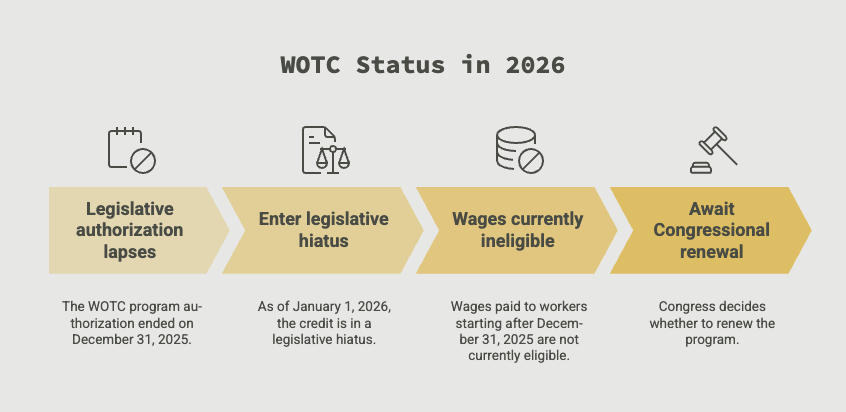
Here is the part every employer needs to hear first. The WOTC program was authorized through December 31, 2025, under Section 113 of Division EE of the Consolidated Appropriations Act, and that authorization has now lapsed. As of January 1, 2026, the credit is in a legislative hiatus, which means wages paid to workers who begin work after December 31, 2025 are not currently eligible while Congress decides whether to renew it.
This has happened before. The credit lapsed after 2013 and was reinstated retroactively, and the Department of Labor is still funding state agencies to process paperwork through its Employment and Training arm even now. Most observers expect the work opportunity tax credit program to come back, likely with a lookback that covers hires made during the gap. Nothing is guaranteed, but the pattern is strong, which is exactly why the filing steps below still matter in 2026.
The credit covers ten target groups, all made up of people who have faced barriers to employment. An eligible worker has to be certified as a member of a targeted group before you can claim anything, and for several groups the rules look at a period ending on the hire date, so eligibility depends on a window ending on the hire date. The full list of WOTC groups includes:
Qualified veterans, including those discharged or released from active duty and those unemployed for stretches before being hired. Recipients of Temporary Assistance for Needy Families, both short-term and long-term, where long-term family assistance looks at an 18-month period ending near the hire date. SNAP recipients, often described by the older food stamp label, where an individual who is a member of a family that received benefits for a set period such as at least a 3-month period or benefits for any month ending in the window the rules define. Ex-felons convicted under federal or state law. Designated community residents and vocational rehabilitation referrals, including anyone referred through the Ticket to Work program or an employment network under the ticket. Supplemental Security Income recipients. Summer youth employees aged 16 or 17 who live in an empowerment zone and work between May 1 and September 15. And qualified long-term unemployment recipients, generally people jobless for at least 27 consecutive weeks.
The size of the credit depends on the group and on how long the person stays. For most target groups, the credit is 40 percent of the first 6,000 dollars of first-year wages, which works out to a maximum credit of 2,400 dollars per eligible hire. Hire a qualified veteran and the ceiling climbs much higher, up to 9,600 dollars depending on the category.
Hours matter too. An employee must work at least 120 hours in the first year of employment before any credit applies, and those hours only count once the individual begins work. Employees must work a minimum of 120 hours to earn anything. Work a minimum of 120 hours but fewer than 400 and the credit is 25 percent of qualified wages. Once employees must work at least 400 hours, the full 40 percent rate kicks in. Long-term family assistance recipients can even generate wages across two years, which is where the biggest numbers come from. Either way, the tax savings scale with retention, so keeping good people pays twice.
This is where employers most often trip. Claiming the credit starts on the day of hire, not at tax time. You complete IRS Form 8850, the Pre-Screening Notice and Certification Request from the Internal Revenue Service, with the new hire, and you pair it with an ETA form, usually ETA Form 9061, the Individual Characteristics Form.
Then comes the deadline that catches people out. You have to submit Form 8850 to a state workforce agency no later than 28 days after the employee's start date. Miss that window and the credit is gone for that hire, even if they clearly qualify. So the practical rule is to build screening into onboarding, submit or mail to the WOTC coordinator at your state workforce agency within 28 days, and wait to receive a certification back. At that point the employer is eligible to claim the tax credit. That WOTC certification is what unlocks the credit.
Once the certification arrives, the path splits by employer type. Employers who qualify to claim the Work Opportunity Tax Credit and are eligible to claim the tax credit figure it on Form 5884 and carrying it into the general business credit, where it becomes a business credit against their income. Because it runs through the general business credit, it is limited by your income tax liability, with the usual carryback and carryforward rules if the credit is larger than the tax.
Tax-exempt employers claim the credit differently and only in one case. A qualified tax-exempt organization can claim the credit against its share of payroll taxes, but only for hiring qualified veterans. For everyone else, the credit is designed to reduce federal income tax, so a business with little or no tax to offset in a given year may carry it forward rather than lose it. It sits alongside other business credits like the R&D tax credit that also flow through the general business credit.
The lapse does not mean you should stop. History says the smart move during a hiatus is to keep every process running so you are ready if a retroactive renewal arrives. Employers who take advantage of the WOTC and keep screening are eligible to claim credits later; those who let paperwork slide usually cannot. Workers who qualify for the WOTC still need the paperwork filed on time.
So keep completing Form 8850 at hire, keep submitting it within 28 days, and keep your documentation clean. State agencies are accepting and date-stamping 2026 requests even while they hold determinations. The WOTC joins other workforce programs aimed at helping American workers get a foothold, and staying compliant now protects the benefit if it returns. A clean W-2 employee onboarding flow is the easiest place to bolt this on, since contractors do not qualify.
The credit rewards process more than luck. The employers who win with it treat screening as a standard onboarding step, track the 28-day clock, and file cleanly every time, which is a natural fit for a solid outsourced payroll and onboarding routine. Madras Accountancy supports U.S. CPA firms and their clients tax preparation workflows on exactly this, wiring WOTC screening into hiring, tracking certifications, and preparing Form 5884 so the credit holds up when it is time to claim.
If you want to build this into your workflow, you can reach out here. This is general information, not tax advice, so confirm the current rules for any client with their preparer, and you can learn more about the WOTC on the IRS website.
1. What is the Work Opportunity Tax Credit? The WOTC is a federal tax credit available to employers who hire individuals from certain target groups that have faced barriers to employment. It is a dollar-for-dollar reduction of the tax you owe, claimed through the general business credit after the state certifies the hire.
2. Is the WOTC still available in 2026? The program's authorization expired on December 31, 2025, so it is in a hiatus and wages for workers hired after that date are not currently eligible. Congress has reinstated the credit retroactively after past lapses, which is why employers keep filing.
3. Who qualifies as a target group for the WOTC? Ten target groups qualify, including qualified veterans, SNAP recipients, TANF recipients, ex-felons, designated community residents, vocational rehabilitation referrals through the Ticket to Work program, SSI recipients, summer youth, and the long-term unemployed. Each hire must be certified as a member of a targeted group.
4. How much is the WOTC worth? For most groups the credit is 40 percent of the first 6,000 dollars of first-year wages, a maximum credit of 2,400 dollars, and up to 9,600 dollars for qualified veterans. Employees must work at least 120 hours to earn a 25 percent credit and at least 400 hours for the full rate.
5. What is IRS Form 8850 and when is it due? IRS Form 8850 is the Pre-Screening Notice and Certification Request. It must be submitted to a state workforce agency no later than 28 days after the employee's start date, usually alongside ETA Form 9061.
6. How do employers claim the WOTC? Taxable employers claim the WOTC on Form 5884 and carry it into the general business credit against their tax liability. The certification from the state workforce agency has to be in hand first.
7. Can tax-exempt employers claim the WOTC? Yes, but only for hiring qualified veterans. Tax-exempt employers claim the credit against their share of payroll taxes rather than income, since they owe no federal tax to offset.
8. Should I keep screening new hires during the hiatus? Yes. Because the WOTC has returned retroactively before, employers who keep completing Form 8850 and submitting it within 28 days stay eligible to claim credits if Congress renews the program. Stopping the paperwork usually means losing those hires for good.

The 2026 1099 reporting threshold changed: 1099-NEC and 1099-MISC now start at $2,000, and 1099-K is back to $20,000. Here is what you must file.

A plain guide to how a 2026 sales tax holiday works, which items are exempt, and the rules on price caps, refunds, and rain checks.
Form 7004 buys a 6-month extension of time to file business returns like 1065, 1120-S and 1120. Deadlines, e-file steps and the payment trap.