

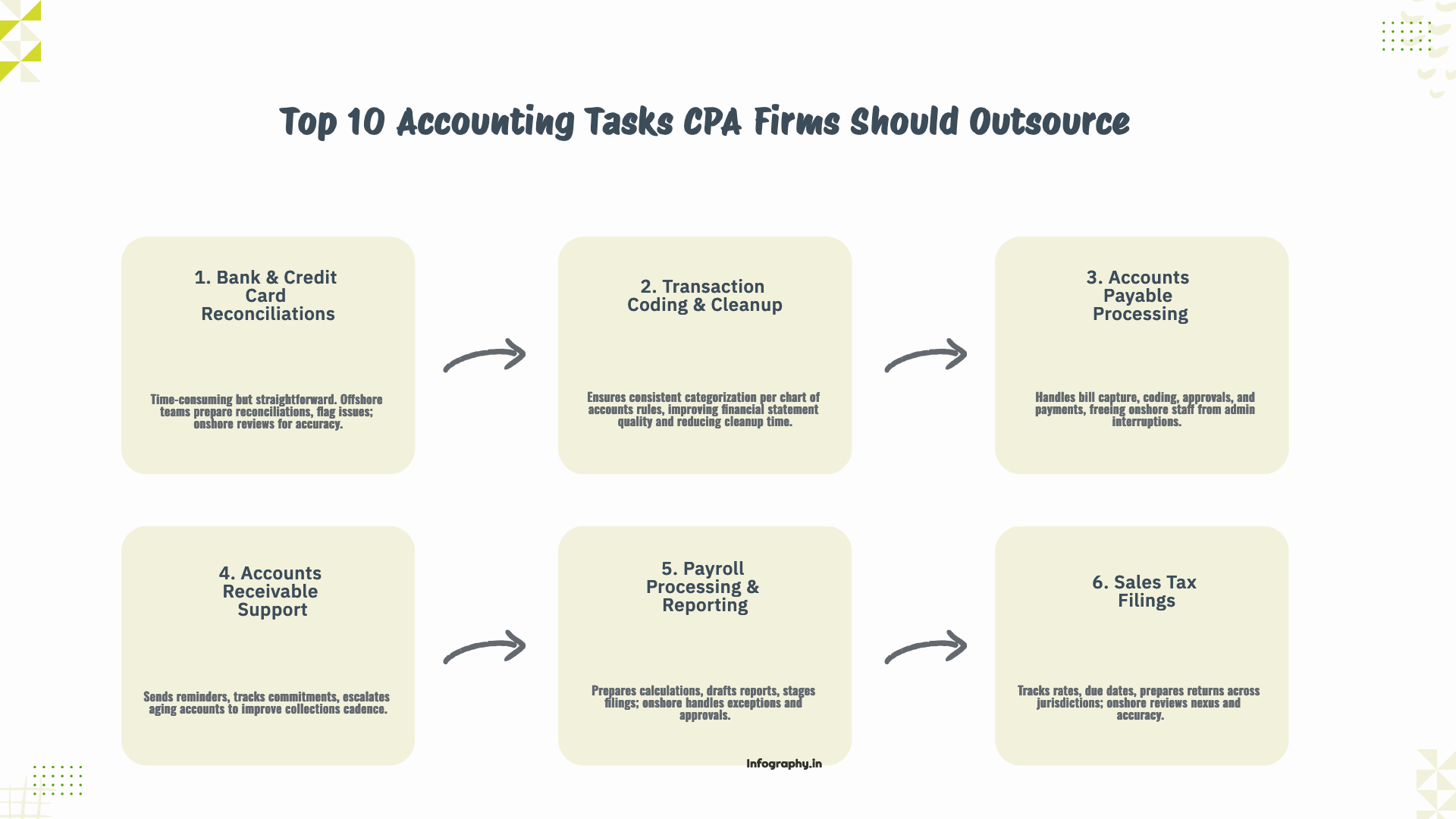

Outsourcing delivers the best return when it targets work that is repeatable, time-consuming, and currently consuming capacity that could be redirected to higher-value activities. This is not about offloading glamorous strategic projects or delegating client relationships. It is about identifying the production work that can be systematized, documented, and executed by a team that specializes in preparation while your onshore staff focuses on review, judgment, and client advisory.
This list is written for CPA firms that want measurable return on investment, not vague promises of help. Each task below is commonly outsourced because it reduces production workload, improves consistency, and allows onshore staff to concentrate on work that requires professional judgment and client interaction.
Reconciliations are time-consuming but straightforward when procedures are documented. The inputs are defined: bank statements and transaction records. The output is defined: reconciled balance with all differences explained and supported. The process follows a standard pattern that can be documented in a checklist. When reconciliations are done cleanly, review time drops and month-end close accelerates. Offshore teams can prepare reconciliations, flag unusual items for investigation, and document their work according to firm standards. Onshore staff review for accuracy and approve before close is finalized.
Good transaction coding makes financial statements readable and meaningful. Poor coding creates chaos that managers spend hours cleaning up. The difference is not talent. It is consistency and adherence to documented chart of accounts rules. Offshore teams can follow coding rules reliably if those rules are written down clearly. They code transactions according to the chart of accounts, identify ambiguous items that need clarification, and maintain consistent categorization across periods. This consistency improves financial statement quality and reduces the cleanup burden on managers.
Accounts payable is repetitive and follows a standard workflow: capture vendor bills, code them to the correct expense accounts, route them for approval according to authority limits, and schedule payments based on terms and cash flow. Outsourcing AP processing reduces interruptions for onshore staff who otherwise get pulled into administrative tasks throughout the day. It also improves payment timeliness because the offshore team can focus on processing without the distractions of client calls and meetings.
Accounts receivable follow-up is easy to postpone when staff are busy with urgent tasks, which is why it matters. Delayed follow-up leads to aging receivables, cash flow pressure for clients, and write-offs that could have been avoided. Outsourcing AR support can improve collections cadence because the offshore team sends reminders, tracks payment commitments, and escalates aging accounts according to firm procedures. Client-facing staff are freed from spending afternoons calling about unpaid invoices and can focus on more strategic client interactions.
Payroll has rigid deadlines and immediate penalties for errors or late filings. Outsourcing can keep payroll runs and tax filings consistent by having the offshore team prepare payroll calculations, draft reports, and stage filings for review. Onshore staff handle exceptions, answer client questions about unusual pay situations, and approve final runs before funds move. This division of labor reduces the administrative burden while maintaining quality control and client communication.
Sales tax work is detail-heavy and error-prone. Tax rates change frequently. Rules vary by state and sometimes by local jurisdiction. Filing frequencies differ based on volume thresholds. Keeping track of these variables for multiple clients across multiple states consumes significant staff time. Outsourcing sales tax preparation helps firms handle the volume without needing to build an internal specialist bench for every client scenario. The offshore team prepares returns, tracks due dates, and organizes exemption certificates. Onshore staff review for accuracy and handle nexus determinations that require professional judgment.
Draft financial statements are a strong candidate for outsourcing when the underlying bookkeeping is stable and accounts are properly reconciled. Offshore teams can prepare draft statements according to firm templates, calculate common ratios, prepare comparative period presentations, and draft variance explanations for significant changes. Onshore staff review the drafts, make client-specific adjustments, refine the narrative commentary, and finalize for delivery. The drafting work is time-consuming but follows standard formats. The review and customization work requires knowledge of the client and industry context.
Month-end close is not a single task. It is a chain of account reconciliations, schedules, analyses, and adjustments that must be completed in sequence. Outsourcing parts of the close workflow can remove bottlenecks and accelerate the overall timeline. Fixed asset schedules, prepaid expense rollforwards, accrual calculations, and deferred revenue analyses are examples of schedules that can be prepared offshore. The offshore team calculates the schedules, documents the methodology, and attaches supporting documentation. Onshore staff review for reasonableness and accuracy before incorporating into the final close package.
Tax workpaper assembly is not technically complex, but it is critical to efficiency. When workpapers are organized properly, labeled consistently, and complete with all required source documents, review is fast and errors are easy to spot. When workpapers are a mess, reviewers waste time hunting for documents and correcting organizational issues. Offshore teams can assemble tax workpapers according to the firm's file structure, organize source documents by category, prepare the organizer based on prior-year returns, and flag items that require follow-up. Onshore CPAs handle the technical tax preparation, judgment calls, and signing.
Audit engagements consume significant time in document organization and routine workpaper preparation before substantive audit work begins. Offshore staff can organize client-provided documents according to the audit file structure, prepare lead schedules, perform mathematical tie-outs between schedules and financial statements, prepare first-draft workpapers for routine tests, and document their work according to firm auditing standards. US auditors handle risk assessment, sampling decisions, evaluation of test results, and audit report sign-off. This division allows the audit team to focus on professional judgment while administrative preparation happens in parallel.
Outsourcing should not extend to work that requires professional judgment, client relationship knowledge, or regulatory accountability. Client advisory conversations and strategic planning must stay with licensed professionals who understand the client's business, goals, and industry context. Pricing decisions and scope negotiations require relationship knowledge and commercial judgment. Final review and sign-off for tax returns, financial statements, and audit reports must be performed by licensed CPAs or auditors who bear professional responsibility. Complex technical positions and gray-area judgments about tax treatment, accounting recognition, or audit scope require expertise and accountability that cannot be delegated offshore.
Start by identifying which task currently consumes the most senior or manager time without requiring their level of expertise. If managers are spending hours reconciling bank accounts or assembling tax workpapers, those are prime candidates because the time is expensive and the tasks do not require manager-level judgment.
Write the process checklist before outsourcing begins. Document every step, every input requirement, every quality standard, and every supporting document that must be attached. This documentation becomes the training material and the quality control tool.
Run a pilot for at least four weeks with a small group of similar clients. Measure rework rates, which reveal whether the offshore team is producing quality work, and track time savings to confirm that onshore capacity is actually being freed.
If rework rates drop and time savings are real, scale the workflow to more clients or add a second task type. If rework remains high, the issue is usually the process definition, documentation clarity, or training quality, not the geographic location of the team. Fix the process before expanding.
The ten tasks listed above represent the work that commonly delivers strong ROI when outsourced. They are high-volume, repeatable, and amenable to standardization. They free senior capacity for work that creates more client value and strengthens relationships. That combination is what makes outsourcing worthwhile.

Section 4960's 21% excise tax now reaches far more nonprofit employees. See who is a covered employee in 2026 and what changed.

The Section 45S paid family leave credit is permanent for 2026 with new options. See who qualifies, the amounts, and how to claim it.

Opportunity zones become permanent in 2027 under the One Big Beautiful Bill. See the new deferral, rural bonus, and the 2026 handoff.



